Cover Story: Kaze no Jigorou
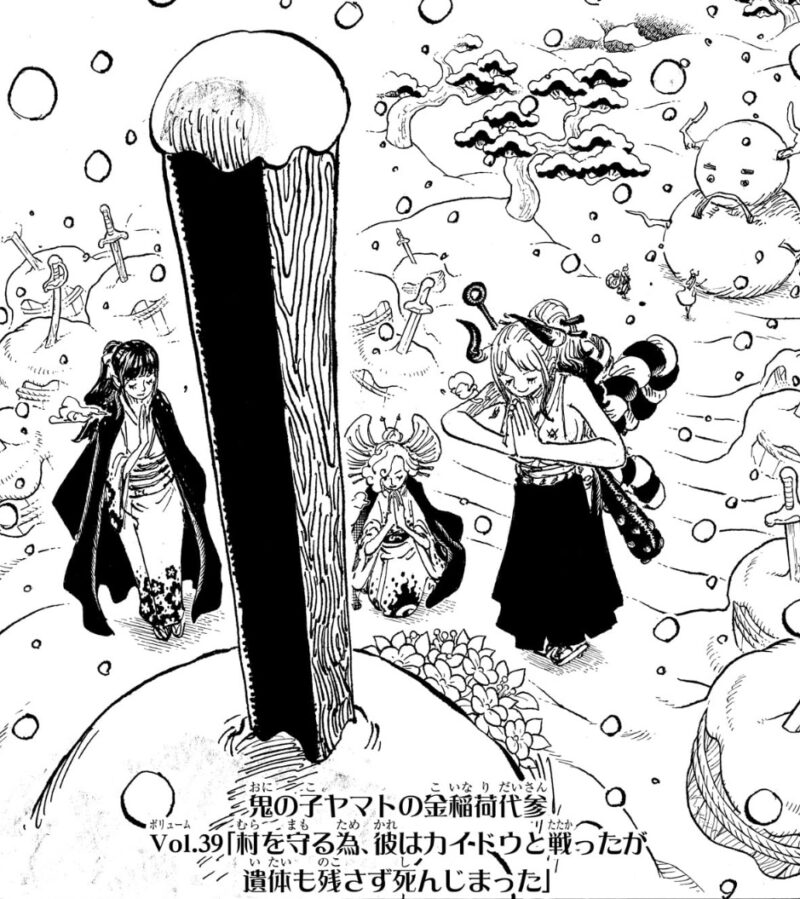
Yamato cover story Vol.39: “To protect the village, he fought Kaido — but died without leaving a body.” The identity of the hero in the grave has now been narrowed down considerably. Characteristics established: born in the West Blue, raised in Wano, the weapon in the gravestone is not a katana, he fought Kaido to protect the village, and his body was never recovered. That’s Kaze no Jigorou.
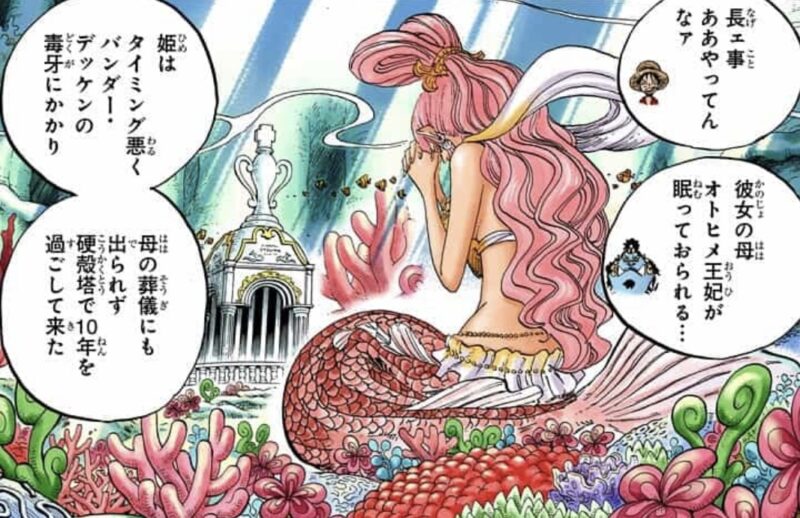
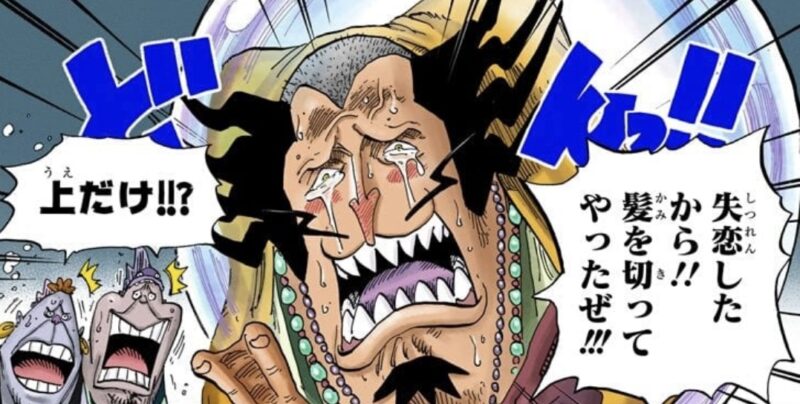
Last week’s cover was Shanks building Whitebeard and Ace’s graves after Marineford. This week it’s a Fishman Island homage — Shirahoshi visiting Fisher Tiger’s grave at the Sea Forest. And there’s a thematic chain connecting the cover to the main story: Jigorou’s ronin-style hair → Vander Decken who cut his hair after being rejected in love → Rocks, who gets rejected by Shakuyaku. The cover and chapter are woven together as always.
Jigorou and Moria
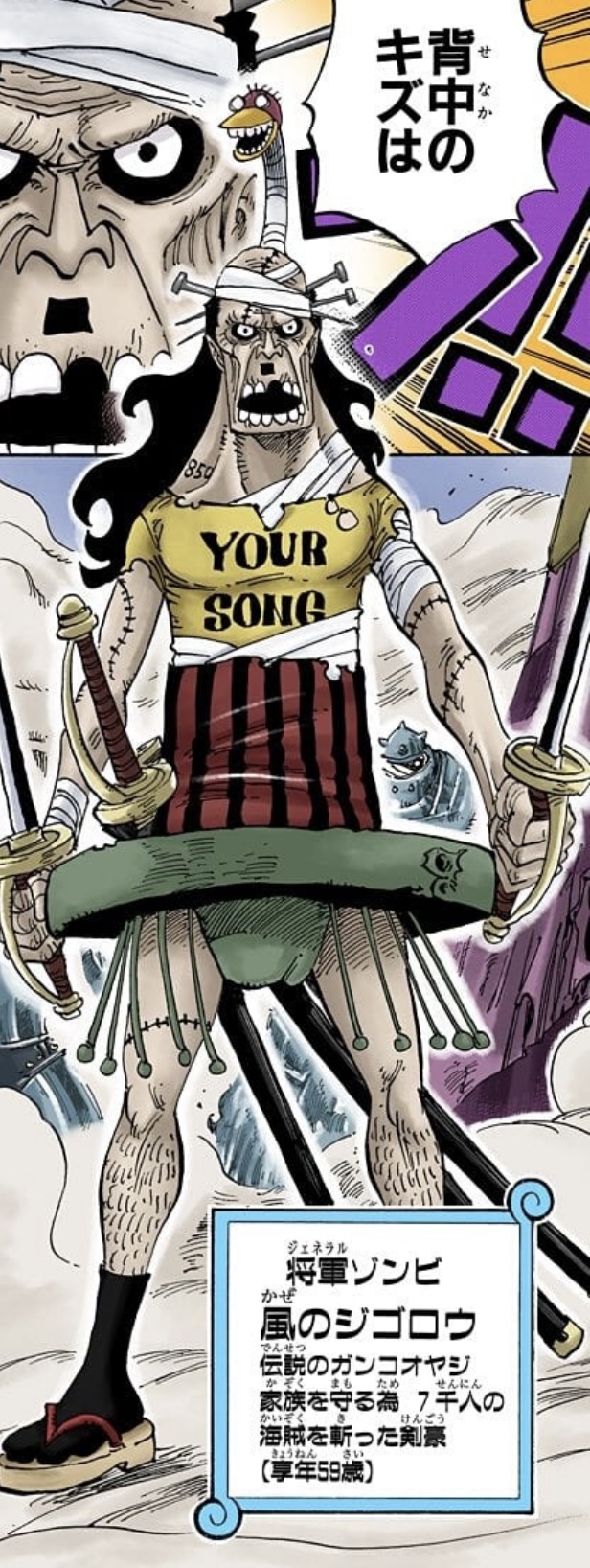
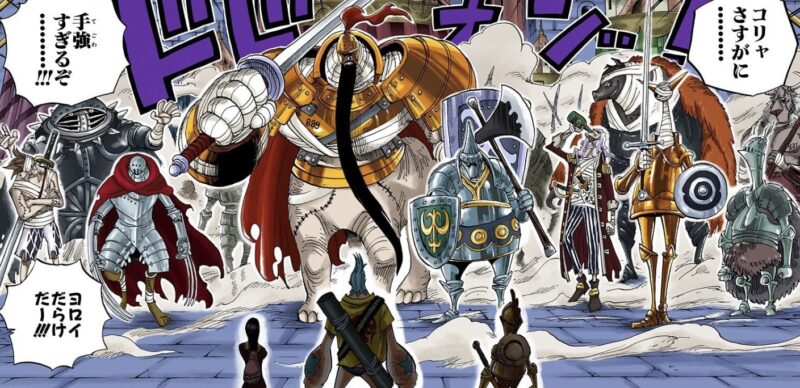
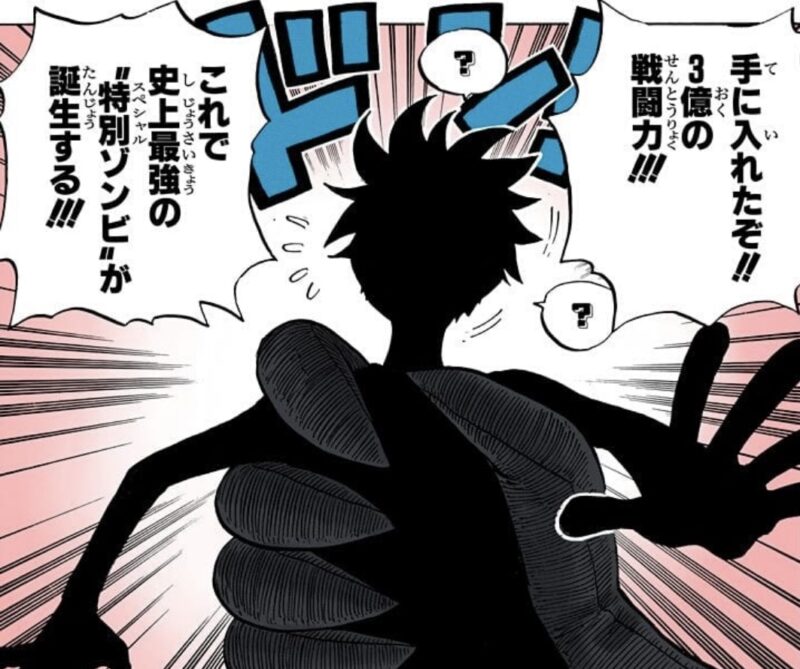
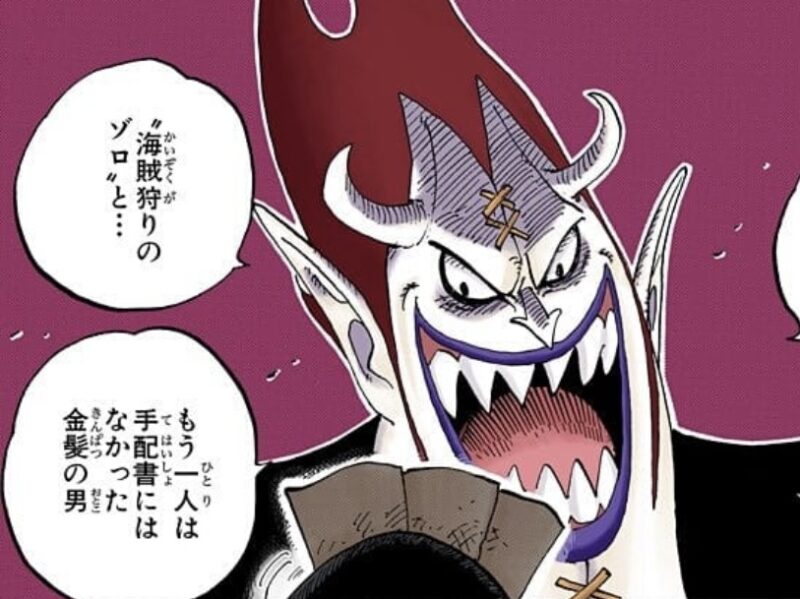
Most of the Rocks Pirates were turned into General Zombies by Moria — but Jigorou was treated as a full tier above them. Moria used Zoro’s 120 million berry shadow for Jigorou’s body. Moria’s logic: bounty = combat power. Oars gets Luffy’s 300 million shadow because Oars is the strongest. By the same logic, Jigorou’s body was reserved for a shadow worth over 100 million — Oars-tier quality.
Why did Moria value Jigorou so highly? Because Jigorou’s profile said he cut down 7,000 pirates to protect his family. That’s a remarkable number, and Moria clearly understood what it meant.
The Hero Who Defended the Village — A Theory
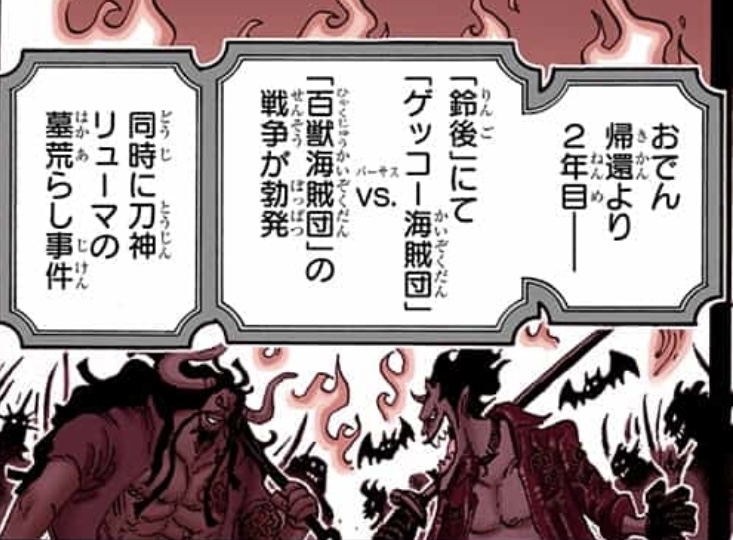
Here’s a theory for how Jigorou ended up in that situation: During the 5 years Oden performed the naked dance, a war broke out between the Gecko Pirates and the Beast Pirates → Jigorou’s village became a battlefield, civilians caught in the crossfire → Jigorou stood up to protect his village and family → treating both pirate crews as equal enemies, he cut down 7,000 fighters from both sides → he fell to Kaido and died → Moria witnessed his strength on the battlefield and retrieved the body for a zombie → after the war ended, the villagers searched for Jigorou’s body and found nothing.
That explains every data point: he fought Kaido, he died without leaving a body, and the timeline fits. What this revelation means going forward is another question. Possible future: Jigorou’s descendants appear and join Yamato’s crew — a child who inherited his father’s great swordsmanship becomes Yamato’s right arm. Kaido’s child, Hanafuda’s child, Jigorou’s child forming a Yamato Pirate Team would be a fun configuration.
Does Foot Colony Have a Real-World Model?
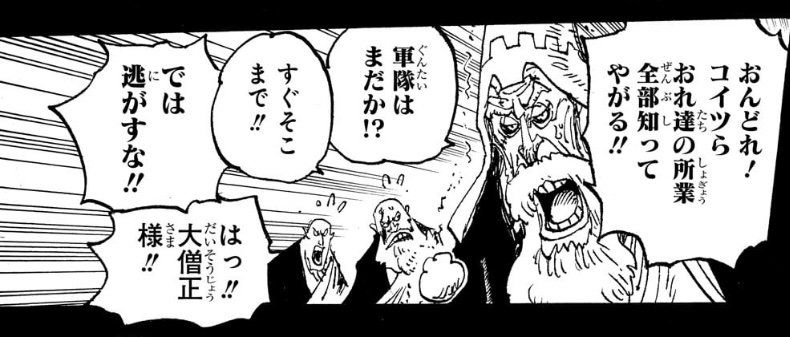
The “International Charity Alliance Temple — Foot Colony” — raided by the Rocks Pirates — had enormous charitable donations stockpiled for underprivileged children. The organization’s leader is called a Grand Abbot and dresses like a temple monk. Temple → religious corporation → tax-exempt → luxury cars in the parking lot. International charity collecting money for the world’s poor children → this might be the UNICEF equivalent of One Piece’s world. Is Foot Colony the real face behind that front?
“World Law” Article 18
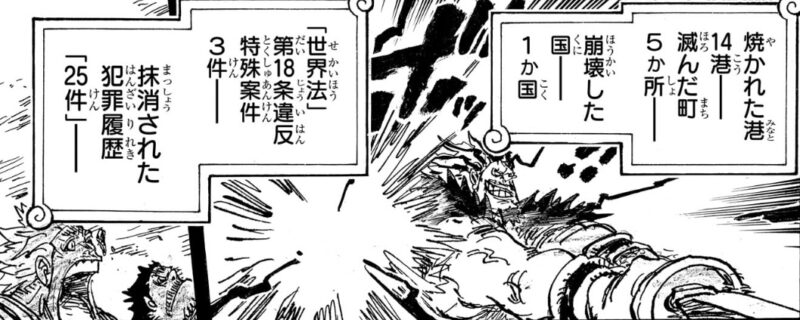
Among the crimes attributed to the Rocks Pirates: violating Article 18 of World Law. Looking at real-world equivalents, Article 18 appears in: the Universal Declaration of Human Rights (freedom of thought, conscience, and religion); the ICCPR (same); the Japanese Constitution (prohibition of involuntary servitude); and the EU Charter (right of asylum). All of these connect to One Piece themes in some way. The most likely model is Japan’s Article 18 — prohibition of slavery — but inverted. In World Law, freeing Celestial Dragon slaves is the crime. Rocks did this three times, making him the Fisher Tiger of his era. This also ties back to Fishman Island and explains the Shirahoshi grave-visit homage in the cover story.
The “Treasure” of God Valley = Shakuyaku
“She will become a treasure that the pirates of this island cannot do without.” And from the God Valley flashback: “If there’s no treasure, they won’t take it.” The “treasure” Garp mentioned at God Valley — that was Shakuyaku herself. Both the Roger Pirates and the Rocks Pirates charged into God Valley for the woman they loved.
Rocks and Roger — Were They Friends?
Timeline: 42 years ago, Shakuyaku quit as Nine Snakes captain and landed on Hachinosu. 38 years ago: God Valley Incident. So there’s a 4-year window during which Shakuyaku was captured by Celestial Dragons and the incident occurred. Roger couldn’t see Shakuyaku for 1 year. But the other 3 years? Was Roger visiting Shakuyaku’s bar on Hachinosu? Did Rocks allow Roger to land on his island?
Consider the evidence: Rocks was immediately friendly with Harald. He recruited strangers via Davy Back Fight without hesitation. He managed to hold together a crew of enormous, clashing egos — all of them followed him. He apparently respected Garp despite loathing the Marine hierarchy. He instantly opened Loki’s heart. In the final panel of God Valley, Roger was trying to stop Rocks. You don’t try to stop someone you want dead.
Conclusion: Rocks looks like Teach on the outside but acts like Luffy on the inside — strong, charismatic, genuinely a good person. Possibly the greatest pirate who ever lived. And he and Roger may have been actual friends, drinking together at Shakuyaku’s bar (like Teach and Aokiji). What brought them together: falling for the same woman.
Roger Pirates’ Goal: Unanimous
The Roger Pirates’ objective at God Valley: rescue Shakuyaku. The lines Roger, Gaban, and Rayleigh spoke upon arriving at God Valley each perfectly matched their personal feelings for her. Three men, one goal, no debate.
Rocks Pirates’ Goal: Fractured
The Rocks Pirates had the same primary objective — rescue Shakuyaku — but individual agendas splintered the rest. Those focused purely on the rescue: Newgate, Shiki, Captain John. Those with secondary goals: Rocks (who declared war on Imu directly and would have every reason to massacre Celestial Dragons who touched his love); Big Mom (a Devil Fruit for her son); Kaido (a Devil Fruit for himself); Miss Bakkin (came to outcompete Shakuyaku for Newgate); Gloriosa (came to win Roger). The “decisive battle” these two beauties talked about? A love story.
Sabaody Archipelago Homage
Female character kidnapped by Celestial Dragons, pirate destroys a Celestial Dragon to get her back. This happened at Egghead, and it’s happening again here. In Kuma’s flashback, Jinny was kidnapped and could not be rescued — she was impregnated, experimented on, abandoned, and died. A story with no satisfaction. This time, Rocks heading to God Valley is the moment that has a chance to avenge everything Jinny suffered. Here’s hoping Rocks gets to do what couldn’t be done for Jinny.
Related Reading
- ← Ch.1156: The God Valley Incident Half-Revealed, a
- Ch.1158: Roger Pirates Crew Guide and Kozuki Mori →
- Browse all Chapter Analysis →