Most attempts to trace the name “Nika” run toward Greek mythology — Nike, goddess of victory, source of the sneaker brand. That explanation doesn’t fit Oda’s method: he has changed character designs specifically to avoid implying endorsement of real corporations, and he is not naming Luffy’s awakened form after a shoe company’s mascot. The actual answer is in linguistics, and it points somewhere far more interesting.
“Nika” Means Marriage — in Five Languages
Run “NIKA” and “NICA” through all 130 languages available in Google Translate and five return the same result: marriage.
Uyghur. Tatar. Turkmen. Odia. Kinyarwanda. In each of these languages — Turkic, Mongolic, Indo-Iranian, South Asian, and Central African in origin — the word means marriage or the act of marrying.
That list is not random. Every language on it maps to a place Luffy has already been.
Uyghur is spoken by the Uyghur people of Central Asia — and Punk Hazard is modeled on the Xinjiang Uyghur Autonomous Region. Tatar has Mongolic roots — and Long Ring Long Land is modeled on Mongolia. Turkmen traces to the Turkic-Iranian corridor — and Baltigo is modeled on Turkey, Zou on Iran. Odia is spoken in eastern India — and the Goa Kingdom is modeled on Goa, India. Four of the five languages align with arcs Luffy has completed.
The fifth is Kinyarwanda — the language of Rwanda, in central Africa. Africa, along with South America and Australia, is one of the few remaining continents that has not yet appeared as a clear model for any One Piece location. Rwanda, as the home of one of the five Nika languages, may be pointing toward where the final destination sits.
Marriage in One Piece Has Always Been Catastrophic
Before the theory can land, it helps to notice what Oda has done with marriage throughout the series. Every marriage-adjacent event in One Piece is designed to fail, corrupt, or threaten death.
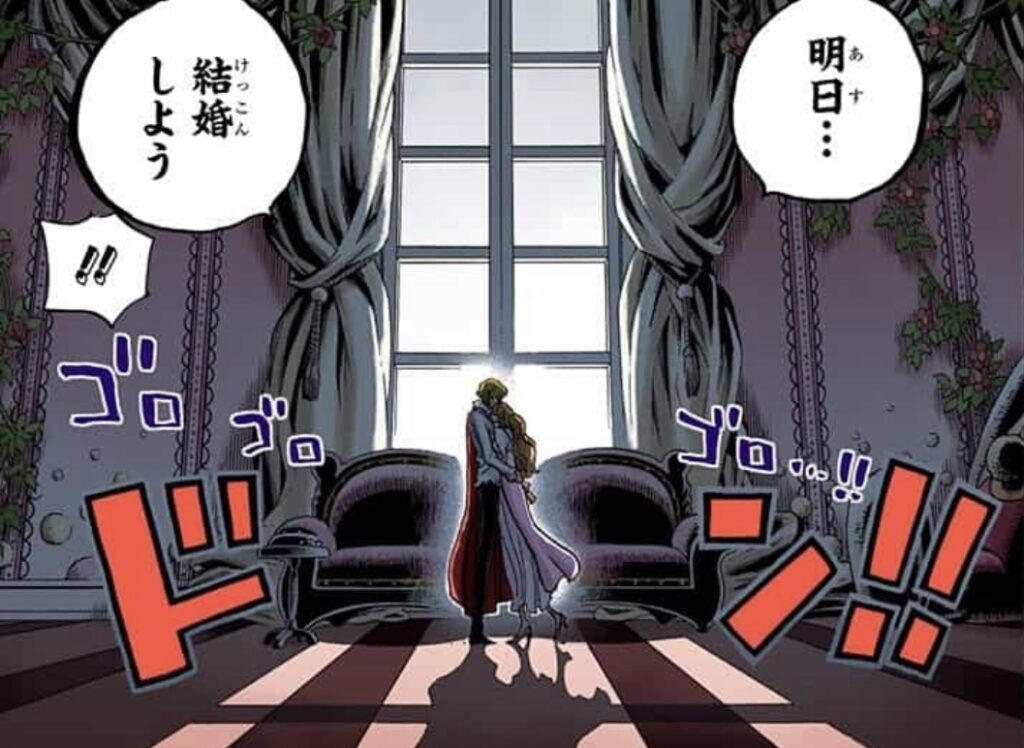
Lola proposes to strangers on sight and has been rejected 4,444 times. Vander Decken IX sends “YES or DIE” proposals to Shirahoshi for years. Big Mom’s wedding invitations are functionally threats — decline, and someone close to you disappears. Nami is kidnapped by Absalom and walked through a wedding ceremony while unconscious, with a corpse speaking her vows. And Sanji’s arranged marriage in Whole Cake Island contains every element of a wedding designed to destroy: the venue chosen without him, the date set without him, the guests assembled without him, the bride attempting to kill him — and no wedding bell.
That last detail matters. Sanji’s wedding has no wedding bell. Every other element of a ceremony is present — the venue, the guests, the elaborate cake stage, the political stakes — but nothing rings. No bell announces it to the world outside. The counterfeit marriage is silent.
Skypiea: The Arc That Was Always About Marriage
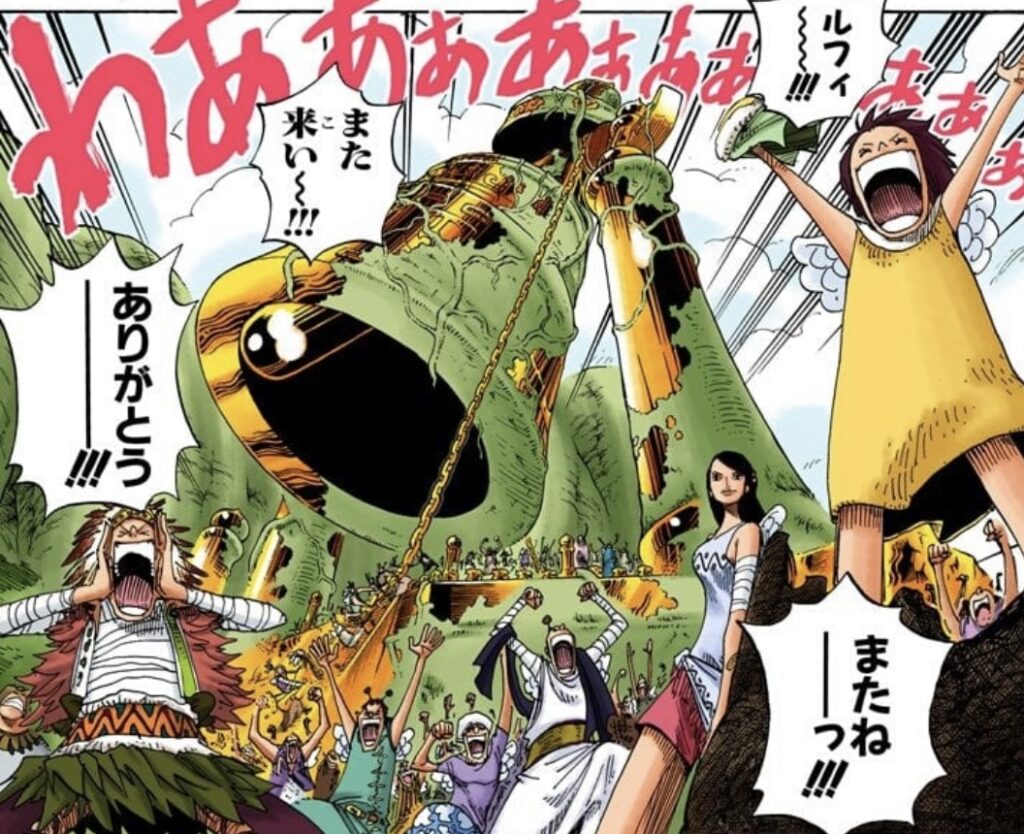
The Skypiea arc ends with two things: a giant golden bell, and a golden pyramid. The bell — the Great Belfry — is the moment the arc resolves. Noland promised Calgara he would find a way to ring it, and four hundred years later, Luffy does. The golden pyramid sits beside it.
A golden bell rung to announce a joyful event, with witnesses gathering to hear it, is a wedding bell. That is what wedding bells are — a signal rung so that those who could not attend the ceremony would know the marriage had taken place. When Calgara’s daughter married, he rang it. The sound reached Noland on the sea below. That is the promise being kept when the bell rings at the arc’s end.
The golden pyramid alongside it is structurally identical to the oversized tiered stage at Sanji’s wedding on Whole Cake Island — except that one had no wedding bell and ended in disaster, and the one in Skypiea is golden and rings across the sky.
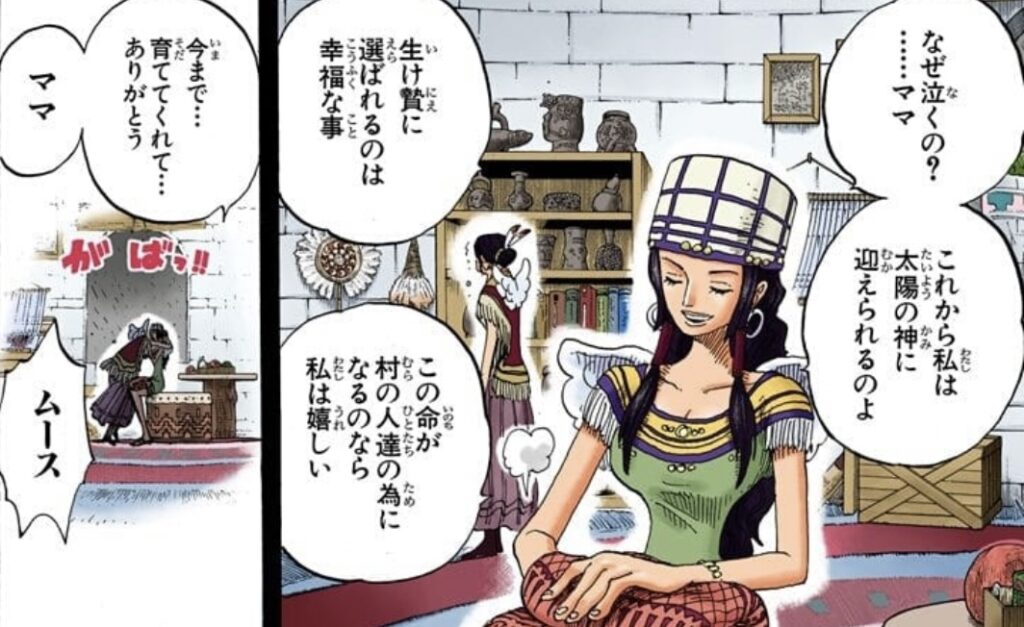
The 800-year-old war that destroyed Shandora may have begun as a religious conflict over the Sun God Nika — and if Nika means marriage, then the conflict may have been about a marriage. Who the Sun God’s people were allowed to marry. Who was eligible to take part in the ceremony. The sacrificial altar in Skypiea, seen through this reading, may have originally been built for a completely different kind of celebration: the ritual where the woman who danced most joyfully to the music was chosen as the Sun God’s bride.
The Disney Pattern
One Piece’s relationship with Disney has been documented throughout the series — the visual language, the structure of arcs, the way characters are introduced. Oda changed the Whitebeard Pirates’ Jolly Roger specifically because the original version too closely resembled a symbol associated with a real organization, and he has been careful about real-world corporate associations since. The Disney connection is not incidental.
What Disney’s most beloved works — Cinderella, The Little Mermaid, Beauty and the Beast, Aladdin — share is not the adventure. It is the ending. The happy ending in Disney is marriage. The princess finds her person and the story closes on a wedding, or the promise of one. If One Piece follows the Disney template, then Nika — the Sun God whose name means marriage in five languages — ends the story by getting married.
The Last Panel
The theory closes like this: at the end of One Piece, the Great Belfry of Skypiea rings again. Not as a signal of battle won or an island liberated. As a wedding bell — the same function it has carried since Shandora, the same reason Calgara rang it when his daughter was married. Luffy, the Sun God Nika, whose name means marriage in the languages of every continent he has crossed, marries Nami. Everyone is there. The bell rings three times, as wedding bells do, so that all those who could not attend will know.
Every failed wedding in the series — Lola’s rejections, Decken’s threats, Big Mom’s invitations, Nami’s abduction, Sanji’s goldless disaster — was the setup. The real one is the last scene.
For the ancient weapon that may complete the final voyage, see Ancient Weapon Pluton Is Space Battleship Yamato. For the complete history and mythology guide, see One Piece History is Real History.