Jingi Is Part of Confucian Teaching
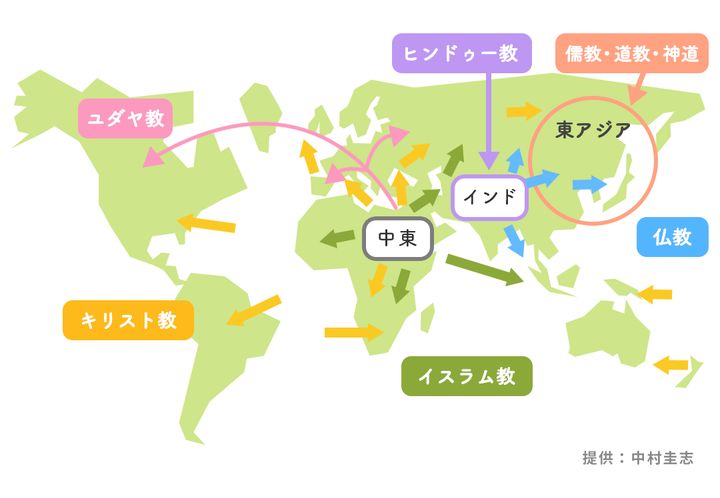
Religion is a branch of philosophy — the study of humanity itself — so its core principles vary widely by culture and environment. Here’s a rough breakdown of popular religions by world region:
Europe, America, the Middle East, Russia → Judaism, Christianity, Islam; India → Hinduism, Buddhism; China and Korea → Confucianism and Taoism; Japan → Shinto
Each tradition offers its own vision of “how to live well,” so the best approach is to listen to all of them, then throw your support behind whichever resonates most with you.
In other words, religion is the ultimate lifelong fandom. Personally, I belong to the “One Piece Religion.”
“Jingi” (仁義) is a concept rooted in Confucianism, a philosophy widely popular throughout East Asia, including China.
Jin, Gi, Rei, Chi, Shin — The Five Virtues
Confucianism was founded by Confucius, one of the so-called “Four Sages” alongside the Buddha, Socrates, and Jesus.
Two of the “Five Constants (Five Virtues)” he taught are jin (仁, benevolence) and gi (義, righteousness).
Jin (仁 — Benevolence)
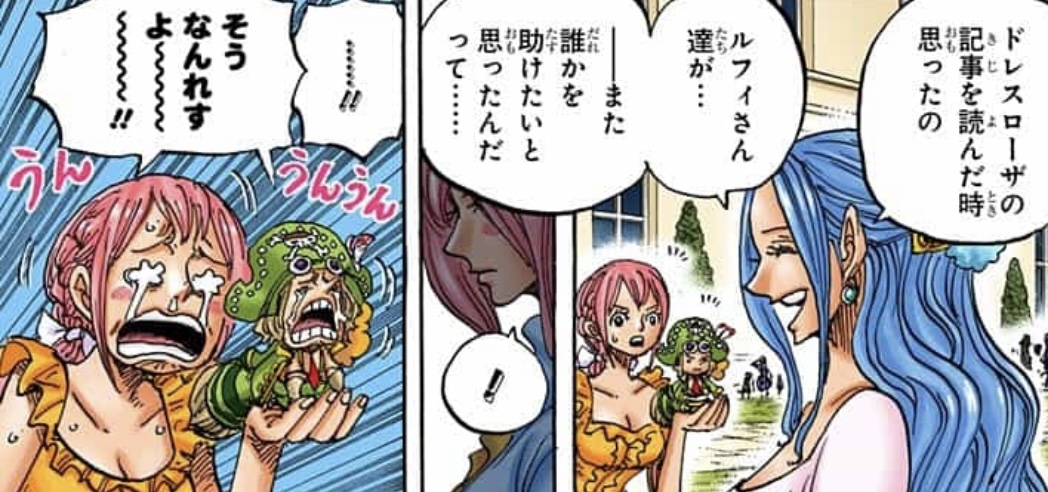
Compassion or benevolence toward others.
Confucius considered jin the highest moral virtue — not something remote from daily life, yet not easily attained.
The Analects offers many explanations: in one passage, it is described as “loving others.” To the disciple Yan Hui, Confucius said jin means “overcoming oneself and returning to propriety (li)” — that is, conquering self-interest and practicing proper conduct.
The former refers to outward conduct toward others; the latter to one’s inner self-cultivation.
A well-known practical maxim is: “Do not impose on others what you yourself do not desire” (Analects, Yan Yuan chapter — the Golden Rule).
In short, jin means loving all people with a compassionate heart, and restraining selfish desires in order to practice proper conduct.
Gi (義 — Righteousness)
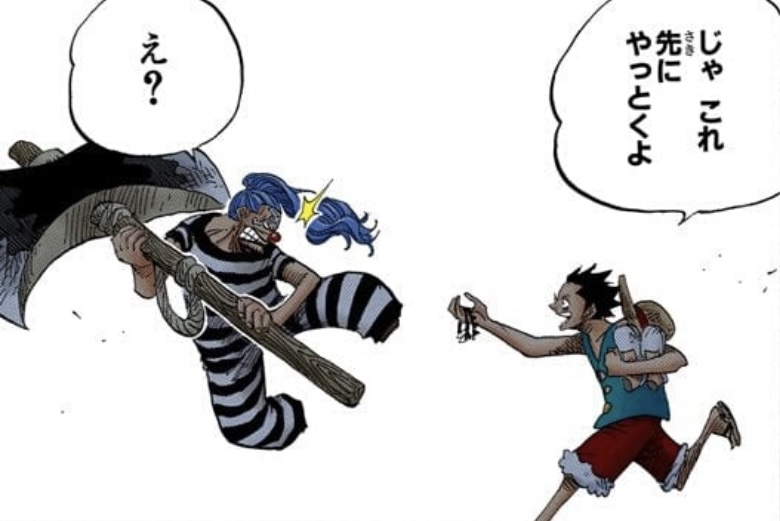
Doing what must be done, free from selfish desire. Justice.
In Chinese philosophy, gi is always contrasted with “ri” (利), meaning self-interest or profit.
Rei (礼 — Propriety)
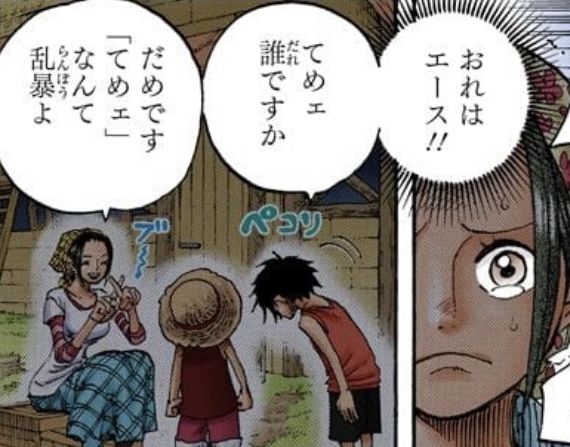
The concrete expression of jin in outward action.
Originally, it referred to taboos and traditional customs in religious rituals.
Over time, it came to mean the proper conduct required within social hierarchies.
The Confucian scholar Xunzi, who held that human nature is inherently evil, placed particular emphasis on rei.
Chi (智 — Wisdom)
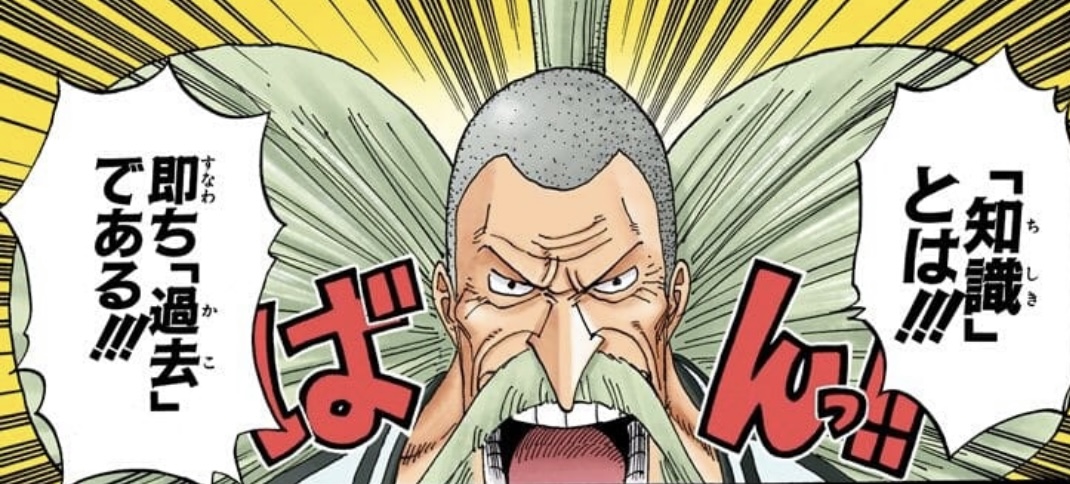
A person who truly knows reason and principle.
One who is rich in knowledge.
Shin (信 — Integrity)
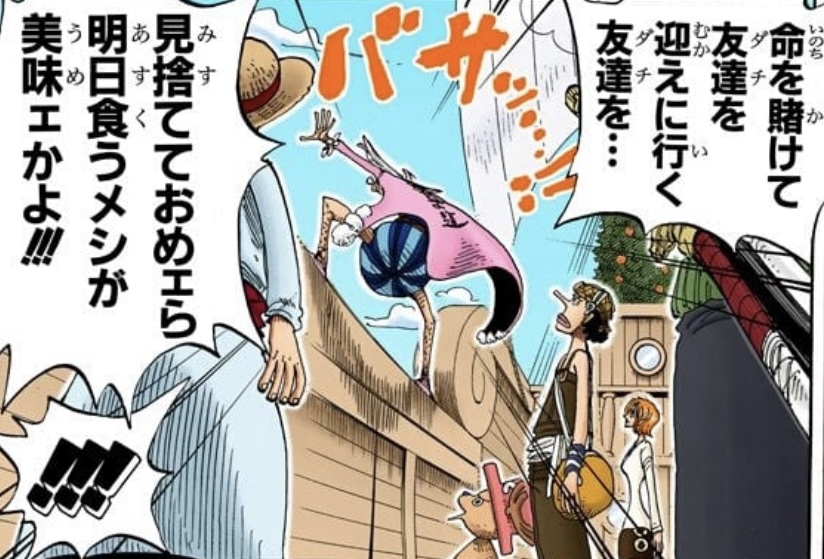
Being loyal in friendship, keeping one’s word, speaking the truth, honoring promises, being sincere.
To the four virtues of jin, gi, rei, and chi taught by Mencius, the Han-dynasty Confucian Dong Zhongshu added “shin” based on the Five Elements theory.
Jingi in Various Scenes of One Piece
Now that we have a rough sense of what each of the Five Virtues means, let’s look at the scenes in One Piece where the word “jingi” appears — and explore what it actually means in each context.
Think of it as a series of case studies to deepen our understanding of the concept.
Listen Up — “Pirate Jingi”
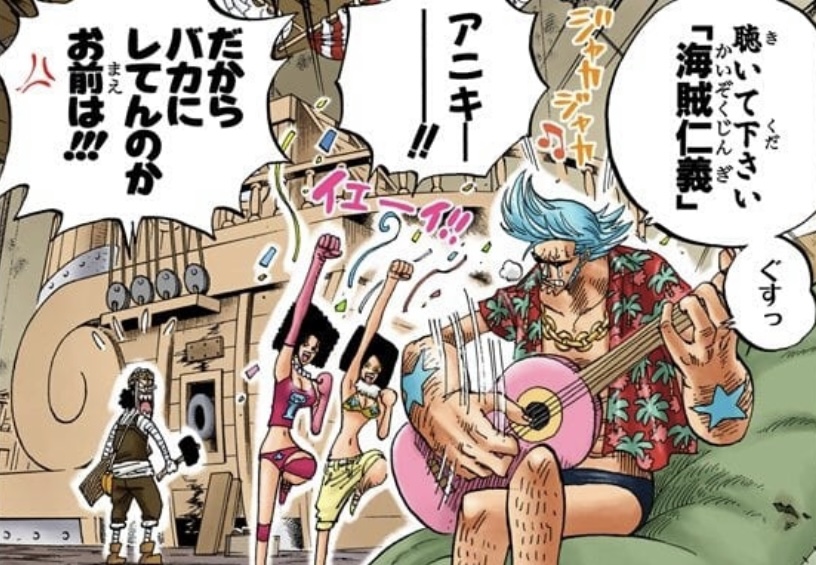
When the Merry reached the end of her life as a ship, Usopp couldn’t bring himself to abandon her. After a duel with Luffy, he left the crew. Franky heard the story and invited the now-rootless Usopp to join his gang, but Usopp turned him down: “I have no intention of becoming a dismantler — even if I left the crew, I’m still a pirate!!”
That’s the moment Franky wrote the song “Pirate Jingi.”
Here, jingi refers to the resolve to live out one’s chosen way of life as a pirate.
Among the Five Virtues, this best matches gi — doing what must be done, free from selfish desire.
Jingi = Code / Law
Even on a pirate ship full of outlaws and misfits who can’t abide by society’s laws, there are minimum rules everyone must follow. For example:
- Desertion or keeping secrets from the crew → death penalty
- Gambling on board is forbidden
- Women are not allowed aboard because they cause conflict
Most of these rules exist to prevent betrayal and fighting. Those who break them are marooned on a deserted island or executed.
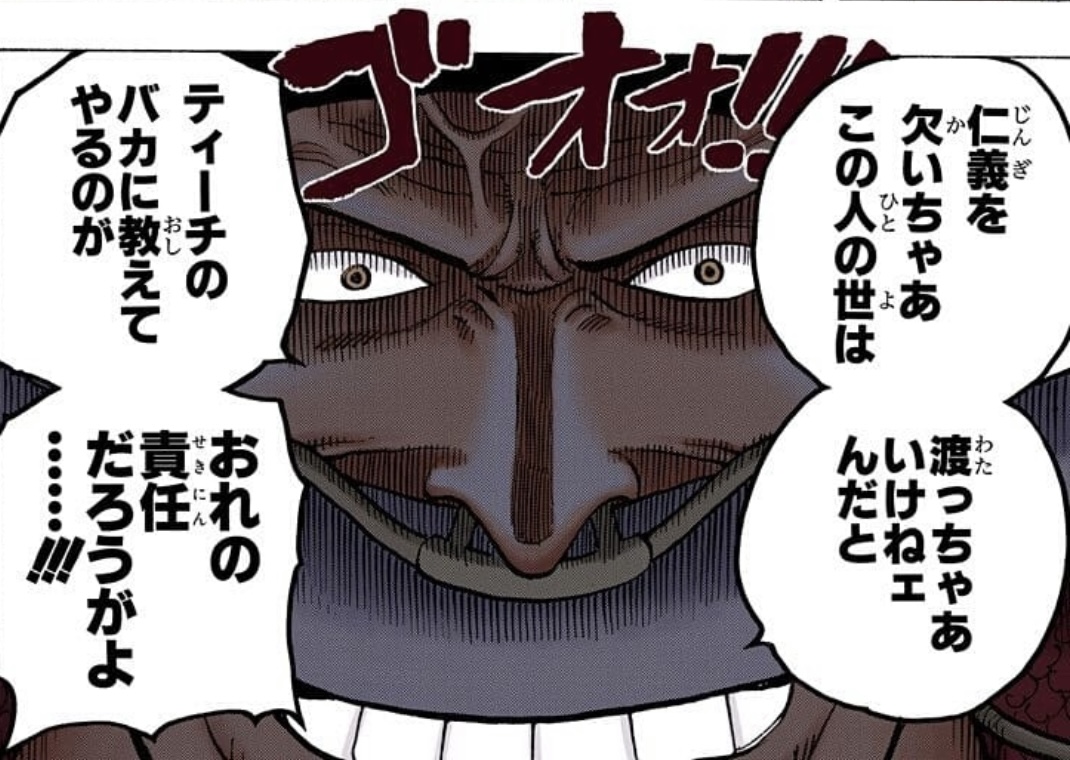
That’s why Blackbeard’s killing of a crewmate over a Devil Fruit was the worst possible betrayal — a capital offense.
So when Whitebeard says someone “lacks jingi,” he means they broke the pirate code. In this usage: jingi = code (okite).
Jingi in the Name of “Justice”
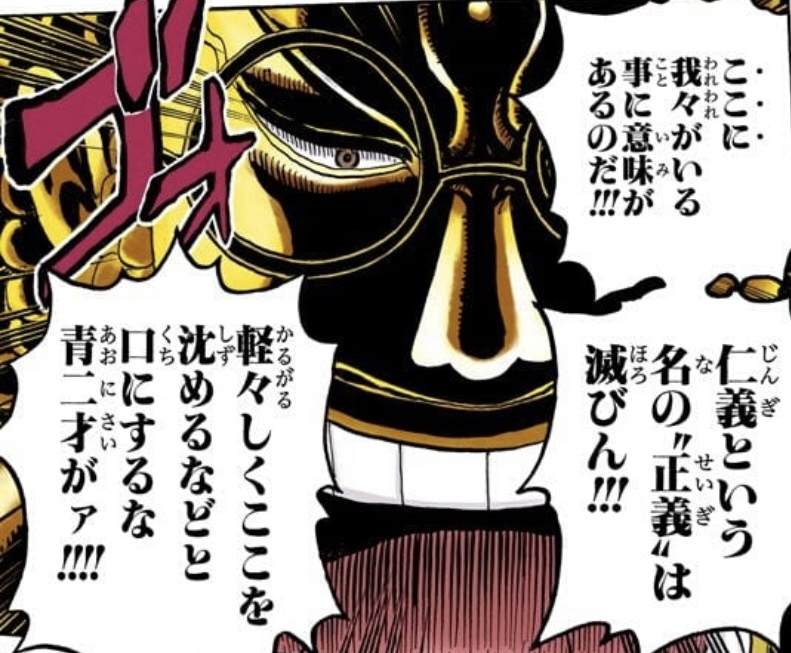
When “jingi” is translated into English, it becomes “Justice.” But when “Justice” is translated back into Japanese, you get “seigi” (正義) — not “jingi.” They’re different words.
In other words, there’s no English word that precisely captures the meaning of “jingi.” That’s how nuanced and context-dependent this concept truly is.
So when Sengoku uses “jingi,” we’ll treat his version as closest to the English concept of “Justice.”
Following the Path of Jingi
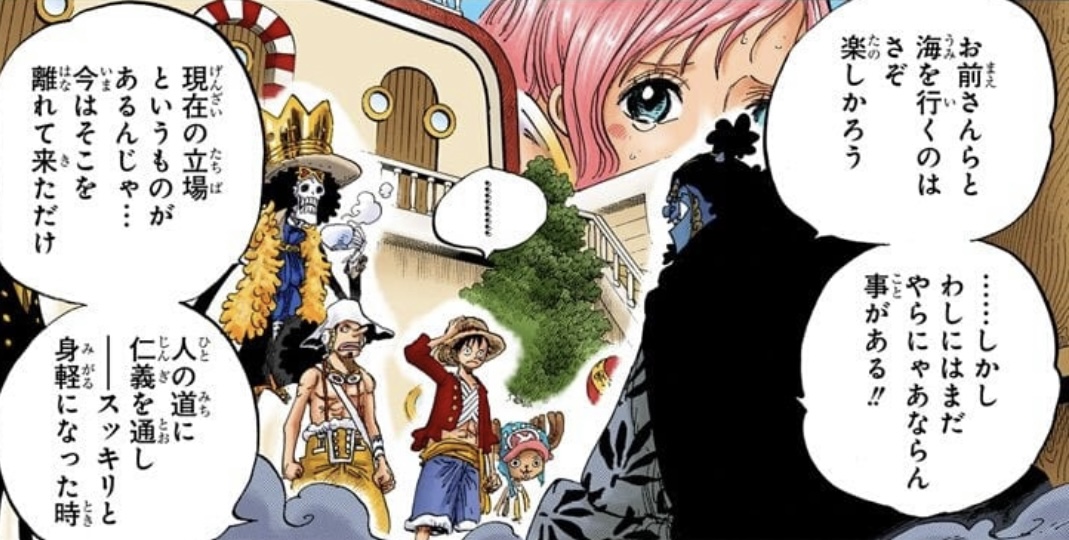
After receiving Big Mom’s sake cup and entering her service as a subordinate, Jinbei had to formally return the cup and leave her crew before he could join Luffy’s.
If he skipped this step and accepted Luffy’s invitation, he would effectively become a spy within the Big Mom Pirates.
In the yakuza world, even after becoming “parent and child” or “brothers” through the sake cup ceremony, both parties can dissolve the relationship through a formal cup return — provided both agree.
However, being asked for the cup’s return is seen as humiliation by the receiving party, so they almost always attempt to kill the person the moment the relationship ends.
So in this context, “following the path of jingi” means seeing things through with integrity, even at the cost of your life.
And “the path of humanity” (人の道) here seems to refer to the “rules of the pirate world.”
Jingi in the World of Evil

When you think about it, the Germa Kingdom at that point was still a World Government member state with the right to attend the Reverie — meaning they were civilians (katagi), not criminals.
Yet Judge, who mistakenly believed himself to be on equal footing with Big Mom, walked right into a great pirate’s territory — bringing his land, castle, laboratory, soldiers, citizens, and all of his nation’s wealth.
Pirates only keep their word with other pirates. When dealing with civilians, they simply plunder without restraint.
So Judge the “wannabe villain” civilian king and Big Mom were not fellow residents of the “world of evil” — they were pirate and civilian: plunderer and victim.
Naturally, there was no jingi between them.
The “jingi” Judge spoke of here means agreement, rules, or code.
A Woman’s Jingi

Chiffon left Bege’s side to bake a cake — all for the sake of repaying a debt to her twin sister Lola.
Her words at that moment:
“Saying ‘thank you for saving Lola’ is easy with words!! It’s precisely when a benefactor is in crisis that the truth of those words is tested!!”
In other words, she acted to help a benefactor without regard for her own safety.
This too perfectly fits gi from the Five Virtues — doing what must be done, free from selfish desire.
The Jingi of Oshiruko

While Big Mom showed no jingi to Judge (a civilian), she did honor jingi when Jinbei (a pirate) formally returned his cup.
Then came the scene where Big Mom screamed “Jingi!!” and punched Page One with Haoshoku Haki — which is honestly pretty unreasonable.
Here’s the breakdown:
- Big Mom arrived in Wano and immediately lost her memory
- Tsuru and the townsfolk of Okobore Town gave oshiruko to the amnesiac Big Mom
- Big Mom regained her memory and formed an alliance with Kaido’s Beasts Pirates
- Big Mom learned that Holdem (a Kaido subordinate) had burned down Okobore Town
- Big Mom punched Page One (another Beast Pirate) with Haoshoku Haki, shouting “Jingi!!”
From Page One’s perspective: “That happened before you arrived — no one in the Beasts Pirates even knew about it. What am I supposed to do about it…?”
Just when the meaning of jingi was starting to click, this scene throws it all into confusion again.
Jingi wo Kiru — The Yakuza Greeting

When you add “kiru” (切る, “to cut”) after jingi, it becomes the formal yakuza ritual of introducing oneself to a stranger — a highly stylized first meeting between yakuza members.
Here’s what it looks like: Watch on YouTube
Phrases like “no need for stiff formalities” or “if you’re going to ask someone their name, introduce yourself first” are probably remnants of this tradition.
Is Oda a Confucianism Fan?

So jingi was originally a Confucian term.
But I think the reason Oda uses “jingi” so frequently has more to do with the influence of yakuza films than any deep devotion to Confucianism.
For instance, he has Luffy deliver lines that are critical of Confucianism — which reveres ancestors almost like deities.

Does that mean Oda is a Christian or Jewish believer, since he uses so many Biblical names in One Piece? Probably not either.

He may actually have a dislike for the methods of medieval Christianity.
After all, the flag of the organization opposing the protagonist bears a strong resemblance to a Christian cross.
The manga recommended below depicts the clash between medieval religion and astronomers:
Apparently, when heliocentrism was discovered — that the Earth orbits the Sun — the Church executed astronomers one after another rather than admit their geocentric teachings were wrong. It feels a lot like the scholars of Ohara vs. the World Government.
So… What Even Is “God”?
“God” is an incredibly convenient excuse.
Any phenomenon you can’t explain? Blame it on God.
When were the stars of the universe created, and how? → God made them.
How was the Earth formed? → God made it.
How did humans come to exist? → God made them.
Until recently, there was no way to verify any of this. But science and technology have advanced so dramatically that we may actually be approaching the point where we can trace the “origin of humanity.”
And on that note, that’s a wrap for today!