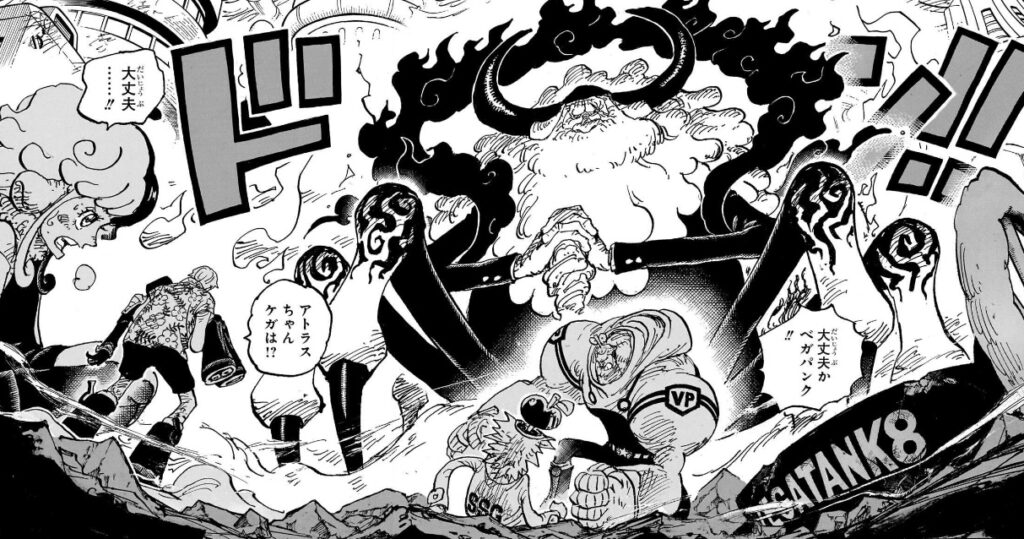
There is a woodblock print made in Japan around 1843 that looks almost identical to the battle layout on Egghead Island. Most readers outside Japan have never heard of it. Once you see the connection, it is impossible to unsee — and it leads directly to one of the most provocative theories in One Piece: that the Five Elders are not a fictional invention, but a reference to five real people from Japanese history who were erased from the record.
The Ukiyo-e That Predicts the Egghead Battle
The woodblock print is titled “Minamoto no Yorimitsu Shitennō Tsuchigumo Taiji no Zu” — loosely translated, “Yorimitsu and the Four Heavenly Kings Slaying the Earth Spider.” It was created by Utagawa Kuniyoshi, one of the most celebrated ukiyo-e masters of the Edo period, famous for his dramatic battle scenes and yokai imagery.
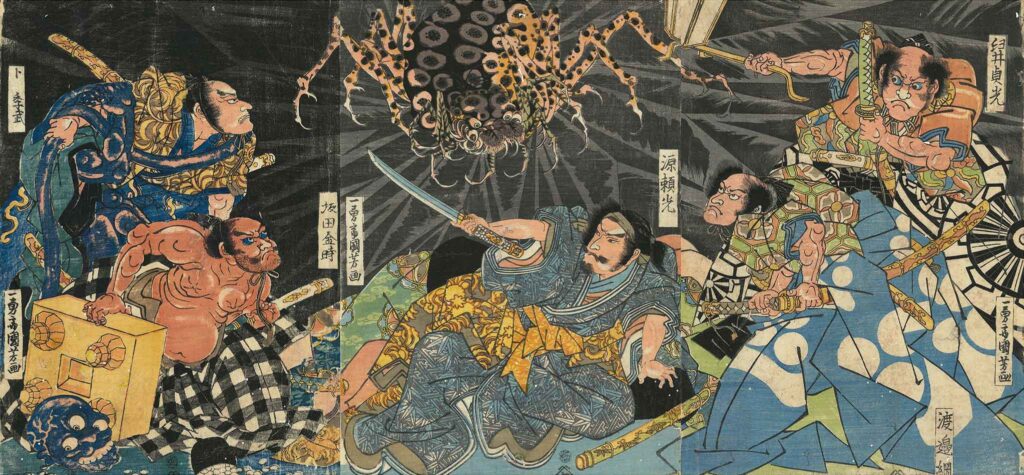
The composition shows the hero Minamoto no Yorimitsu at the center, surrounded by four elite retainers, facing a massive spider-demon. The layout — central figure collapsed or crouching, four allies positioned around him, monstrous spider enemy — maps almost exactly onto the Egghead confrontation between Luffy and the Five Elders.
The parallel goes further than the composition. Minamoto no Yorimitsu’s name is written with characters that can be read “Raikō” — and “raikō” (来光) means “arrival of light” or “sunrise.” Sunrise leads to the sun. The sun connects directly to Nika, the Sun God. In the painting, the hero facing the earth spider is named for the light that arrives at dawn — the same thing Luffy becomes.
The Four Heavenly Kings and the Straw Hats
Yorimitsu’s four retainers — the Shitennō — each have a defining characteristic that matches a Straw Hat present at Egghead.
Usui Sadamitsu was a giant man celebrated for killing a great serpent — the giants at Egghead who hunt dinosaurs carry the same archetype. Watanabe no Tsuna was the head retainer, famous specifically for cutting off a demon’s arm — Zoro, Nika’s right arm and the series’ premier demon-cutter, maps directly. Sakata Kintoki is the adult form of the folk hero Kintaro — Tama, the battle-peach girl whose name connects to Momotaro, occupies the same slot in the Wano arc. Urabe no Suetake was the group’s master archer — Usopp.
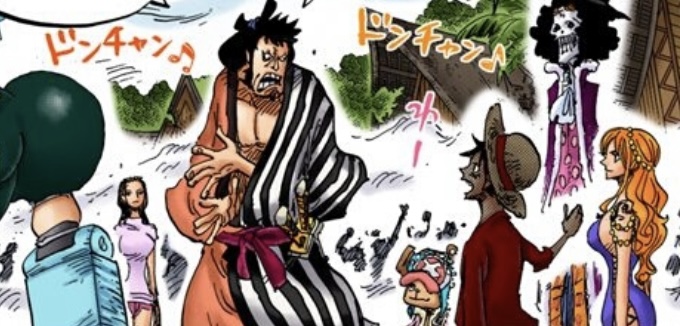
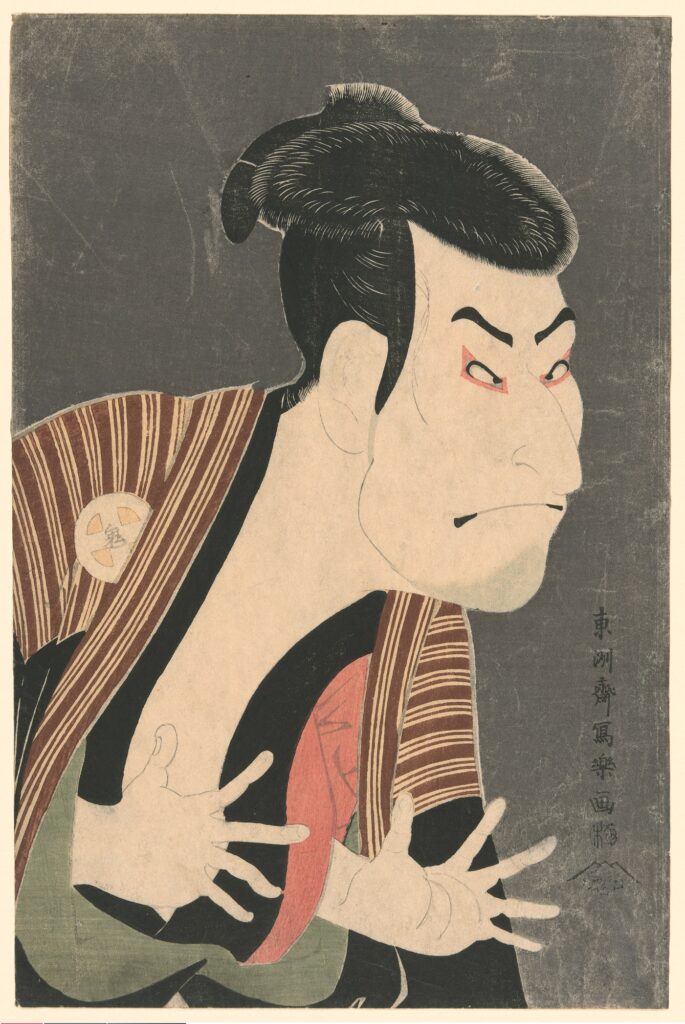
Oda had been embedding Japanese art references for years before Egghead. Kinnemon’s design is lifted directly from Toshusai Sharaku’s ukiyo-e portrait “Sandaime Otani Oniji no Yakko Edobee” — same posture, same expression. The wave Luffy rides into Wano is Katsushika Hokusai’s “The Great Wave off Kanagawa,” reproduced almost panel-for-panel. The octopus Tako Sansuke who guides them inside is taken from one of Hokusai’s more adult works. The execution scene of Oden mirrors the famous death of the outlaw Ishikawa Goemon, who was boiled alive in oil alongside his son. The gashadokuro — the giant skeleton made from the bones of soldiers who died without burial — is cited explicitly as the reason Brook is called by that name, referencing another Kuniyoshi print. Black Maria’s spinning weapon contains a face inside a wheel of fire, which is the exact description of the wanyūdō, a wheel-headed yokai from classical Japanese folklore.
The Egghead painting is not an isolated coincidence. It is the culmination of a pattern that runs through the entire series.
What Saturn Actually Is
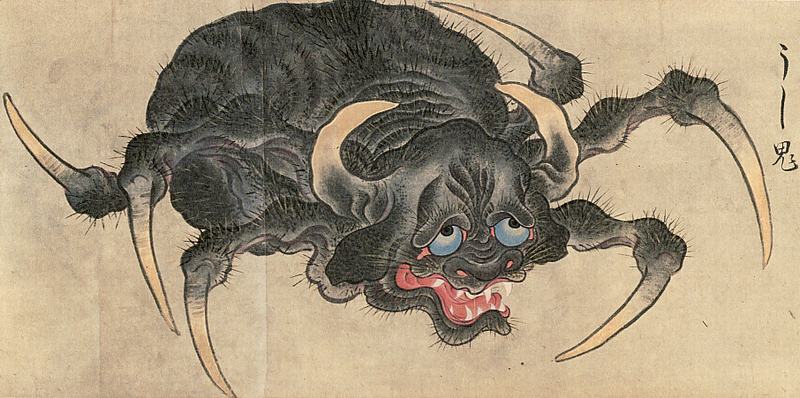
Every spider character in One Piece before Saturn was a breadcrumb. Tararan, the giant-zombie spider chimera in Thriller Bark. Vice Admiral Onigumo, whose beast form revealed a clear spider abdomen. Squard, whose epithet is Whirlpool Spider. Black Maria, modeled on the jorōgumo — the Japanese spider-woman yokai, combined with the world’s oldest known spider fossil for her Ancient Zoan typing. Each one carried a piece of what Saturn would eventually be.
When Saturn revealed his transformed body — bull horns, six legs, spider abdomen — Japanese readers immediately recognized the silhouette. It is the ushi-oni: a yokai from western Japan described as having the head or horns of a bull combined with the body of a spider or crab, appearing on coastlines to attack humans. The ushi-oni is classified as a Mythical Zoan candidate because, unlike ancient species, mythical yokai can do things that defy normal biology — which explains the teleportation circles, the unexplained beams, the regeneration.
The ushi-oni has another name: tsuchigumo.
Tsuchigumo: The Name That Changes Everything
In the woodblock print, the monster being slain is a tsuchigumo — “earth spider.” In Japanese mythology, the tsuchigumo is a giant spider-demon. But in Japanese history, the word has a completely different and far more charged meaning.
According to the historical record compiled in Japan’s early chronicles, “tsuchigumo” was the name given to people in ancient Japan who refused to submit to the Yamato imperial court. The word was used to label those who would not bend to the authority of the emerging central government — rebels, holdouts, the resistant. There were five of them described in one passage: two living in a stone cave called the Rat Cave, and three in a plain called Negi Field, with names recorded as Uchizaru, Yata, and Kunimarō. Five people who defied the emperor, labeled earth spiders and written out of official history.
There are five Five Elders.
One Piece’s Blank Century and Japan’s Blank 4th Century
One Piece has a Void Century — 100 years of history that someone deliberately erased from all records, the knowledge of which is forbidden under penalty of death. Japanese history has something structurally similar.
In the 3rd century, Japan was dominated by the Yamataikoku kingdom, ruled by the shaman-queen Himiko whose power and influence across the archipelago is documented in Chinese historical records of the period. Then, in the 5th century, Japan is suddenly organized under the Yamato imperial court, a completely different power structure centered in the Kinai region. What happened in between — the 4th century — is almost entirely missing from the historical record. Japanese historians call it the “Blank 4th Century.”
What is known is this: during that same period, an enormous number of giant burial mounds called kofun were constructed in the Osaka region in a concentrated burst of activity. The scale and concentration suggests a major conflict — the burial of royalty on a large scale, in a short time, in one place. Someone won. Someone lost. The losers were erased from the record.
Oda is from Kyushu, the southern island where the Yamataikoku kingdom is believed by many Japanese researchers to have been located. The word “Yamato” appears throughout the later chapters of One Piece — in a character’s name, in place names, in structural echoes. The Five Elders who suppress all knowledge of the Void Century are the tsuchigumo — the five who once stood against an imperial power, defeated, demonized, and scrubbed from history. Or perhaps they are the victors of that ancient war, now maintaining the silence that protects their legitimacy.
Either way, the name Oda chose for Saturn’s yokai form is not decoration. In Japan, tsuchigumo means exactly one thing: those who defied the ancient king and were destroyed for it.