Dressrosa’s Spanish identity was visible before anyone looked at a building. The Corrida Colosseum announces the location in its name: corrida is Spanish for bullfighting — corrida de toros, the running of bulls. A colosseum named for Spain’s national sport. The question was never whether Dressrosa was Spain. The question was how precisely Oda had researched it.
The answer: very precisely.
The Port Town of Acacia = Guell Park, Barcelona
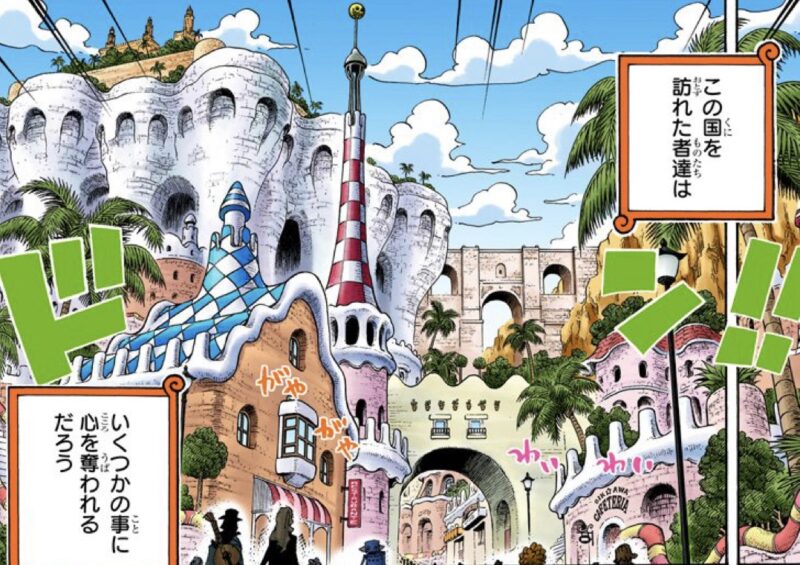
The first buildings shown when the Straw Hats arrive in Dressrosa are the colorful tiled rooftops of the port town Acacia. The model is Guell Park in Barcelona — part of the UNESCO World Heritage grouping of Antoni Gaudi’s Works.
Gaudi’s signature is organic architecture covered in mosaic tile — curved surfaces faced with broken ceramic in patterns of vivid color. The famous serpentine bench at Guell Park is the most recognized example. Dressrosa’s characteristic colorful, curved tile-covered buildings come from this aesthetic directly.
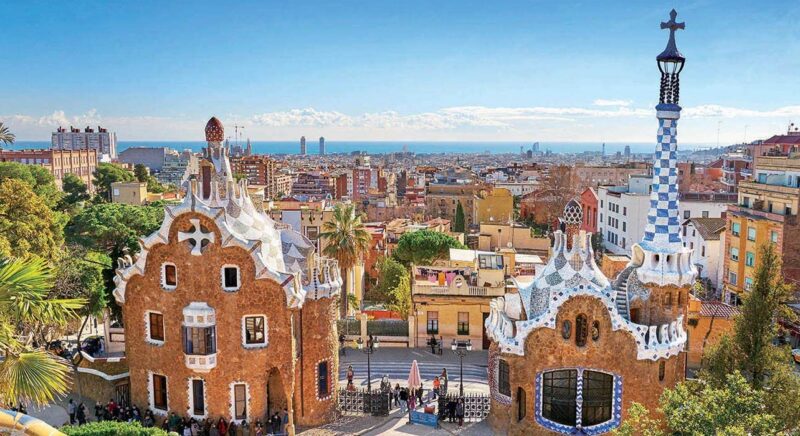
The same UNESCO grouping includes La Sagrada Familia — the most-visited site in Spain — and several other Gaudi buildings across Barcelona. When Oda uses “Gaudi’s Works” as the visual model for a town, the entire architectural vocabulary of Barcelona comes with it.
The Corrida Colosseum: Roman Structure, Spanish Name
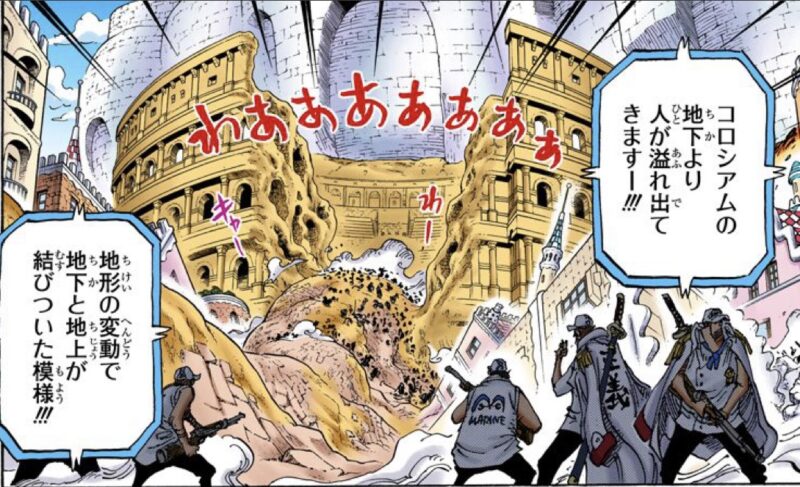
The Corrida Colosseum is circular, with tiered seating and an arena floor — the Roman colosseum form. The Colosseo in Rome is a UNESCO World Heritage Site (“Rome’s Historic Centre”). The structure is Roman.
But the name is Spanish. And this is historically accurate in a specific way: the Romans brought gladiatorial combat culture to Hispania (Spain), where it evolved over centuries into bullfighting. The arena form is Roman; the sport that replaced gladiatorial combat is Spanish. Corrida de toros is the direct descendant of the Roman arena tradition, developed in the specific cultural context of Spain.
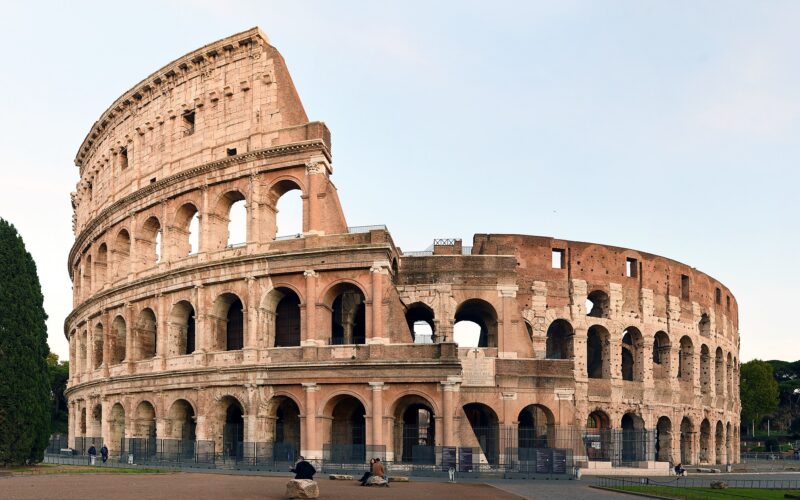
The Corrida Colosseum therefore encodes both its architectural ancestor (Roman arena) and its cultural content (Spanish bullfighting) simultaneously in its name and design. This is not coincidence. It is a historically accurate compression of how the building type evolved.
The Culture of Dressrosa
Beyond the buildings, the cultural texture of Dressrosa is Spanish throughout: the passionate temperament of its citizens, women throwing roses, dance that resembles flamenco, emotional intensity as a defining national character. Spain — especially Andalusia — has a specific cultural identity built around passion, pride, and expressive art forms. Dressrosa’s people embody this.
The political structure is equally Spanish in its historical resonance: a noble family (Donquixote) maintaining absolute control over an island population through a combination of theatrical spectacle (the Corrida Colosseum) and hidden coercion (SMILE production, slavery underground). This mirrors the structure of Spanish colonial governance in its territories — a performance of grandeur above, extractive exploitation below.
Donquixote: The Name Is Also a Reference

The family name Donquixote is a direct reference to Don Quixote — the 17th-century Spanish novel by Miguel de Cervantes, considered the first modern novel and one of the most influential works in Western literature. Don Quixote is a deluded nobleman who believes he is a heroic knight; he mistakes windmills for giants and attacks them, confuses inns for castles, and generally inflicts chaos on the world around him while believing he is doing good.
Doflamingo is a deluded noble who believes he has the right to rule the world; he creates elaborate systems of control that harm everyone around him while genuinely believing himself to be above ordinary morality. The literary reference explains the character’s psychology.
For the complete route and all island models, see The Real Grand Line. For the broader historical pattern across arcs, see One Piece History is Real History.