Roger, who knew the truth of the Void Century. His technique names — “Aramitama” (Rough Divine Spirit) and “Kamigakari” (Divine Departure) — are both Shinto words.
Why are Roger’s technique names from Shinto? Digging into this brings us closer to the true identity of the Void Century.
Roger’s Technique Names
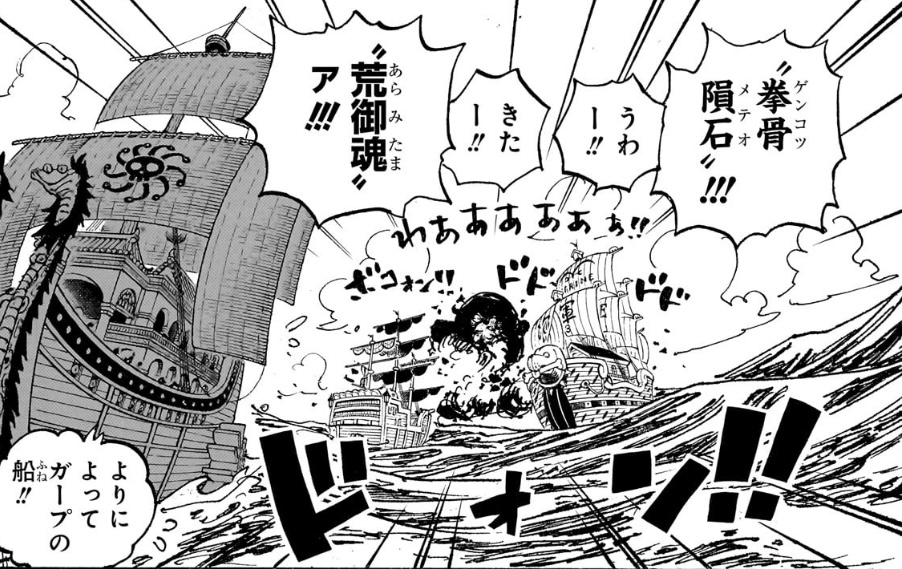
In the Elbaf flashback arc, we saw young Roger vs. Garp.
There, another of Roger’s technique names was revealed.
“Aramitama”
Looking closely at the scene where Roger called out the technique name, the two ships were still some distance apart, and Garp was also attacking from long range.
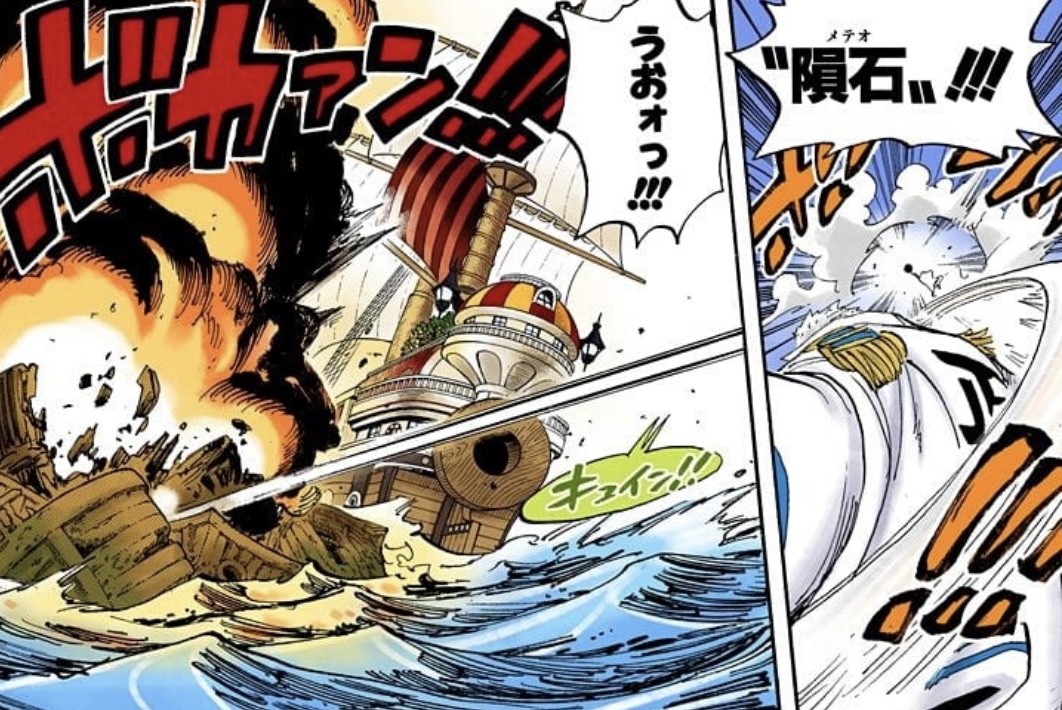
That means “Aramitama” is likely a technique capable of canceling Garp’s “Knuckle Meteor.”
In other words, it’s probably a flying slash or a technique that shoots compressed Haki.
What is “Aramitama”?
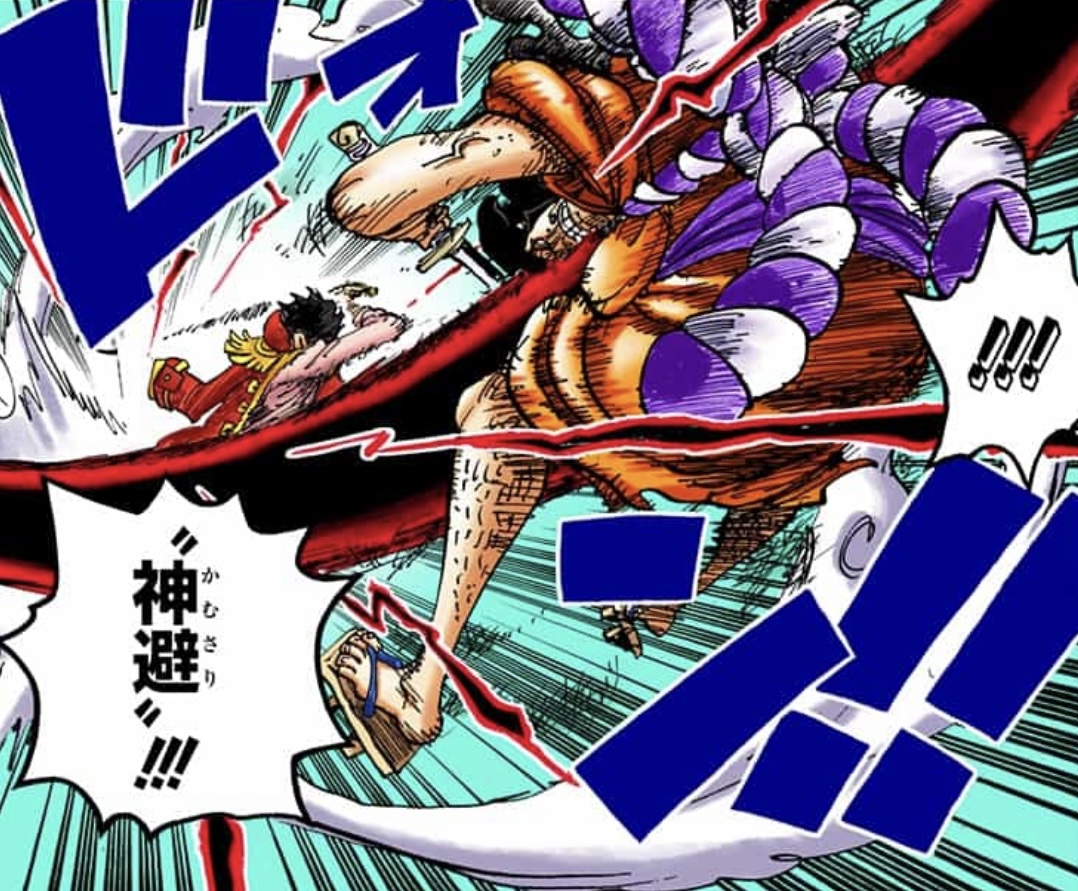
Roger’s technique names:
Kamigakari means a god dying, or a god departing from a place so its divine power disappears.
Aramitama means a violent/rough god. The opposite — a calm god — is called Nigimitama (Gentle Divine Spirit).
Both of these are Shinto terms.
What is Shinto?
Shinto tends to be confused with Japanese mythology (which features Amaterasu, Susanoo, Tsukuyomi, Izanagi, Izanami) — but they are different.
Japanese mythology (the Kojiki) was a creative work compiled and edited by the Yamato court from regional myths and oral traditions across Japan, to legitimize their rule.
Shinto, on the other hand, is older than Japanese mythology — a primitive religion whose prototype was formed from the Jomon period through the Yayoi and Kofun periods.
Japan’s religion. With no founder, no scripture, and unlike monotheism, based on the idea that divine spirits dwell in all phenomena of nature.
A faith born from the Japanese people’s life engaging with nature through farming and fishing — containing mythology, eight million gods, nature and natural phenomena; an animistic, ancestor-worshipping folk religion.
Seeing divine spirits in the power of nature beyond human control, carefully worshipping those divine spirits to soothe nature’s threats and pray for the peace of agricultural life — that’s the origin of Shinto.
(Source: Wikipedia)
In short: awe of the power of nature, worshipping it as gods. What’s important here is the era when this prototype was formed.
Why did Oda-sensei make the technique names of Roger — who knew the secret of the Void Century — Shinto words?
Because the “Void Century” in One Piece likely corresponds to Japan’s real history: the “Blank 4th Century.”
The Void Century
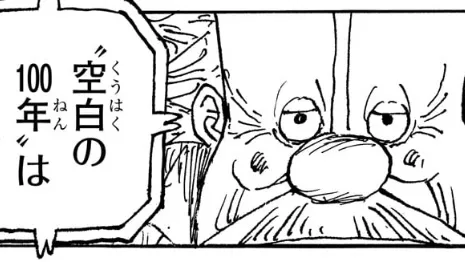
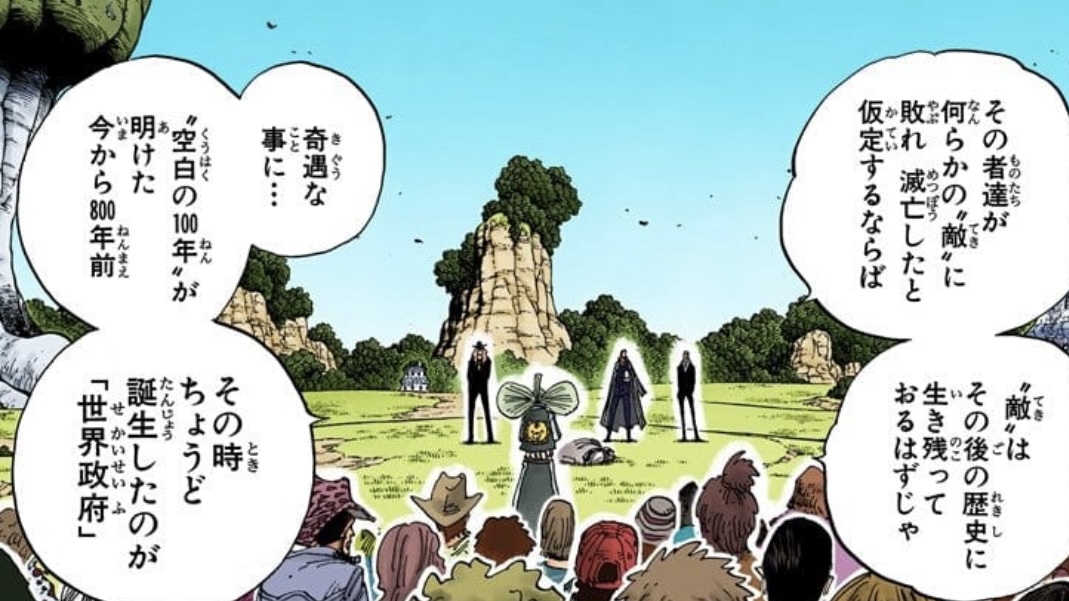
Before the Void Century, a certain great kingdom was at the center of the world.
But a great war involving the whole world occurred, and the great kingdom vanished without a trace. In its place, the World Government was born and has dominated the world ever since.
In real Japanese history, meanwhile…
Before the “Blank 4th Century,” the Yamatai-koku held great power; a queen named Himiko ruled the land.
But when the “Blank 4th Century” ended, the rulers of Japan had changed to the Yamato Court.
Moreover, all traces of Yamatai were completely erased — even where it existed remains a mystery. (Theories include Kyushu, Nara, and even Tohoku — or that it never existed at all.)
In other words, One Piece is:
A mystery manga about Japan’s Blank 4th Century by history-nerd Oda-sensei
— and that is a strong possibility.
Himiko’s “Kidou” (Demon Way)
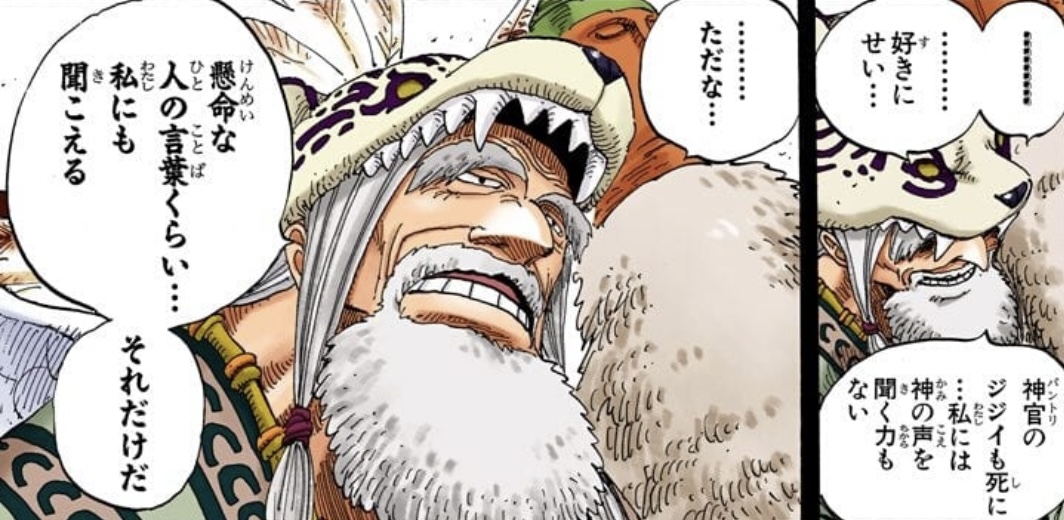
Himiko used “kido” (demon way) divination to govern the country.
Reminiscent of the Shandia priest, Pantri, isn’t it?
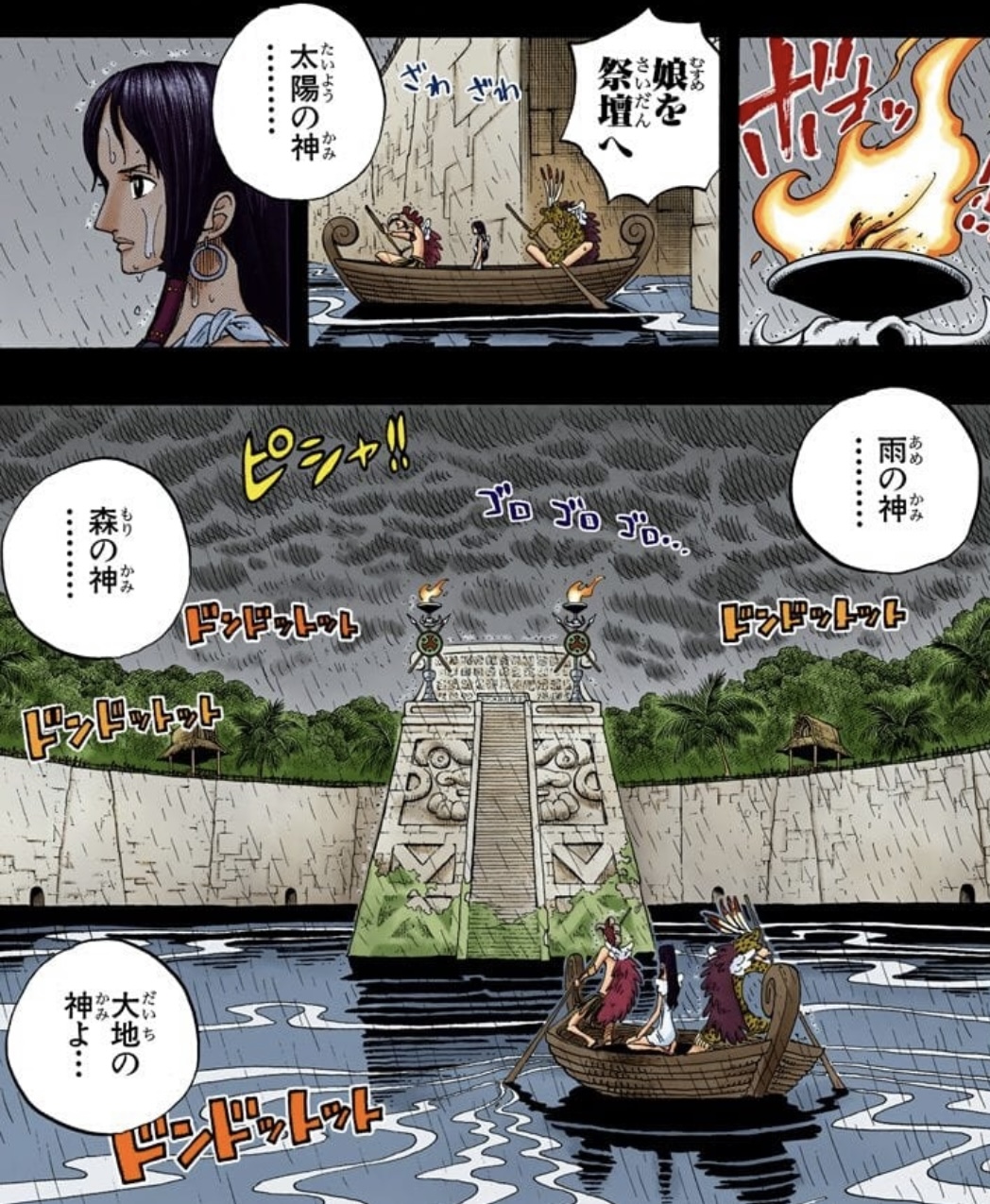
In sacrifice scenes too, “God of the Sun, God of Rain, God of Forest, God of Earth” — worshipping nature as gods, just like Shinto.
The Skypiea arc, with “denial of god” as its theme, had natural compatibility with Shinto worship of nature as divinity.
The reason Himiko’s divination was called “kido” (demon way) is because there was a faction that needed to paint Himiko as a witch — that’s how history works.
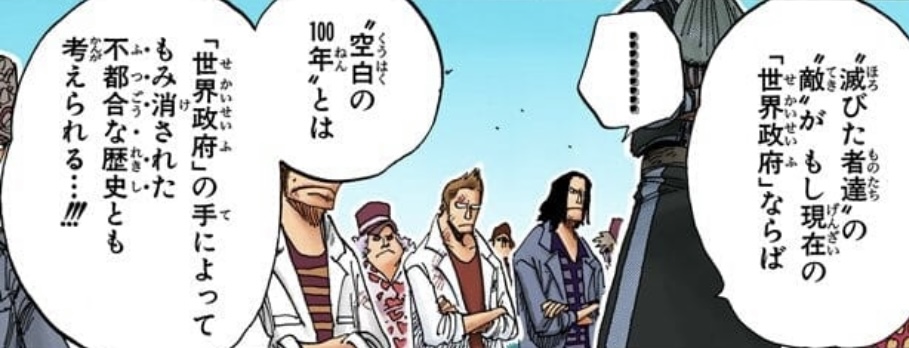
After the Blank 4th Century, the rulers of Japan became the Yamato Court.
But a great battle took place for the transfer of power.
What triggered it? Why did the victor Yamato Court need to attack the loser Yamatai?
The reason can’t simply be wanting power and resources.
Because the descendants of the Yamato Court who still sit at the top of Japan are the Imperial Family.
Japan’s royal ancestors can’t be mere invaders or plunderers, so the trigger for the war needed a “righteous justification.”
So Himiko had to become the villain — an evil witch who used suspicious dark arts to mislead the people.
History is always preserved to suit the convenience of the victors; the defeated are relentlessly made into villains.
Reading One Piece helps you vaguely understand how such historical mechanisms work.
So if Oda-sensei is modeling the Void Century on Yamatai and Himiko:
The World Government = Yamato Court; the Great Kingdom = Yamatai; Himiko, said to have misled people with kido = Nefertari D. Lily? Or…
In any case, in Oda-sensei’s mind, Himiko’s kido was not suspicious sorcery but a righteous divination that saved and guided people.
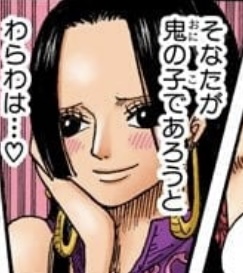
Evidence: Roger called “demon” (oni), Ace and Luffy called “demon child,” Yamato in demon form; Dory and Brogy as red and blue ogres — in One Piece, the oni title carries a positive image.
[Side Note] Izumo Province
Researching Roger’s technique name Kamigakari (divine departure), I found the opposite concept: Kamiari (divine presence).
In the Japanese calendar, October is called “Kannazuki” (month without gods) — because a divine conference is held in Izumo, so the gods go absent from all other regions.
When gods depart nationwide, “Kamigakari” occurs. Conversely, in Izumo where the conference is held, October is called “Kamiaridzuki” (month with gods).
Izumo is also the land of the “Kunibiki” (land-pulling) legend — a giant god named Yatsukamizuomitsunonominoto pulled islands floating at sea and attached them to form the land.
Kunibiki legend — that reminds you of Oars, doesn’t it?

Okuninushi
And speaking of Izumo, the “Kunitsugi” (land cession) of Okuninushi is also famous.
The legend: Okuninushi, king of Izumo, was told by Amaterasu “offer your land to me,” and surrendered without resistance.
This god Okuninushi is fondly called “Daikoku-sama” by the local people of Izumo, reading the kanji with the on’yomi (Chinese reading).
And because they share the same pronunciation, he’s also considered the same deity as Daikoku of the Seven Lucky Gods.

Speaking of the Seven Lucky Gods, there’s the treasure ship (Takarabune).
Speaking of the treasure ship — that’s Luffy.

Speaking of Luffy, his Gear 5 form was compared to a Myoo (Wisdom King).
And Myoo and Daikokuten actually share a connection.

Both were originally the Hindu god Shiva.
Luffy is Shiva the Destroyer

Daikokuten was originally the fierce form of the Hindu god Shiva — Mahakala — which entered Japan through Buddhism.
And Myoo (Wisdom King) is also said to be one of the forms of Shiva absorbed into Buddhism; the most representative is Fudo Myoo (Immovable Wisdom King).
Okuninushi → Daikoku-sama → Daikokuten → Shiva’s avatar Mahakala; Fudo Myoo → Shiva.
Therefore, Luffy is Shiva the Destroyer.
Most Shiva statues in India feature a third eye and a snake coiled around the neck.

The third eye — that’s Pudding. She’s currently with Blackbeard.
The snake — that’s Luffy’s Snakeman. The snake-named techniques are also Shiva’s influence (Shiva is accompanied by snakes).

In other words, since Luffy is Shiva who commands snakes, he’ll end up taming Loki — who appears to have a giant snake ability.
That’s the prediction.


…Anyway, all of One Piece’s important foreshadowing connects back to India.
Matching the 800-Years-Ago Timeline with Real History
The “present” in One Piece is around Sea Year 1520. That means 800 years ago was around year 720 — corresponding to the real 8th century.
793 AD: The Lindisfarne Monastery in England was attacked by Vikings — the dawn of the Viking Age.
The giants of Elbaf = the Vikings. The Void Century (800 years ago) overlaps with the start of the Viking Age — which is probably why the “Great Kingdom” formed an alliance with the giants of Elbaf.
And on that note, that’s all for this week. See you next week!