Egghead is a laboratory island 500 years ahead of the rest of the world — and every layer of its design maps to something real. The architecture points to Silicon Valley. The scientist at its center has one of the most recognizable faces in modern history. And the six bodies he split himself into each carry a design pulled from a specific corner of Japanese pop culture that most readers outside Japan have never encountered.
The Island = Apple Park (and the Theater Hidden Underground)
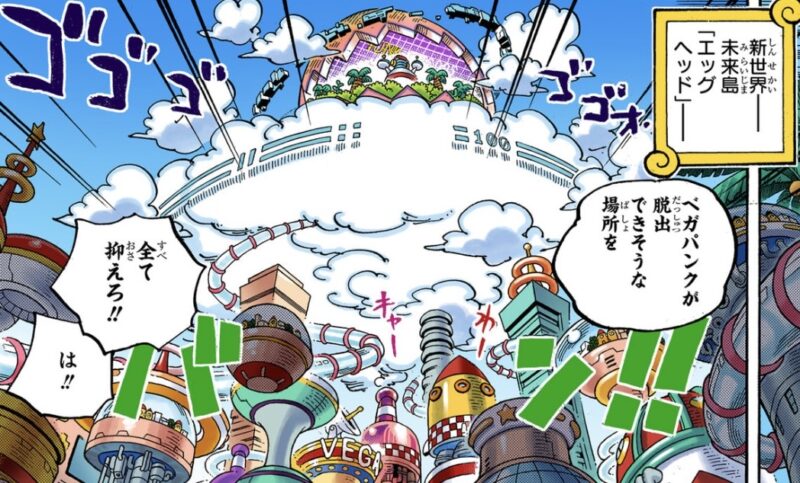
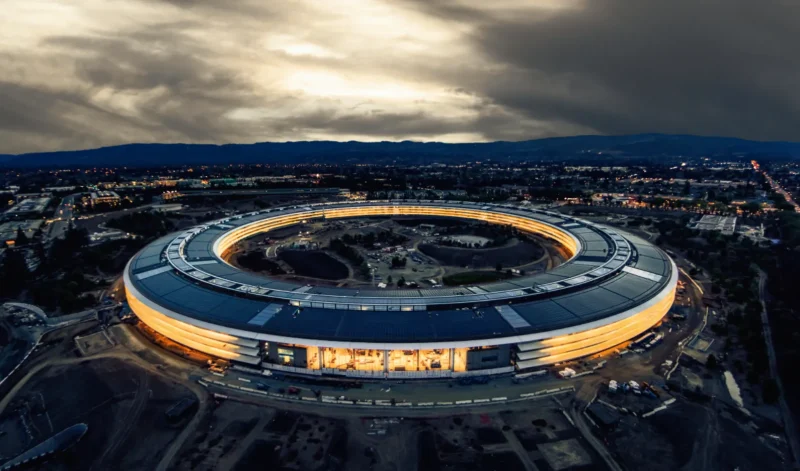
Egghead’s defining feature is a massive circular research facility rising out of the ocean — a ring-shaped structure surrounded by controlled access zones, cutting-edge infrastructure, and open parkland. The real-world model is Apple Park, Apple’s circular headquarters in Cupertino, California.
Apple Park was the final project personally designed by Steve Jobs before his death in 2011. The main building is a 461-meter ring containing over 12,000 employees, set inside a landscape of trees and gardens. Jobs described it as “the best office building in the world.” It opened in 2017.
The second layer of the parallel is the Steve Jobs Theater — an underground glass-dome auditorium on the Apple Park campus that is almost invisible from the surface, sunk into the earth so only the roof is visible above ground. Egghead’s research facilities are similarly split between what is visible above the waterline and what is hidden below. The secret theater buried under a beautiful campus and the hidden laboratories beneath Egghead’s surface are the same design idea.
Vegapunk = Albert Einstein
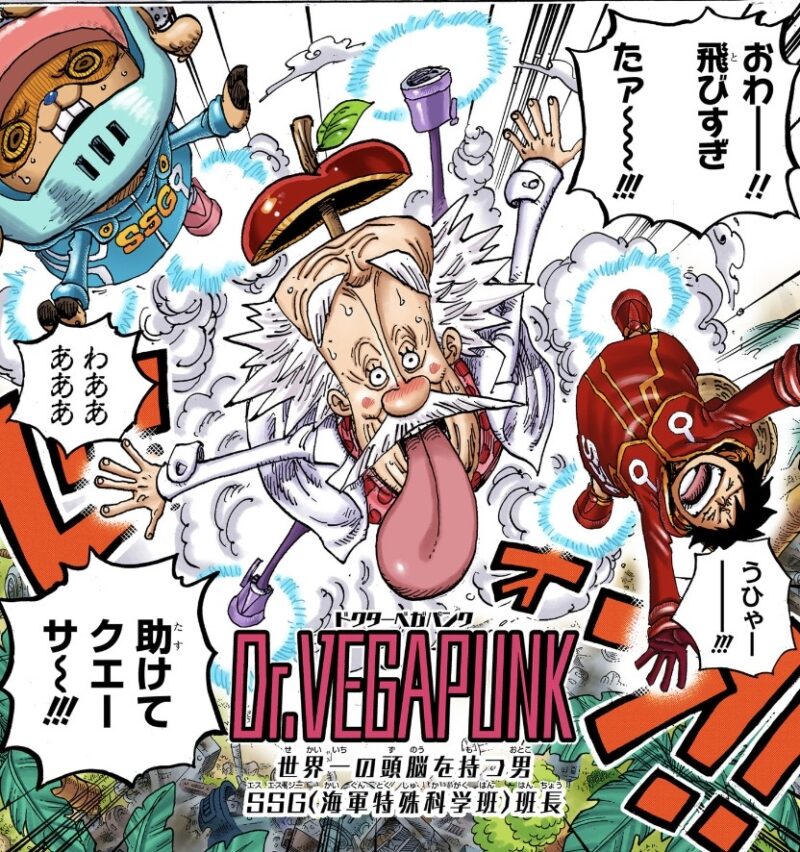
Vegapunk’s face is the giveaway. The pose he strikes in his first full appearance — tongue out, looking directly at the viewer — is taken from one of the most famous photographs of the twentieth century: Albert Einstein on his 72nd birthday in 1951, turning to the press photographers and sticking out his tongue. The image went around the world. Oda used it as the visual template for the scientist who develops every weapon and technology the World Government depends on.

The deeper parallel runs through Mother Flame. Einstein’s most famous contribution to physics, E=mc², became the theoretical foundation of nuclear weapons — a discovery that Einstein himself, a committed pacifist, spent the rest of his life trying to reconcile. He understood what he had made possible. He knew that the same equation that described the energy of stars was also the equation behind the bomb. He continued working, continued thinking about it, and never resolved the tension.
Mother Flame is Vegapunk’s equivalent. It is simultaneously the World Government’s ultimate weapon and a potential energy source that could end poverty and starvation across the world. Vegapunk built it, handed it over, and then spent years watching it be locked away and monopolized. The structure of that situation — the brilliant scientist, the dual-use discovery, the state that controls the technology and decides who benefits — is Einstein and nuclear energy exactly.
The Six Satellites: Named After Scientists, Designed After Anime
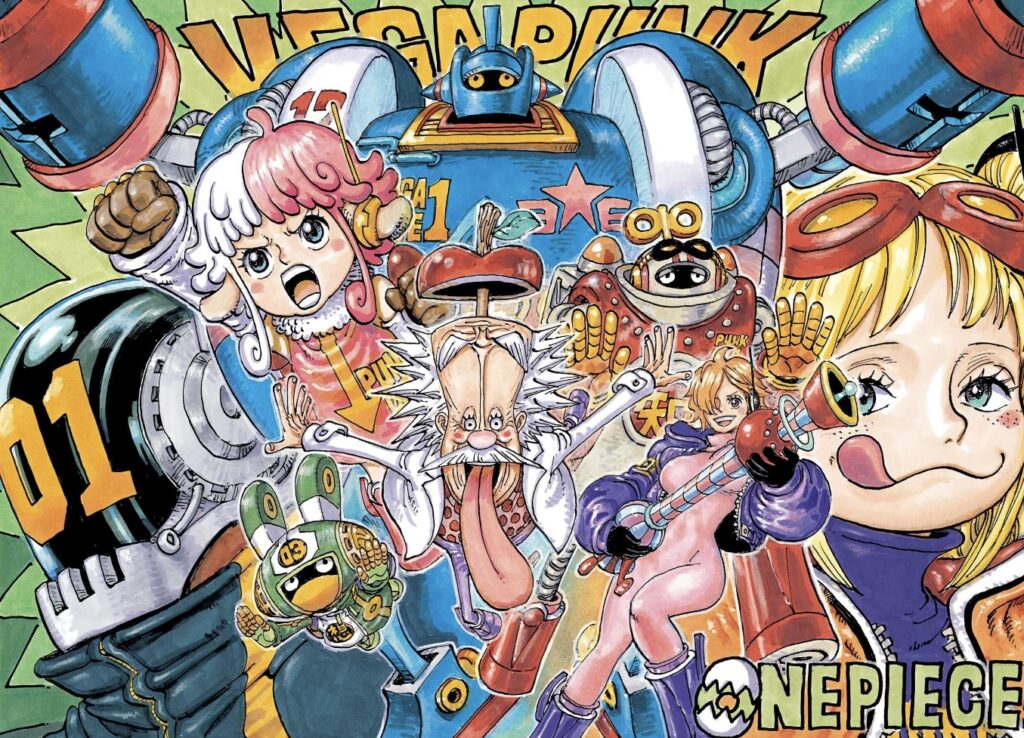
Vegapunk split his consciousness into six autonomous bodies, each carrying a fragment of his personality. They are named after real scientists — Shaka (01/Justice), Lilith (02/Evil), Edison (03/Foresight), Pythagoras (04/Wisdom), Atlas (05/Violence), York (06/Greed). But their visual designs come from somewhere else entirely: a specific generation of Japanese television that most readers outside Japan have never encountered.
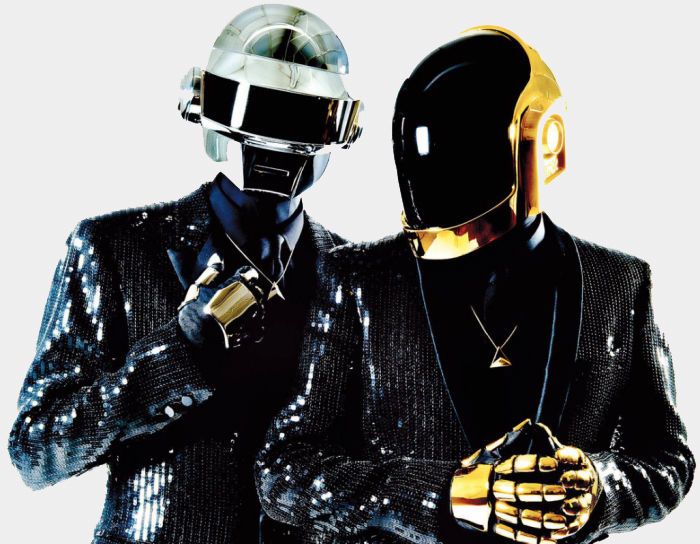
Shaka’s full-coverage helmet that never comes off is Daft Punk — the French electronic duo who spent their entire career performing in robot helmets, identities deliberately concealed. The name connection is there too: Vegapunk and Daft Punk share the same rhythm and ending syllable. Edison’s compact rugby-ball-headed robot body comes from Robokko Beaton, a 1976 Showa children’s anime. York — who is always eating in every group scene, visibly heavier than her baseline — is Guzura, the gluttonous fire-breathing monster from the 1967 Showa anime Oraa Guzura Dado. The three female satellites each carry fragments of Uta, the singer protagonist of One Piece Film: Red.
Each design traces back to a specific creator and a specific era of Japanese animation. For the full breakdown of all six satellite models and the creative lineage connecting them, see Vegapunk’s Six Satellites Are Built from Showa-Era Anime History.
The Seraphim: Mass Production
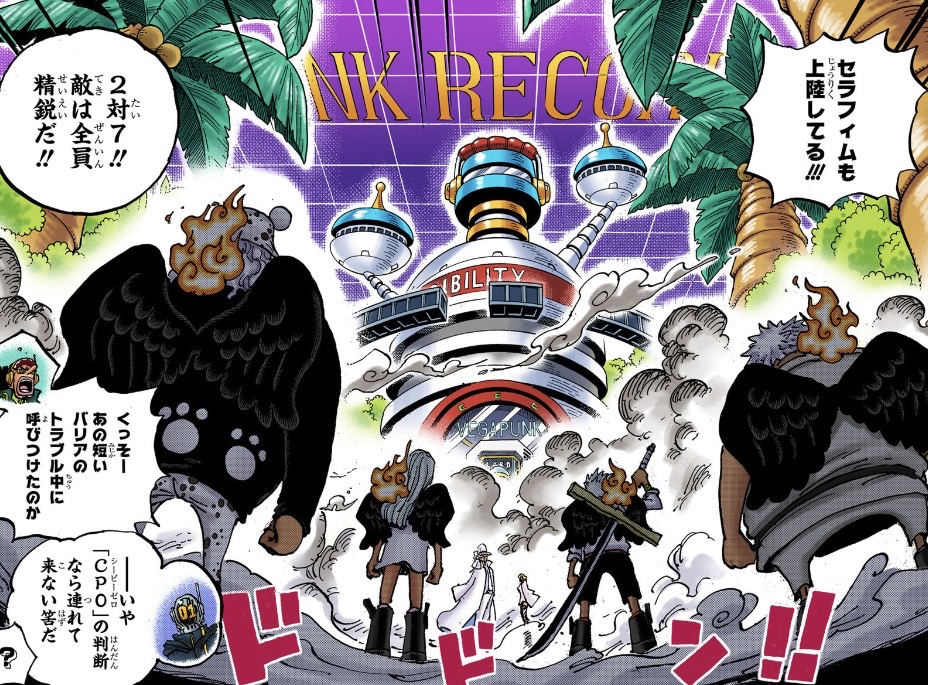
The Seraphim — child-sized bodies modeled on the Seven Warlords, enhanced with Lunarian DNA — are Vegapunk’s mass production line. Where the original Warlords were individuals with histories and motivations, the Seraphim are identical units that can be deployed in quantity. The conceptual parallel is the shift from custom-built technology to manufactured product lines: the same underlying design, reproduced at scale, stripped of individuality. The World Government wanted Vegapunk’s genius standardized and deployable. The Seraphim are what that looks like.
500 Years Ahead
Egghead’s defining phrase — “500 years ahead of the world” — is not just a number. It describes a real condition: the gap between what exists in advanced research and what the public has access to. In military technology, materials science, and computing, the distance between frontier research and public deployment has always been measured in decades, not years. The World Government’s monopoly over Vegapunk’s work — using his discoveries as weapons while suppressing them as public goods — is the structure of that gap made literal. Einstein understood this. Vegapunk understood it too.
For where Egghead fits on the actual navigable route, see The Real Grand Line. For the character models throughout One Piece, see Every One Piece Character and Their Real-Life Model.