Every One Piece admiral has a real-world model — a Japanese film star from the Showa era. What makes this especially remarkable is that a single 1990 samurai film, Roningai (浪人街), turns out to be the origin point for five separate One Piece characters, including the name “Akainu” itself.
The 1990 Film That Inspired Five One Piece Characters
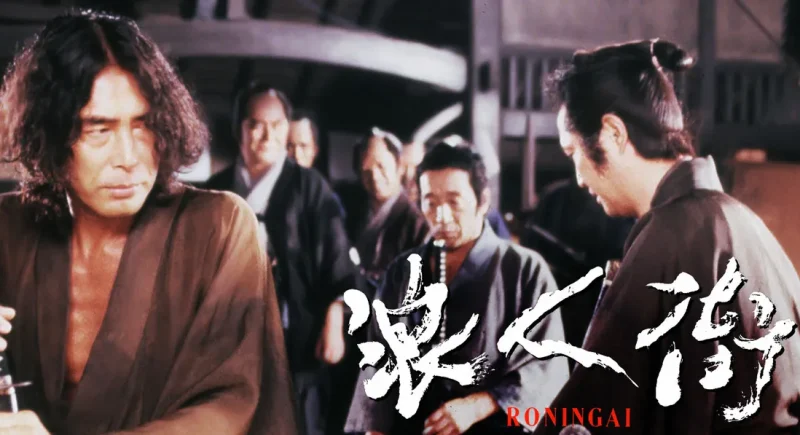
Roningai (1990, dir. Kazuo Kuroki) is set in a Japan where the age of war is over and masterless samurai — ronin — have no place left. The film’s tagline is “Four ronin vs. 120 enemy swordsmen,” though the bulk of the story is a slow, melancholic portrait of men who no longer fit the world around them. The cast reads like a hall of fame of Japanese cinema: Yoshio Harada, Shintaro Katsu, and Kunie Tanaka — the real-world models for Ryokugyu, Fujitora, and Kizaru — all appearing together on screen. It was Shintaro Katsu’s final film.
Ryokugyu (Green Bull) — Yoshio Harada as Aramaki Gennai
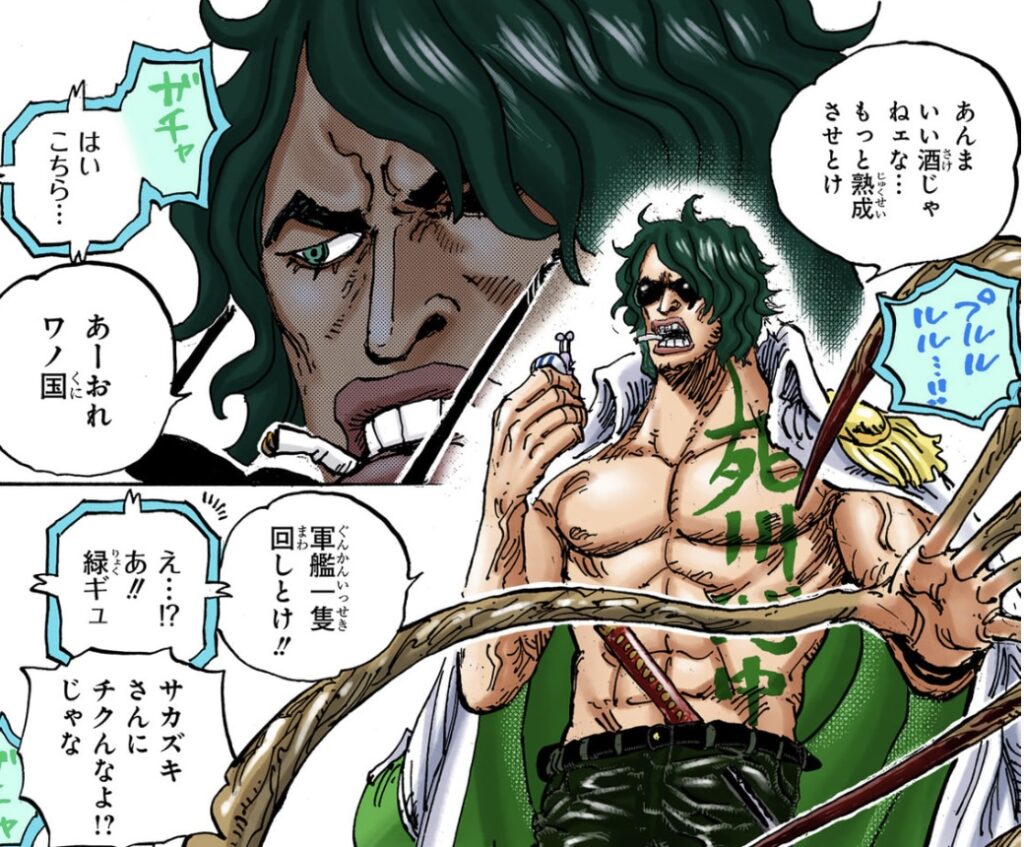
The protagonist of Roningai is Aramaki Gennai (荒牧源内) — a womanizer, a layabout, a man who lives off the women who inexplicably fall for him. He’s shiftless, hard-drinking, and not particularly heroic for most of the film. Then the finale arrives: he picks up seven swords and faces 120 enemy samurai alone.
The character’s name — Aramaki — maps directly onto One Piece’s Ryokugyu, whose real name is Aramaki. The long-haired silhouette, the reputation as a ladies’ man, and fan speculation about a “seven-sword style” all point back to Yoshio Harada’s performance. Harada won the Blue Ribbon Award for Best Actor for this role.
Where the Name “Akainu” Was Born
This is where Roningai becomes something extraordinary for One Piece fans. Shintaro Katsu plays a ronin named Akaushi Yagouemon (赤牛弥五右衛門) — “Red Bull.” Of the four main characters, Akaushi has the least pride. In one scene, he prostrates himself before the villain, begging to be hired. The villain, amused, throws his sandal across the yard and orders Akaushi to fetch it in his mouth like a dog.
Akaushi obeys. The villain laughs: “You are not Akaushi — Red Bull. You are Akainu — Red Dog.”
That is the moment the name Akainu was created. Oda took the name directly from this scene, flipping the humiliation into the title of One Piece’s most feared admiral.
Akainu (Sakazuki) — Bunta Sugawara in Battles Without Honor and Humanity
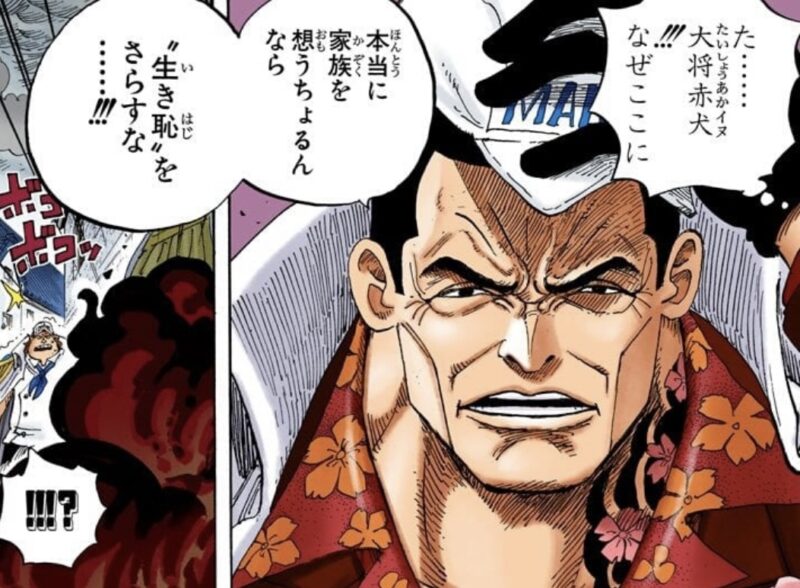
Beyond the name, the admiral Akainu (Sakazuki) takes his visual model from Bunta Sugawara, star of the 1973 yakuza film series Battles Without Honor and Humanity (仁義なき戦い). Directed by Kinji Fukasaku, the film is set in postwar Hiroshima and follows the brutal rise of organized crime with unflinching realism. Sugawara’s protagonist is ruthless, single-minded, and absolutely uncompromising — the same qualities that define Akainu’s “absolute justice.”
Kunie Tanaka also appeared extensively in the Battles Without Honor and Humanity series, playing a character with no loyalty — flattering his boss to his face while secretly colluding with enemies. The same morally flexible quality that defines Kizaru.
Fujitora — Shintaro Katsu as Zatoichi
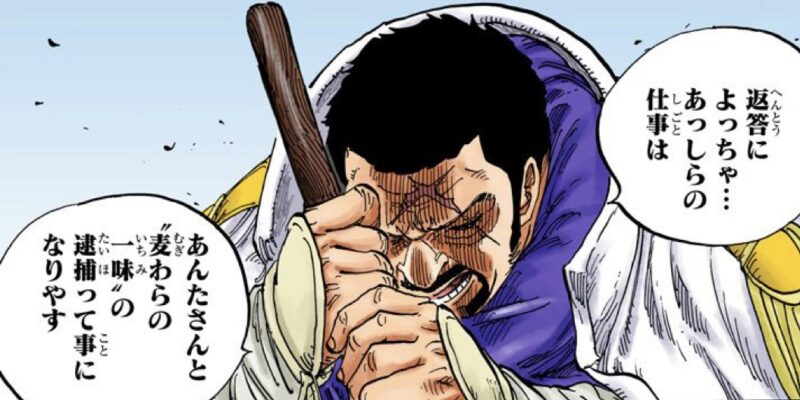
Fujitora, the blind admiral who senses everything through the ground, is modeled on Shintaro Katsu in his most iconic role: Zatoichi, the wandering blind swordsman who appeared in 26 films between 1962 and 1989. Zatoichi is humble in appearance and devastating in combat — a man others underestimate until it is far too late. The visual parallel with Fujitora is unmistakable: the cane-sword, the downcast eyes, the deceptive stillness before violence.
The same Shintaro Katsu who gave One Piece “Akainu” and “Fujitora” also played Akaushi in Roningai, making him the single actor most responsible for One Piece’s admiral mythology.
Kizaru (Borsalino) — Kunie Tanaka
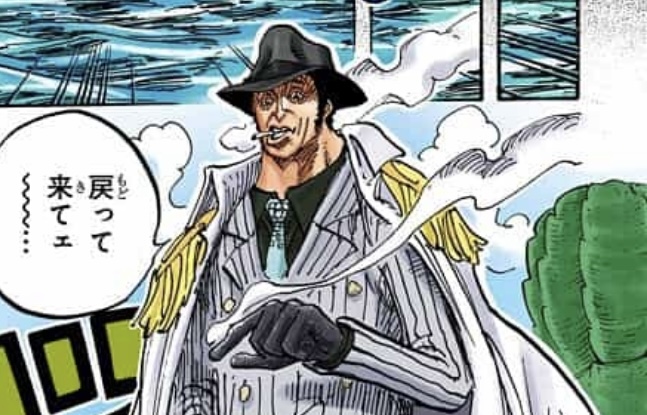
Kizaru’s real name, Borsalino, comes from the 1970 French film Borsalino, starring Alain Delon. But his face belongs to Kunie Tanaka. In the 1975 comedy-action film Truck Rascals: Full Speed #1 (トラック野郎 爆走一番星), Tanaka plays a character literally nicknamed “Borsalino 2” — opposite Bunta Sugawara. The two One Piece admiral models, Akainu and Kizaru, were already sharing the screen decades before Oda created them.
Kunie Tanaka also appears in Roningai, playing the brother of おぶん. This means Shintaro Katsu, Yoshio Harada, and Kunie Tanaka — the models for Fujitora, Ryokugyu, and Kizaru — all share the frame in a single 1990 film.
Aokiji (Kuzan) — Yusaku Matsuda
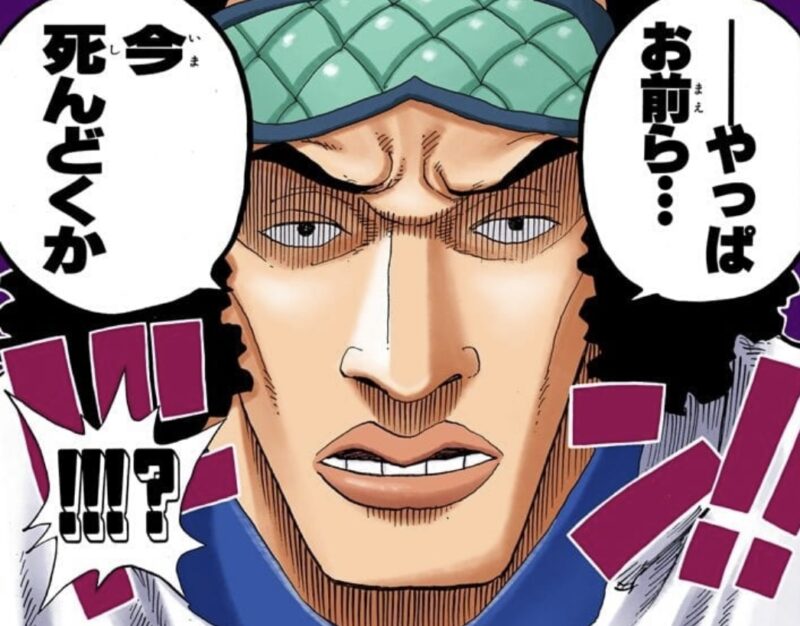
Aokiji’s model is Yusaku Matsuda, the defining cool of Japanese cinema in the late 1970s and 1980s. His best-known role is Detective Story (探偵物語, 1979), where he plays a private eye whose lazy exterior hides sharp intelligence — exactly the spirit of Aokiji’s “lazy justice.” In One Piece chapter 1081, Kuzan is shown drinking TIO PEPE sherry, the same Spanish wine Matsuda famously drank on screen. It is a direct, deliberate nod.
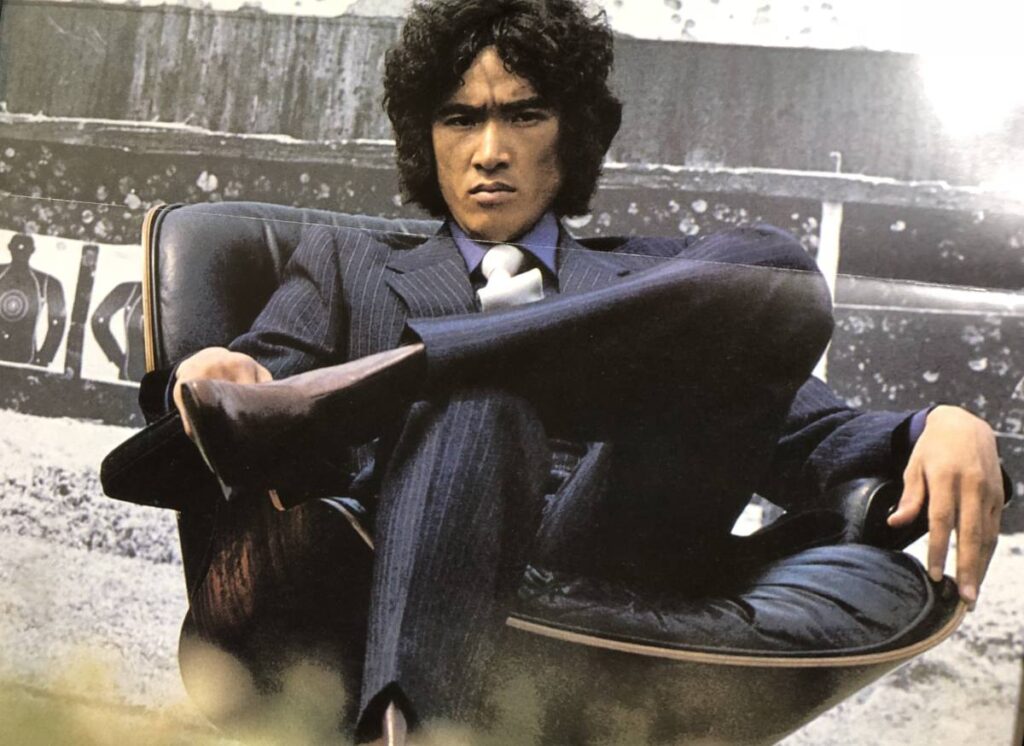
Matsuda was himself a devoted student of Yoshio Harada, calling him “brother” and studying his every move. The model for Ryokugyu influenced the man who became the model for Aokiji.
Bonus: Three More One Piece Characters Hidden in Roningai
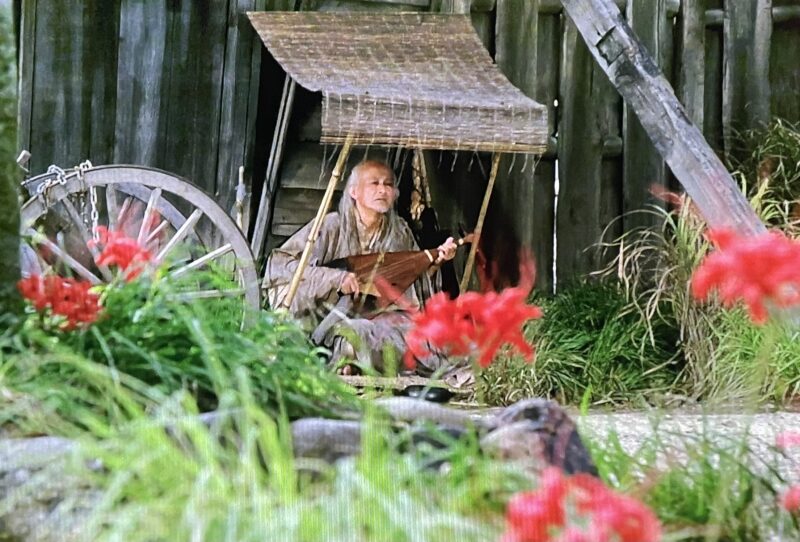
Beyond the admirals, Roningai contains models for three more One Piece characters that most fans miss.
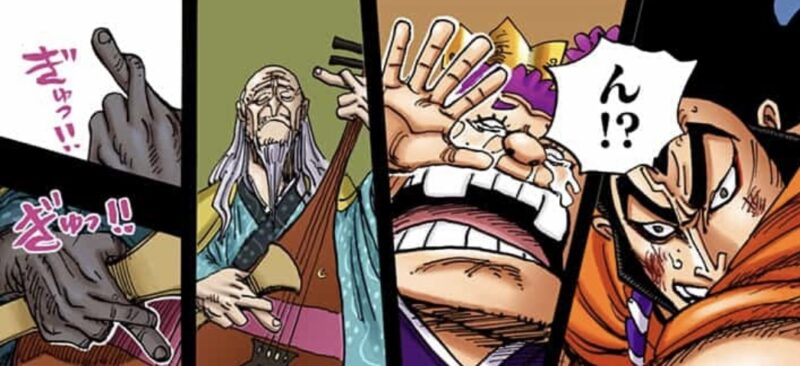
Kurozumi Semimaru — the Wano arc character who could create barriers with the Bari Bari no Mi — is modeled on actor Hideyo Amamoto, who appears in Roningai as a silent biwa-playing monk used as a scene transition. He has no dialogue. He simply plays his instrument between scenes. That haunting, ancillary presence — a man defined by a single strange talent — is exactly what Semimaru is in the Wano arc.
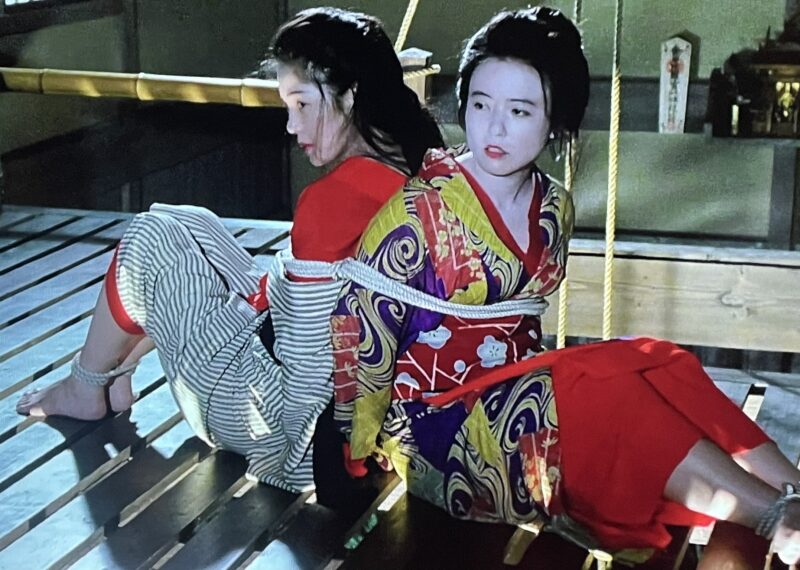
Izou is modeled on actress Kanako Higuchi, who plays O-Shin (お新) in Roningai — a woman who conceals a pistol and attempts to avenge the murder of her benefactor. When O-Shin is captured and bound, her hair falls loose in a way that strikingly resembles Izou’s long, disheveled style.
Kikunojo is modeled on Kaoru Sugita, who plays Obun (おぶん) — O-Shin’s companion who is captured alongside her. The two women tied together, with O-Shin’s unbound hair and Obun’s softness, map onto the Izou-Kikunojo sibling pair from Wano.
One film. One cast. The name Akainu, the face of Ryokugyu, the models for Fujitora and Kizaru, and three Wano characters — all hiding in a single 1990 samurai film that most Western One Piece fans have never seen.