Enies Lobby — the government judicial island — is modeled on Venice‘s political architecture: the Bridge of Sighs, the Doge’s Palace. But Water Seven itself, the city where the arc begins, is modeled on Venice’s physical reality: a city built on water, maintained by the world’s most advanced shipbuilding industry, and threatened by the sea that defines it.
Aqua Laguna = Acqua Alta
The tidal flooding event that strikes Water Seven every year — Aqua Laguna — is modeled on Acqua Alta (High Water), the seasonal flooding of Venice that occurs when autumn storms push Adriatic tides above the city’s foundations. Venice’s lowest areas — the Piazza San Marco, the narrow calli (alleyways) — disappear under water. Residents carry rubber boots. Elevated walkways are set up across the major tourist routes. This happens every year.
In One Piece, Aqua Laguna is described as an annual event that the residents accept as part of life in a city built on the sea. The residents of Venice have accepted Acqua Alta for centuries. The name is close enough to be an intentional reference: Aqua Laguna = Acqua Alta, with “Laguna” pointing directly at the Venetian Lagoon (Laguna Veneta), the UNESCO World Heritage body of water that Venice sits in.
Galley-La Company = The Arsenal of Venice
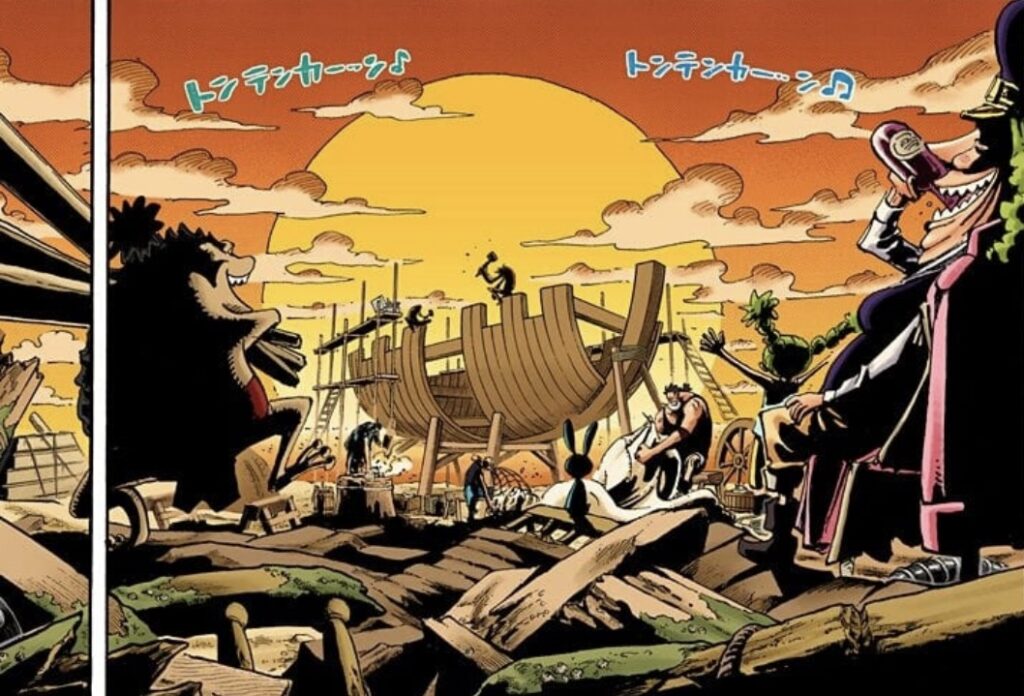
The most important institution in Water Seven is the Galley-La Company — the world’s greatest shipbuilding organization, whose craftsmen can build and repair any vessel, and whose leader (Iceburg) is effectively the city’s most powerful citizen. The real-world model is the Arsenale di Venezia — the medieval shipyard complex that produced the Venetian Republic’s naval fleet.
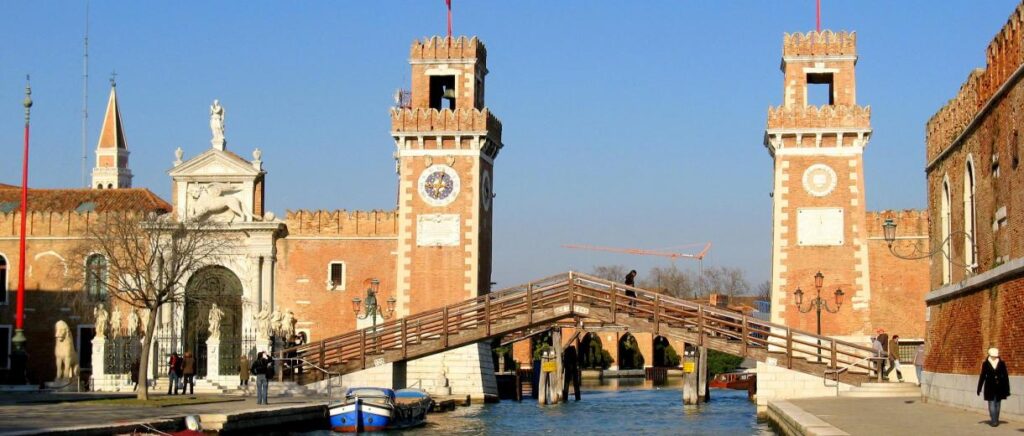
At its peak in the 15th century, the Arsenal employed 16,000 workers and could produce a fully equipped warship in a single day. It was the largest pre-industrial manufacturing complex in the world, and the source of Venice’s maritime dominance for over three centuries. The word arsenal — now used for any weapons or military supply depot — comes from the Venetian Arabic darsina’a, which entered Italian through this specific institution.
Water Seven’s entire identity — a city whose shipwrights are its aristocracy, whose political power comes from controlling ship construction — is the Venetian Republic’s actual political structure.
The Sinking City
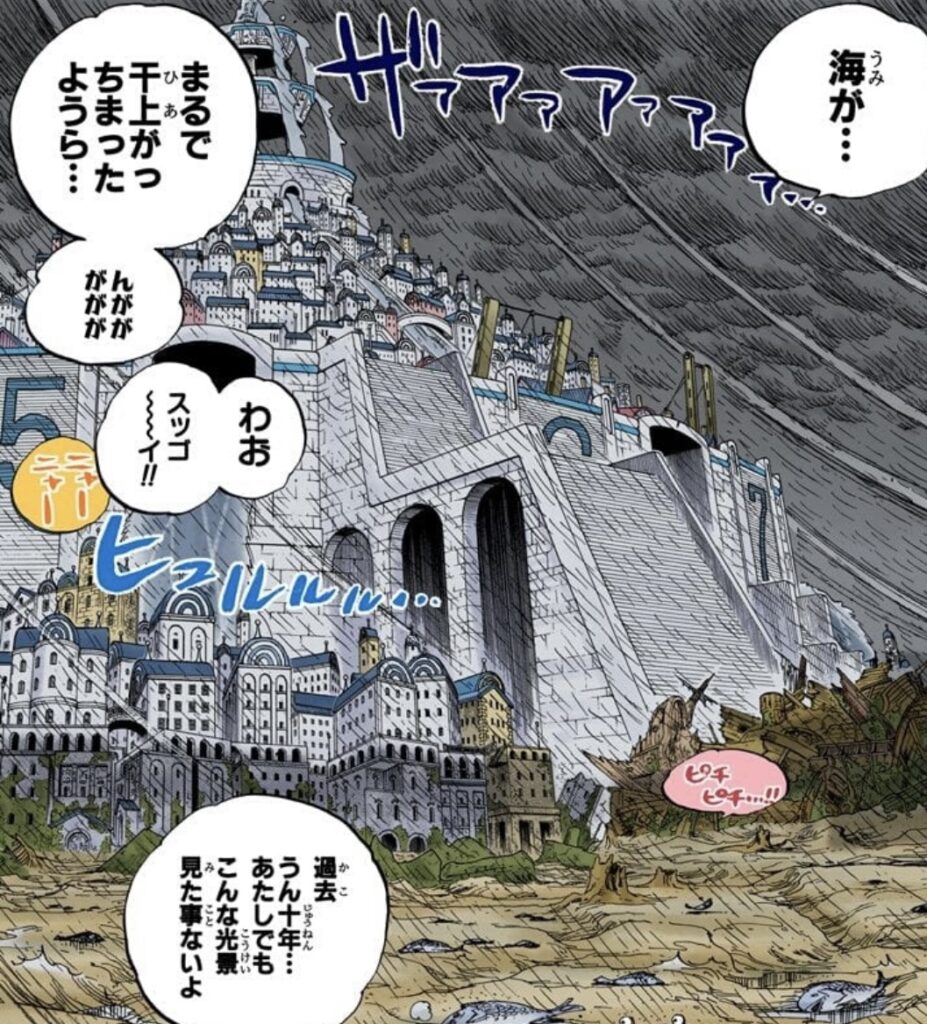
Iceburg’s driving motivation in the Water Seven arc is the knowledge that the city is sinking — the sea is slowly rising, or the city is subsiding, and without intervention it will be lost. This is Venice’s actual 21st-century crisis.
Venice has been sinking at approximately 1-2mm per year for decades, a combination of natural sediment compaction, groundwater extraction, and rising sea levels. The MOSE Project — a system of 78 mobile flood barriers across the three inlets of the Venetian Lagoon — was constructed over 17 years at a cost of €5.5 billion to defend the city. It became operational in 2020. Whether it will be sufficient in the long term remains genuinely uncertain.
Iceburg wants to move the city. The real debate about Venice is structurally similar: a choice between defending an existing structure against an encroaching sea, or fundamentally changing what the city is. Oda built this existential question into the arc’s background while the foreground was a CP9 assassination attempt and a ship-theft conspiracy.
For the Enies Lobby model and the Bridge of Sighs, see Enies Lobby is Venice. For the complete island route, see The Real Grand Line.