One Piece and Indian Mythology
When the move name “Bajrang Gun” came up in the fight against Kaido, I looked up its meaning and found it is another name for Hanuman. That led me to the stories where Hanuman appears, and I summarized the Ramayana.
In chapter 1198, Nika turned into a black monkey, and the Hanuman theory came back. So I researched and summarized the Mahabharata, the other of India’s two great epics in which Hanuman appears.
What Is the Mahabharata?
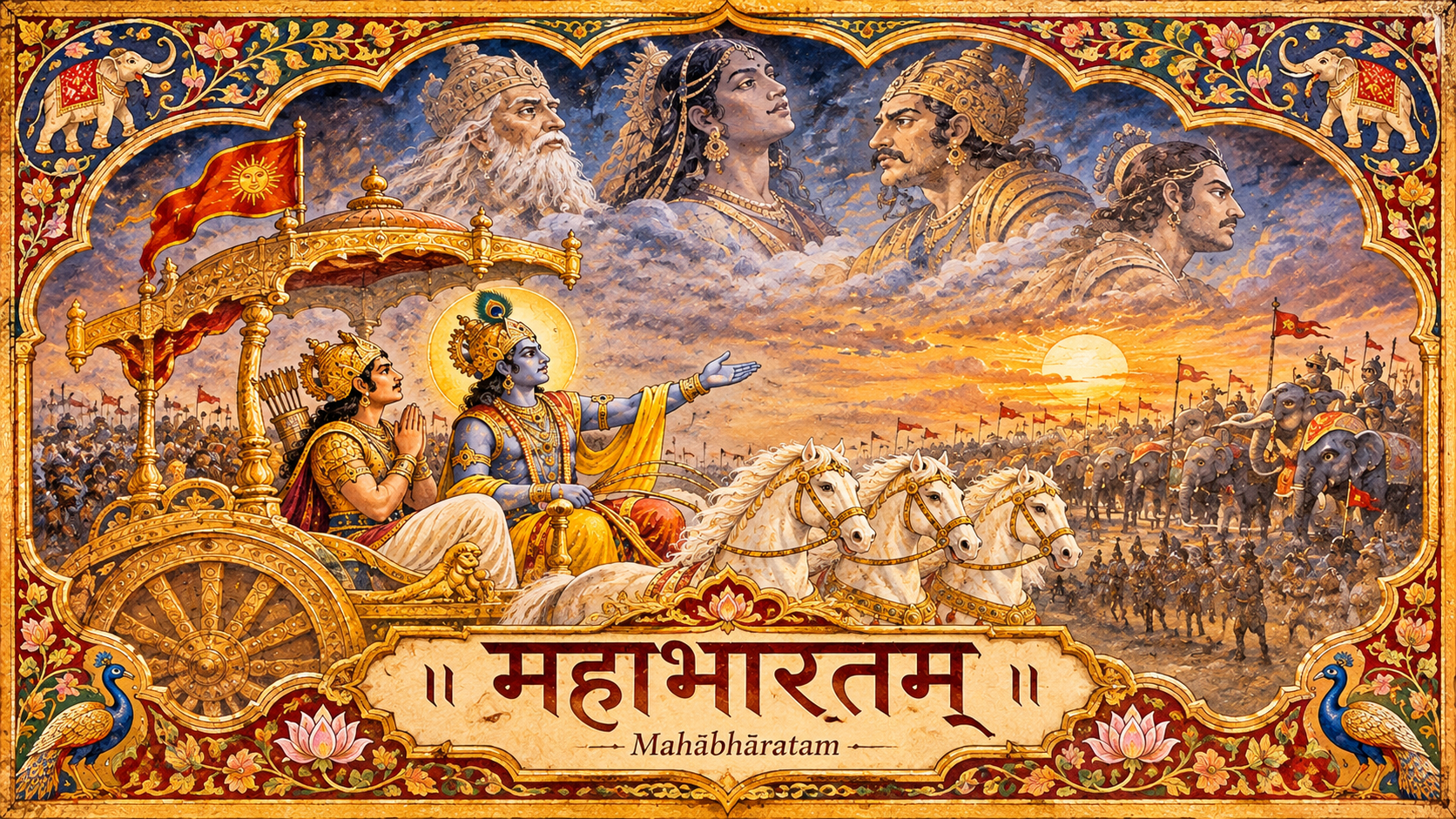
“Maha” in Mahabharata means “great,” and “Bharata” refers to the clan of Bharata, a legendary king of ancient India.
People in India call their country “Bharat” (the land of Bharata).
If you compare it to Japan, you can think of the Mahabharata as something like the Kojiki, the Japanese mythology that records the imperial family descended from the great deity Amaterasu.
Ancient India Was Divided into Many Kingdoms
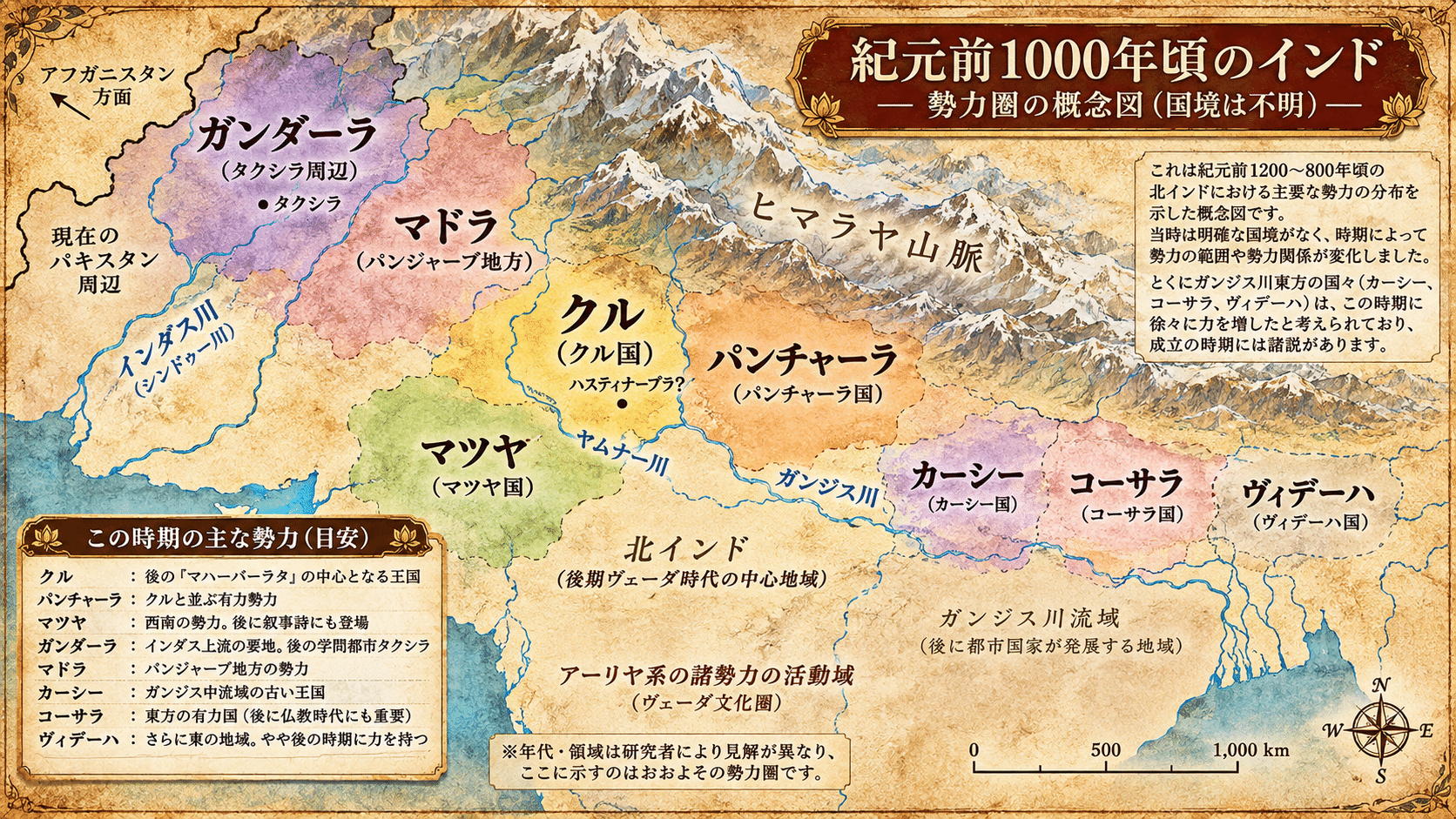
The story is set around 1000 BCE, about the Jomon period in Japan.
India at the time was split into many regions with their own royal houses and rulers, such as the Kuru, Panchala and Gandhara kingdoms.
The heart of the Mahabharata is the Kuru kingdom, where descendants of the great king Bharata fight each other over the throne.
It grows into a huge war that draws in the surrounding kingdoms, and in the end the eldest of the five brothers, Yudhishthira, becomes king.
So think of the five brothers as the heroes and the hundred brothers as their enemies.
The outline is…
- Five sons of the previous Kuru king and a hundred sons of the previous king’s older brother fight over the throne
- The hundred brothers invite the five to a gambling match, win by cheating and send the five into exile
- Their shared relative Krishna tries to settle things by talks, but they fail
- The five brothers marry a princess of a neighboring country and win over the Panchala kingdom and its neighbors as allies
- The hundred brothers also draw in neighboring countries, centered on Gandhara
- The great war of Kurukshetra engulfs all of India, and in the end the five brothers’ side wins
- The battles use not only bows and swords but also plenty of ancient weapons!
Main Characters and Relationship Chart
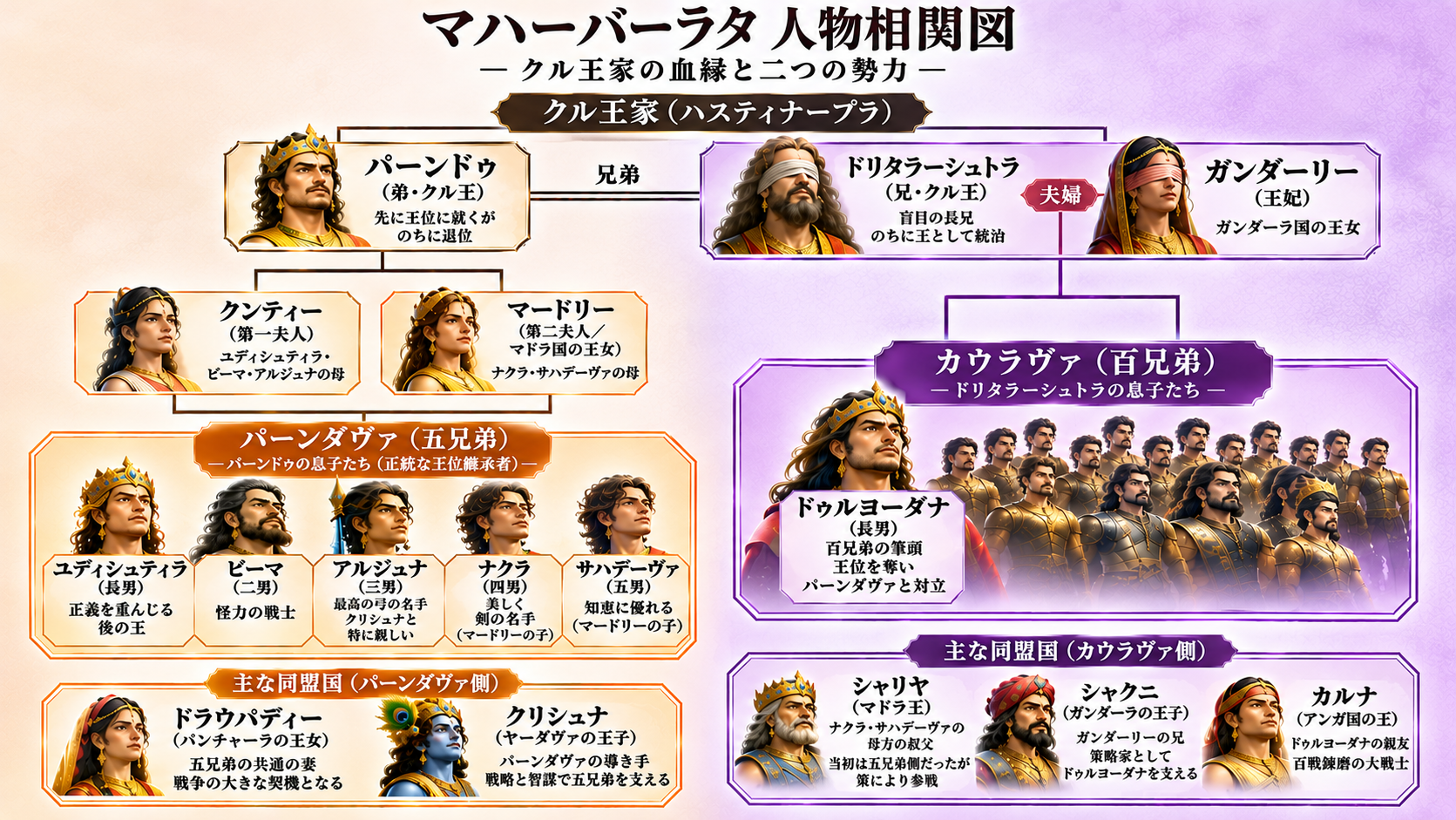
The “five Pandava brothers, sons of the late king who want to take back the Kuru kingdom” and the “hundred Kaurava brothers, who refuse to give up the throne” are cousins, both descended from the great king Bharata.
The five brothers, recognized as sons of the previous king Pandu
- Yudhishthira (eldest. Values righteous conduct but is weak to the temptation of gambling)
- Bhima (second. Immensely strong and a mace fighter. Sharply opposed to the hundred brothers)
- Arjuna (third. A master archer under Krishna’s protection. His archenemy is Karna)
- Nakula and Sahadeva (fourth and fifth, twins)
- Draupadi (princess of the neighboring Panchala kingdom and wife of all five brothers)
- Krishna (the five brothers’ cousin on their mother’s side. A god who protects the third brother, Arjuna)
- Duryodhana (son of the previous king’s older brother. Eldest of the hundred brothers)
- Dushasana (second of the hundred brothers)
- Karna (Kunti’s firstborn; elder maternal half-brother of Yudhishthira, Bhima and Arjuna)
1. Karna Is Born to Kunti and the Sun God Surya
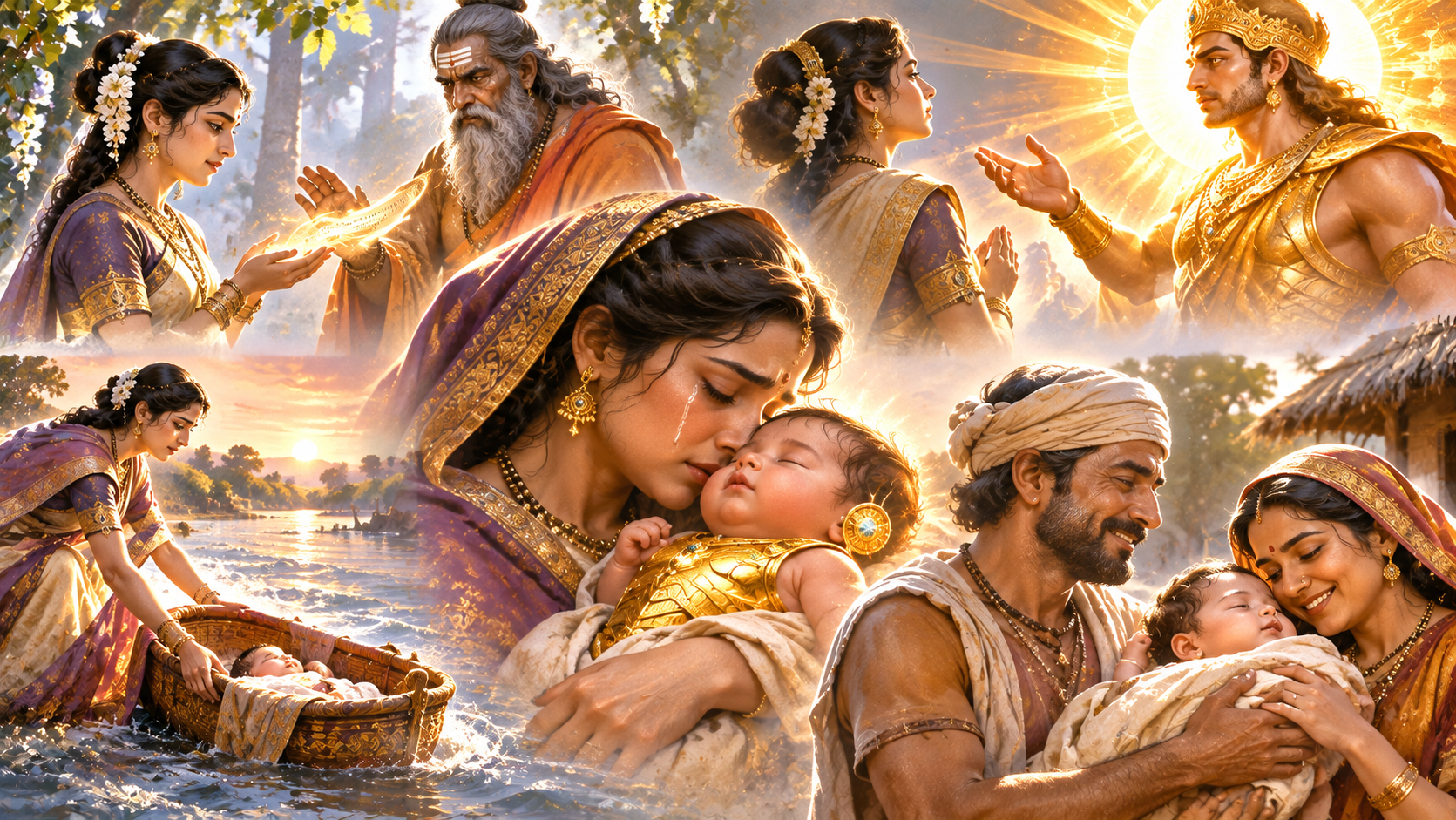
Kunti was the birth mother of Yudhishthira, Bhima and Arjuna; Nakula and Sahadeva were Madri’s sons, whom Kunti later also raised. Before marrying into the royal family, Kunti had already borne a child: Karna, who would later become the Pandavas’ enemy.
She was originally named Pritha, the daughter of Shura, king of the Yadu clan, but she became the adopted daughter of the childless king Kuntibhoja and took the name Kunti.
Entrusted with hosting guests in Kuntibhoja’s house, she once looked after the sage Durvasa. As thanks for her hospitality, the sage gave her a mantra that could summon a god.
One morning Kunti wanted to try the mantra. The sun god Surya really appeared. Kunti said she had only been testing the spell and asked him to leave without doing anything. But Surya said that having been summoned, he could not leave without result, and he gave Kunti a child.
Kunti gave birth to a boy born with armor and earrings (the child of the sun god).
Fearing that bearing a child unmarried would dishonor the house of Kuntibhoja, she put the baby in a box and set it adrift on a river.
The baby was picked up from the river by the charioteer Adhiratha and his wife Radha. The child they raised was Karna, the elder maternal half-brother of Yudhishthira, Bhima and Arjuna.
2. The Childless Kuru Dynasty and the Niyoga System
The Kuru royal house had a long-running problem: no heirs were being born.
In India at the time there was a system called niyoga: if a couple could not have children because of the husband, the wife was allowed to receive a child from another man.
A king died without a child, and his widows Ambika and Ambalika asked the sage Vyasa to give the dynasty a successor. Ambika bore Dhritarashtra (father of the hundred brothers) and Ambalika bore Pandu (father of the five brothers).
For some reason Vyasa also had a child with a maidservant, and Vidura was born.
The three half-brothers Dhritarashtra, Pandu and Vidura grew up as heirs of the royal house.
Pandu excelled at archery. His elder brother Dhritarashtra was blind from birth and did not take the throne. Vidura did not inherit it either because of his mother’s status, so the younger brother Pandu became king of the Kuru dynasty.
Around then, King Kuntibhoja invited kings and princes from many lands and held a ceremony for Kunti to choose a husband. Pandu was chosen from the suitors, and the two married and traveled to the Kuru capital, Hastinapura.
3. The Curse Laid on Pandu
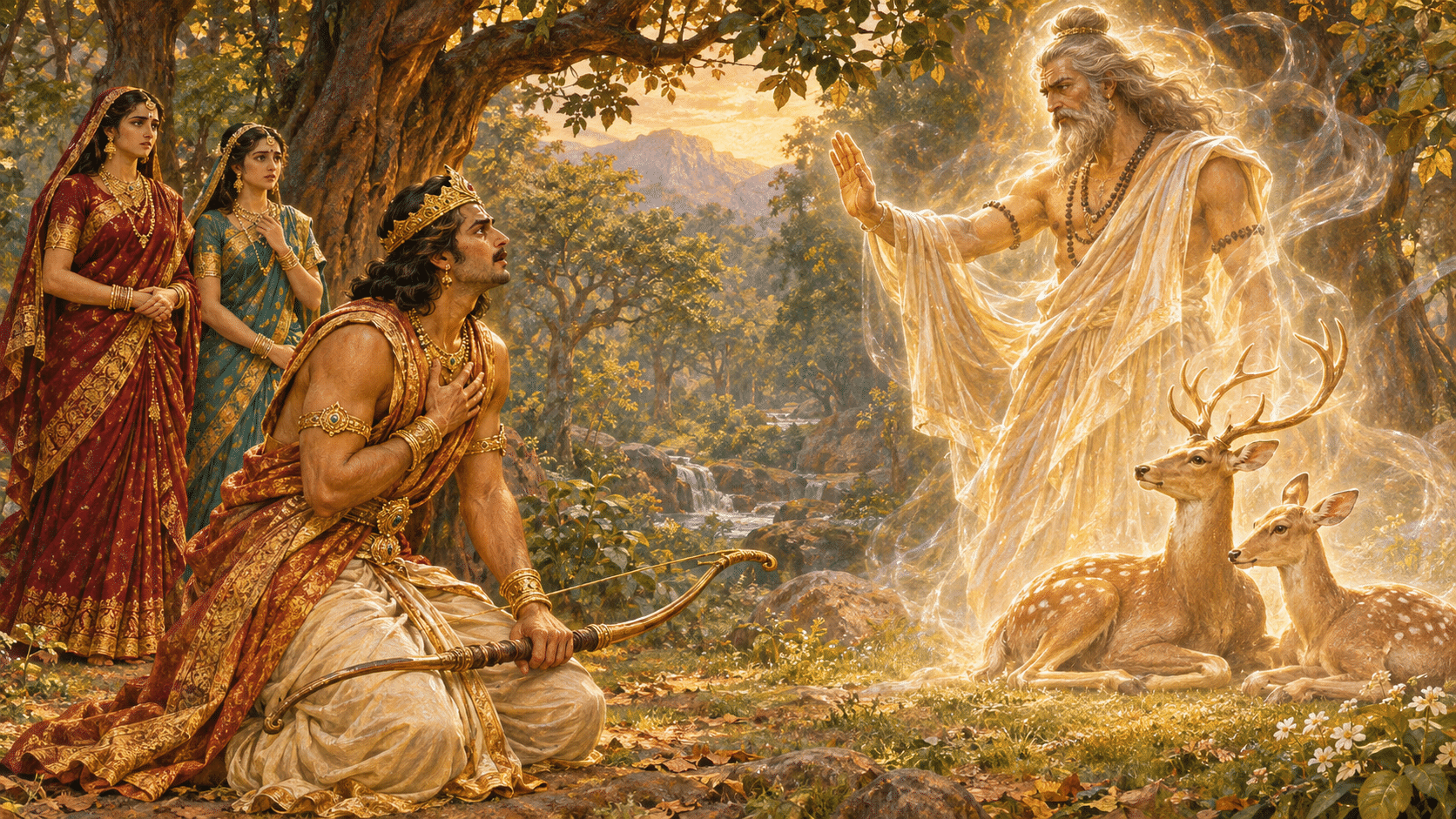
After marrying Kunti, Pandu campaigned across the land as king of the Kuru house and expanded his territory.
He later also took Madri, a princess of the Madra kingdom, as a wife. In the stories of that age it was not unusual for a king to have several wives, and Pandu lived with both.
One day Pandu went hunting in the forest. There he found two deer mating and shot them with his bow.
But the two deer were actually a sage, Kindama, and his wife, who had taken the form of deer.
The sage was furious. He condemned Pandu for shooting during mating and cursed him: if he ever lay with his wife, he would die. Pandu fell into despair, gave up the throne and went into the forest with his two wives to live like an ascetic.
In the capital Hastinapura, the blind eldest brother Dhritarashtra now ran the government.
Even in the forest Pandu stayed depressed. Because of Kindama’s curse he could not have children with his two wives and worried that he would have no heir.
So Kunti told her husband about the mantra that summons gods. She proposed that the two wives could have children with gods.
She kept quiet about the fact that she had once used this very mantra to summon the sun god Surya and bear Karna.
To keep the royal bloodline alive, Pandu asked Kunti to use the mantra and receive children.
4. The Birth of the Five Pandava Brothers
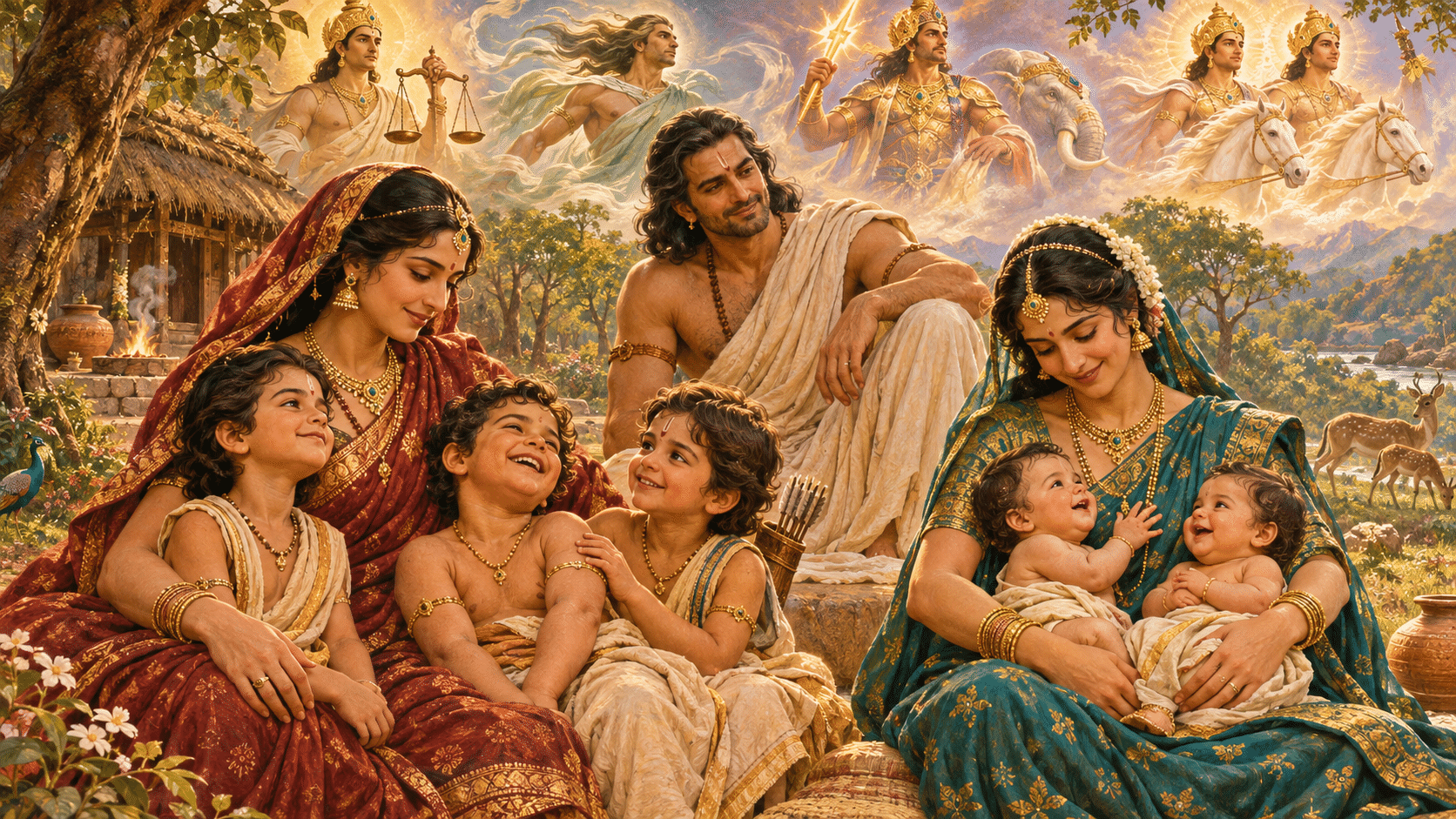
The first god Kunti summoned with the mantra was Dharma, god of justice and law. Their child was the eldest son, Yudhishthira, who grew up honest and devoted to doing right.
Next Kunti called the wind god Vayu and bore the second son, Bhima. Bhima had extraordinary strength from childhood and would later shine in mace combat.
The third god she summoned was Indra, king of the gods. Their child was the third son, Arjuna. Arjuna excelled at archery and became one of the central warriors of the story.
Pandu’s other wife, Madri, still had no children. Pandu wanted her to have children too and asked Kunti to teach her the mantra.
Taught the spell by Kunti, Madri summoned the twin gods, the Ashvin brothers. As a result the twin boys Nakula and Sahadeva were born.
In this way Pandu came to have five sons. They were born through the power of gods, but all were recognized as Pandu’s sons and came to be called the Pandavas.
These five would later become one of the two central sides in the great war of the Mahabharata.
But Kunti had a secret the five brothers did not know.
Karna, her firstborn, had been raised in another family. He shared a mother with Yudhishthira, Bhima and Arjuna, but without knowing it he would come to stand against his younger brothers as an enemy.
5. Pandu’s Death and the Return to the Capital
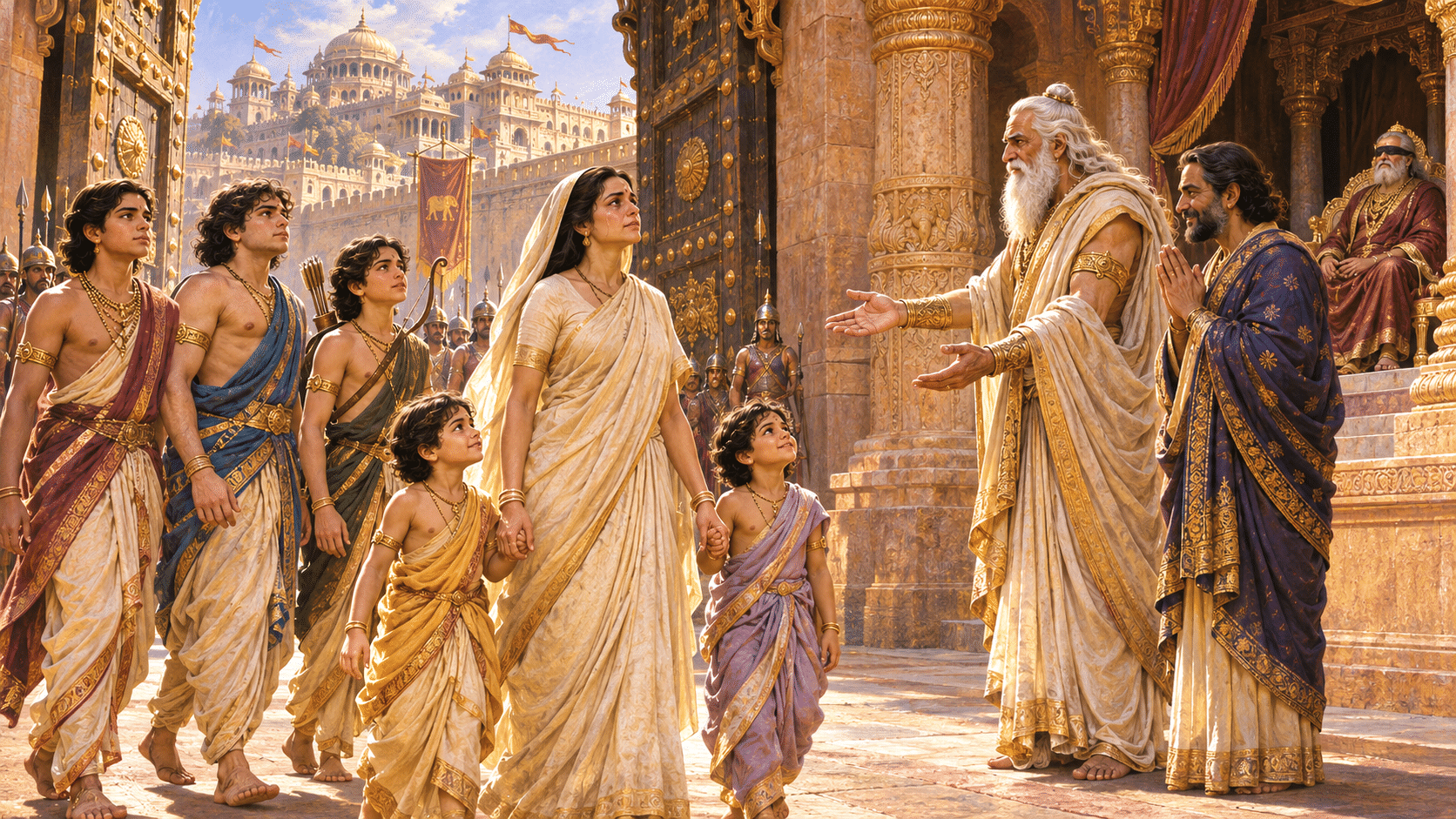
As life in the forest went on, Pandu delighted in watching his five sons grow. But the sage’s curse had not gone away.
One spring day, Pandu was captivated by his wife Madri, forgot the curse and tried to embrace her. The sage’s curse took effect and he died.
Madri mourned her husband deeply, entrusted the twins Nakula and Sahadeva to Kunti, and threw herself into the funeral fire at Pandu’s cremation and died. (This is the Hindu practice known as sati.)
Kunti thus had to raise five children alone. The sages who lived in the forest took Kunti and the children to the Kuru capital, Hastinapura.
In the capital, relatives of the royal house and Pandu’s elder brother Dhritarashtra welcomed them.
By this time Dhritarashtra also had many children with his wife Gandhari. After a long pregnancy Gandhari gave birth to a lump of flesh, and by the power of the sage Vyasa it became a hundred sons and one daughter, so the story goes.
The eldest of the hundred sons was Duryodhana. They were called the Kauravas, and because their father and Pandu were brothers, they were cousins of the Pandavas.
Here arose the problem that would lead to the later war.
Dhritarashtra was the elder brother but, being blind from birth, had not inherited the throne, and his younger brother Pandu had become king. But with Pandu’s death, the elder brother Dhritarashtra was now in charge of the kingdom.
So who would be the next king?
Would it be Yudhishthira, eldest son of the late king Pandu? Or Duryodhana, eldest son of Dhritarashtra, who now ruled the kingdom?
This question deepened the conflict between the two families.
6. The Conflict Between the Pandavas and the Kauravas
In the capital Hastinapura, the five Pandava brothers were raised together with the hundred Kaurava brothers. They were educated as children of the same royal house and learned martial arts and warfare.
Bhima (second of the five) and Duryodhana (eldest of the hundred) often competed in feats of strength. Bhima had a large body and extraordinary strength from childhood. Even at play he overpowered the Kauravas and sometimes hurt them with rough behavior.
Duryodhana came to hate Bhima intensely.
The Pandava brothers were also impossible to ignore as heirs to the throne. Above all, the eldest, Yudhishthira, was a strong candidate to inherit the kingdom.
For Duryodhana to become king, the five Pandava brothers were in the way.
Before long Duryodhana plotted to kill Bhima. He mixed poison into his food and threw the unconscious Bhima into the river.
But Bhima did not die. The tale says he sank to the bottom of the river, reached the world of the serpent clan called the Nagas, gained strength there and returned.
Duryodhana’s plan failed, but the hatred between the two families never faded.
After that the princes began full training under their martial arts teacher Drona. Drona taught the princes archery and the handling of weapons, and he thought most highly of the talent of Arjuna (third of the five).
Arjuna trained hard and rose as an outstanding archer.
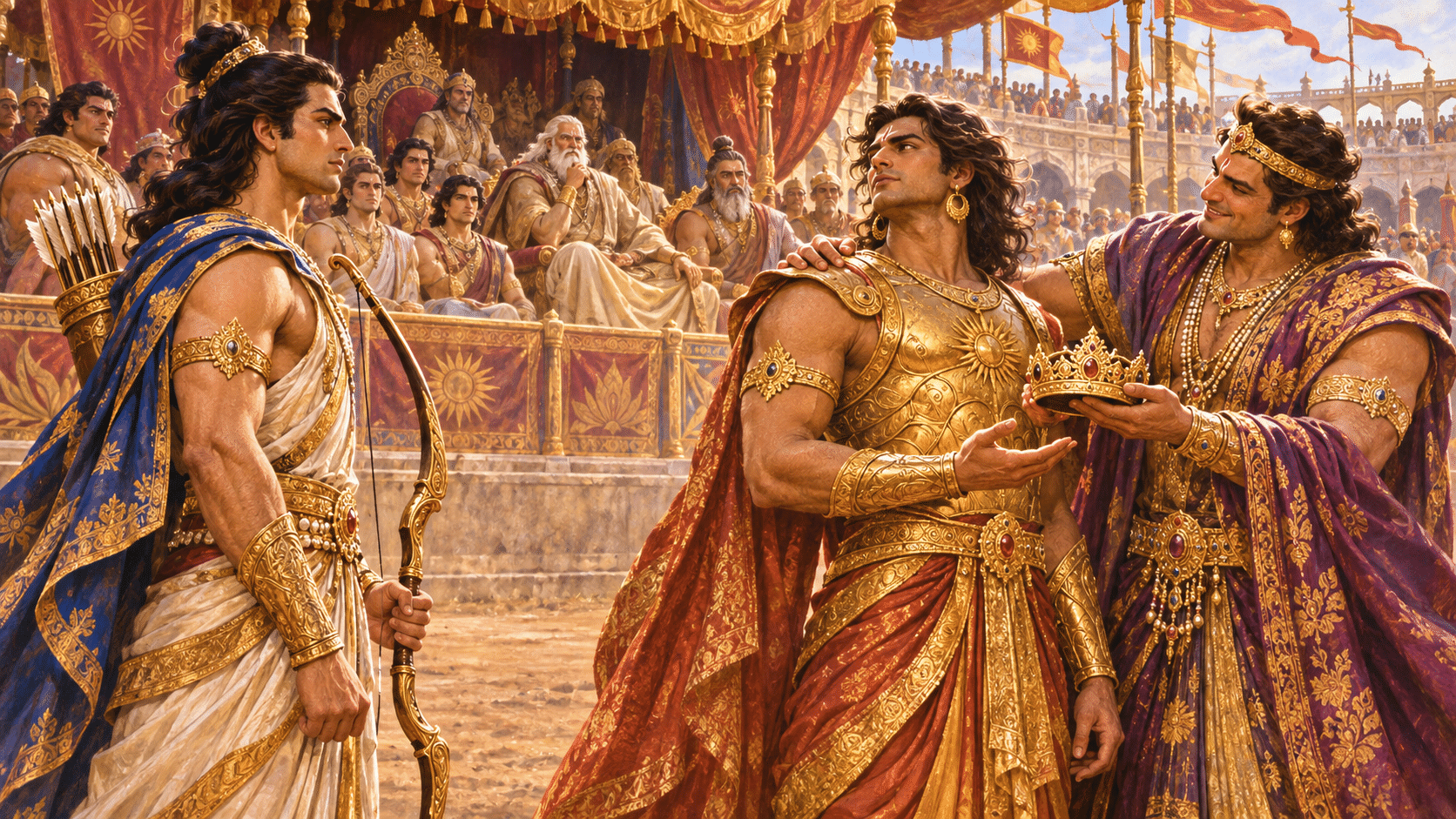
Then, at a tournament where the princes showed off the results of their training, Karna appeared, displayed archery that rivaled Arjuna’s and challenged him. But because he had been raised in a charioteer’s household and not a royal one, he was questioned on whether his status entitled him to face a prince.
It was Duryodhana who backed Karna on the spot. Duryodhana made Karna king of Anga and gave him standing to fight Arjuna as an equal.
Karna was deeply grateful to Duryodhana for accepting him and became his loyal friend from then on.
This is how the rivalry between Arjuna and Karna began.
But the two did not know that they were brothers born of the same mother, Kunti.
7. Escape from the Lacquer Palace and the Marriage to Draupadi
Duryodhana sent the Pandava brothers away from the capital to a town called Varanavata. The residence prepared for them there was a palace built from flammable materials such as lac and resin.
It was officially a welcome gift, but the real plan was to set it on fire and burn the brothers and their mother Kunti to death.
Sensing the danger, an uncle quietly warned Yudhishthira (eldest of the five). The brothers dug an underground escape tunnel and fled on the night the palace burned.
Because other people’s bodies were left in the ashes, the people of the capital believed they were dead. The brothers hid their identities and traveled from place to place with their mother.
On this journey Bhima (second of the five) met Hidimbi in the forest and had a son with her, Ghatotkacha. He too would become an important ally of his father and uncles in the later war.
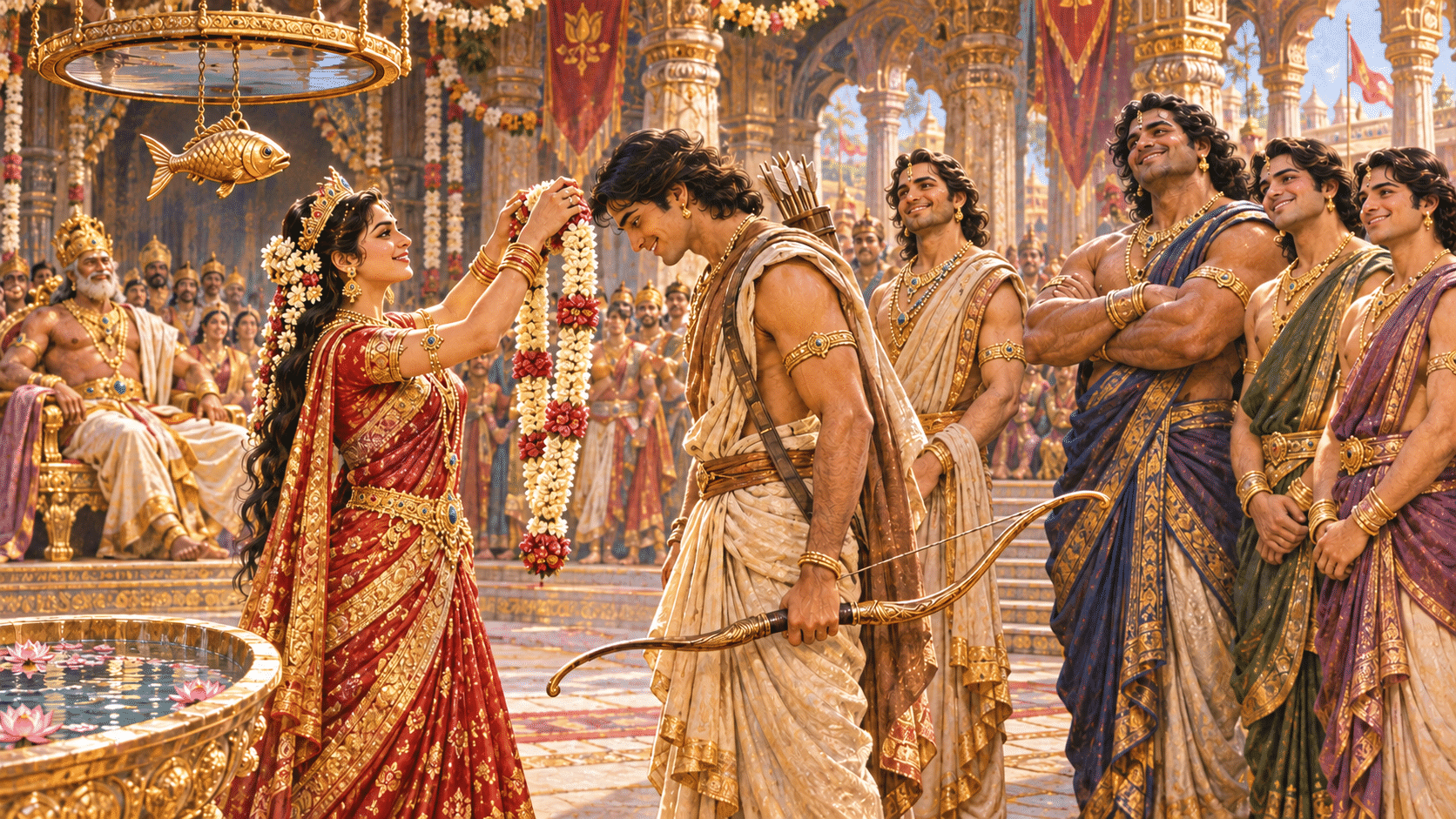
Eventually the brothers took part in the svayamvara of Draupadi, princess of the Panchala kingdom. The suitors were set a task: draw a bow and hit a difficult target set up with a mechanical device.
Arjuna (third of the five), who had hidden his identity, succeeded and won the princess.
However, without looking at her returning sons, Kunti told them to share whatever they had brought home. For that reason Draupadi became the wife of all five brothers.
Thus the brothers’ survival came to light, and they gained a powerful ally in the Panchala kingdom. They were no longer easy to get rid of.
8. The Division of the Kingdom and the Gamble That Cost Everything
When it became known that the five Pandava brothers were alive, the Kuru royal house divided the kingdom to settle the conflict.
The Pandavas developed the land they were given into their capital, Indraprastha, and Yudhishthira (eldest of the five) became king.
Krishna also helped them. Krishna was the son of Vasudeva, brother of Kunti (mother of the five), so he was a cousin of the five on their mother’s side.
He was especially close to Arjuna (third of the five), and his sister Subhadra became Arjuna’s wife. Their son was Abhimanyu.
Yudhishthira (eldest of the five) held a great ritual to make other kings acknowledge his authority and extended his power. Seeing that prosperity, Duryodhana’s (eldest of the hundred) jealousy only grew stronger.
His maternal uncle Shakuni then proposed a way to take the kingdom by gambling.
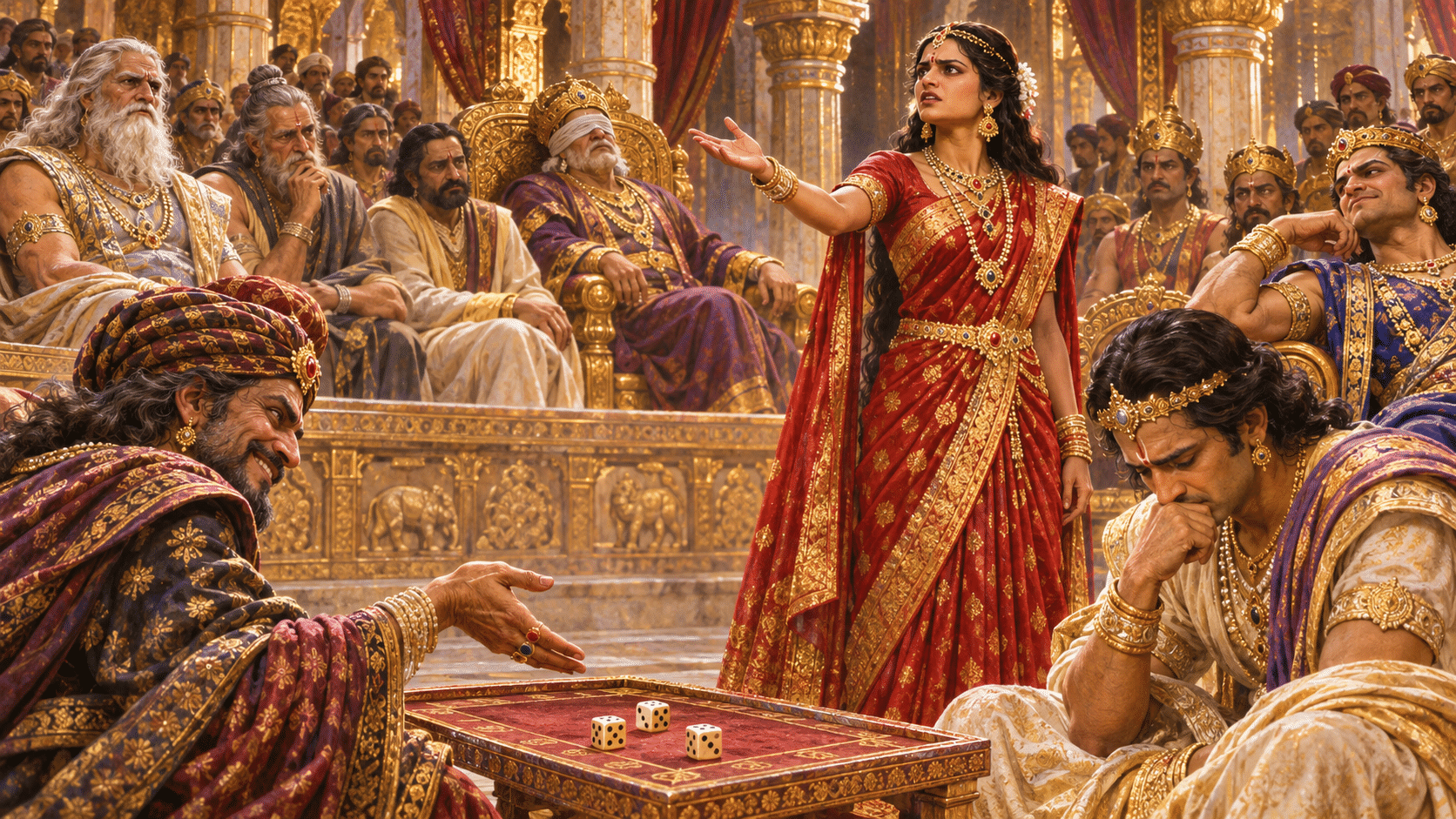
Invited, Yudhishthira (eldest on the five brothers’ side) played against Shakuni (uncle of the hundred), a master gambler, and lost his treasure, his kingdom, his brothers and finally himself.
Then Draupadi (wife of the five, princess of Panchala) was also staked, and the princess was dragged into a hall full of royalty.
Draupadi asked whether a man who had already lost himself had the right to stake his wife afterward. But the elders failed to protect her adequately. At the insults of Dushasana (second of the hundred) and others, Bhima (second of the five) swore revenge.
Dhritarashtra (father of the hundred) calmed the situation for the moment and returned what had been taken, but the gambling took place again.
This time the terms were that the losing side would live in the forest for twelve years, then spend the following year without being recognized.
Having lost again, the five brothers had to leave the capital with their wife Draupadi.
9. Thirteen Years of Exile and a Peace That Never Came
During their time in the forest, the brothers went through hardship after hardship while preparing for the battle that would one day come.
Arjuna (third of the five) received weapons from the gods, and Bhima (second of the five) protected the family.
Yudhishthira (eldest of the five) came to question what a king should protect through the sages’ tales and trials.
Weapons from the Gods and the Flying Celestial Chariot
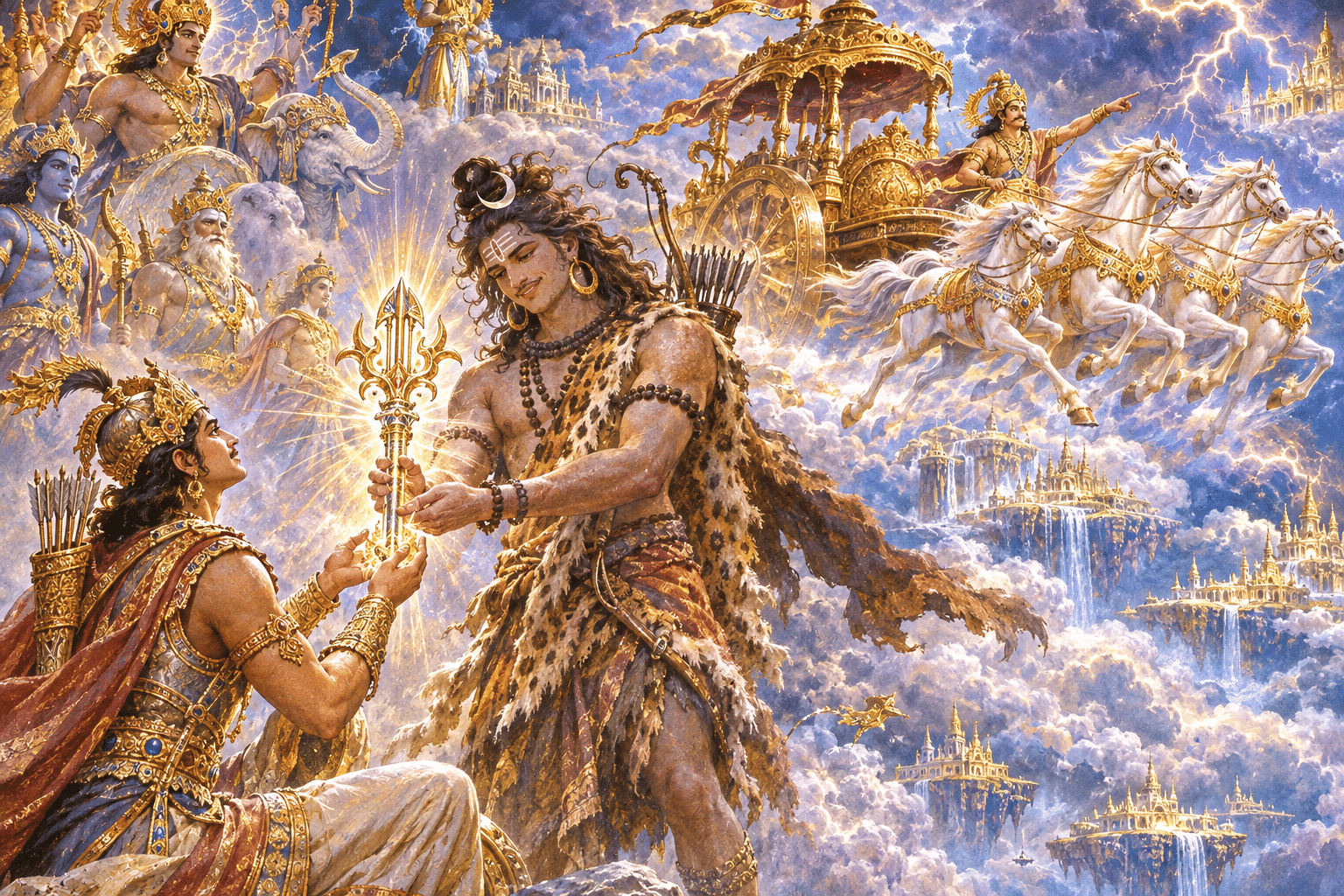
The weapons Arjuna received from the gods are a little different from ordinary bows and arrows. They are called “astras,” special weapons activated by divine power and spells. The Brahmastra, which comes from the creator god Brahma, appears among them.
During the exile Arjuna kept training and fought the god Shiva, who appeared in the form of a hunter. Because Arjuna showed respect when he realized the hunter was Shiva, Shiva granted him the Pashupatastra (a magic arrow). He was warned that it was so powerful that shooting it at a weak opponent could destroy the world.
Later the “celestial chariot,” driven by Matali, charioteer of the god Indra, came to fetch Arjuna. It appeared parting the clouds, lighting up the sky with a sound like thunder. It is described as a vehicle with lightning and various weapons, pulled by divine horses as fast as the wind, and Arjuna rode it to the world of the gods.
Hanuman Appears | Mighty Bhima Cannot Move a Monkey’s Tail
There is one more encounter in the forest exile that should not be overlooked.
Hanuman, the monkey hero who helped Prince Rama (the protagonist) in the Ramayana, also appears in this Mahabharata. The two epics connect here.
It started with a single fragrant lotus. Draupadi (wife of the five), pleased with a flower carried by the wind, asked for more of the same. To grant his wife’s wish, Bhima (second of the five) went up the mountain path in the direction the flower had come from.
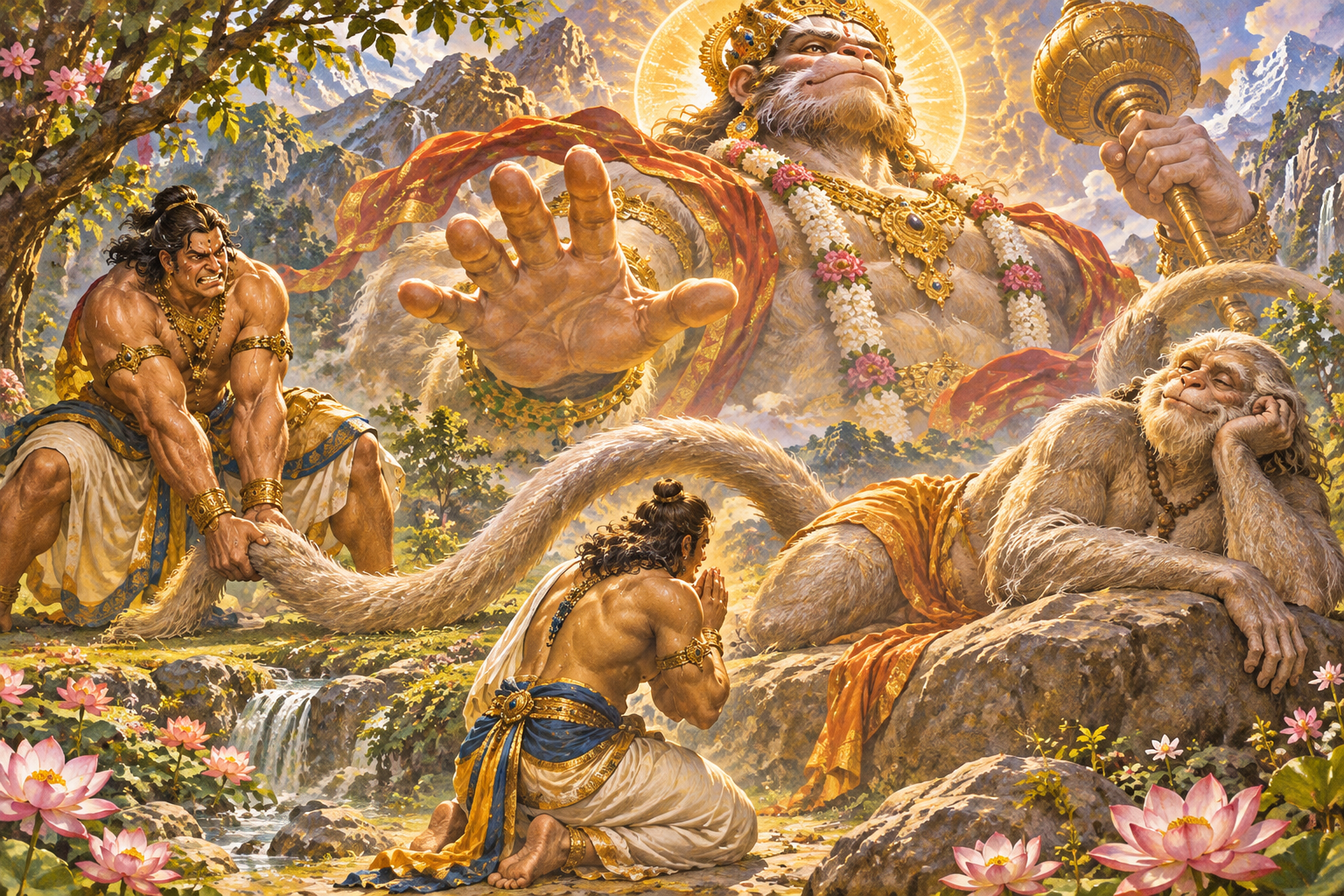
But an old monkey lay on the path, his long tail blocking the way. When Bhima asked him to make way, the monkey answered that he was too old to move and asked Bhima to move the tail aside himself.
Bhima, the strongman, first tried to move the tail with one hand. It would not budge. He strained with both hands, and pulled until he sweated, but the tail would not lift.
A man of superhuman strength was no match for the tail of one old monkey. He who had been proud of his strength changed his attitude, apologized for his rude words and asked who the monkey really was.
That monkey was Hanuman. Bhima is also a son of the wind god Vayu, so the two are brothers with the same wind god as father. Here it is easiest to see it as an elder brother, a hero of an earlier age, making a younger brother of a later generation realize the arrogance of his strength.
Asked by Bhima, Hanuman showed the giant form he had taken when he once leapt across the sea. Seeing a body as huge as a mountain, the younger brother was overwhelmed by his power. The elder told him not to act with brute force and also showed him the way to find the flowers.
At parting Hanuman embraced Bhima and promised to help him in the battles to come. When his younger brother let out a battle cry, Hanuman would add his own voice, and he would climb the flagpole of Arjuna’s (third of the five) chariot and roar a cry that breaks the enemy’s spirit.
The End of the Thirteen-Year Exile and the Peace Talks
In the thirteenth year the five brothers and Draupadi (wife of the five) worked in disguise in the kingdom of King Virata.
They gave up their lives as kings and princes and each took on a different role. When the period ended, they asked for their kingdom back as promised.
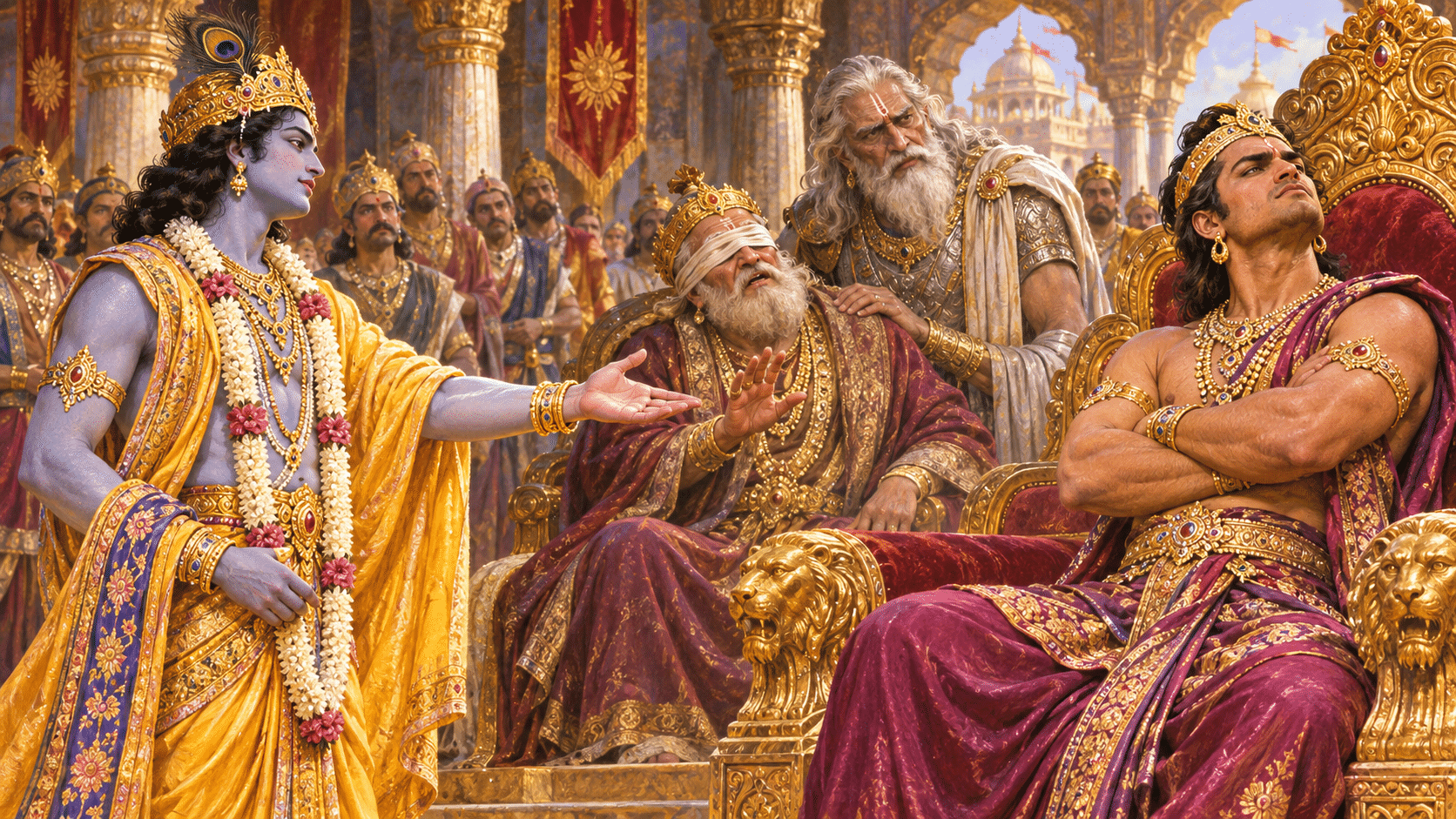
But Duryodhana (eldest of the hundred) refused to return it. To avoid all-out war, Yudhishthira (eldest of the five) conceded as far as asking for just a small piece of land where the five could live, but even that brought no agreement.
Krishna (cousin of the five, a god) also visited the capital as an envoy and tried to stop a war between the kin. But Duryodhana would not accept reconciliation. Even the advice of his uncles had no power to stop the conflict.
Before the war, Karna (Kunti’s firstborn) was told that he was Kunti’s (mother of the five) son and the elder brother of the five. Kunti also met him and asked him to join his brothers’ side. But Karna could not abandon Duryodhana, who had accepted him when others looked down on him because of his status.
Karna promised not to kill the other four Pandava brothers, while still seeking a showdown with Arjuna (third of the five). Even after the secret of his birth was revealed, the debts of gratitude and the rivalry built up until then did not disappear.
So the dispute over the throne, the stolen kingdom, the insult to Draupadi (wife of the five), long-standing hatred and loyalty to allies all piled up, and the road to peace was closed.
10. The Start of the War at Kurukshetra and the Bhagavad Gita
The two armies gathered on the plain of Kurukshetra.
On the Pandava (five brothers) side, allies such as the Panchalas joined, and on the Kaurava (hundred brothers) side stood Bhishma (great-uncle of both families), Drona (martial arts teacher of both families’ princes), Karna and others.
The elders and teachers who had supported the royal house also took the field, each bound by his position and by debts of gratitude.
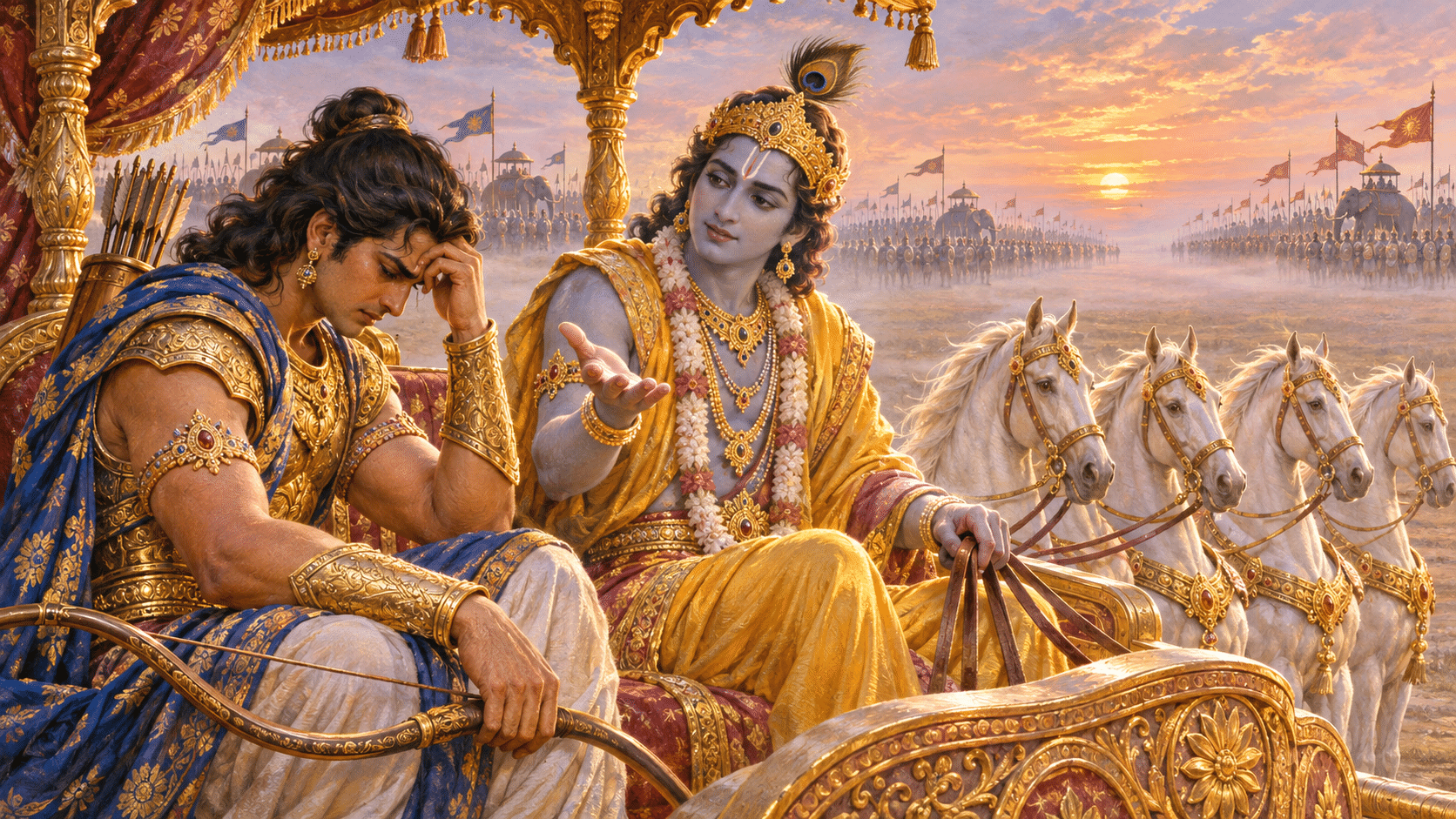
Krishna (cousin of the five, a god) took no weapon himself and chose to serve as charioteer of Arjuna (third of the five). Just before the battle began, Arjuna had him drive the chariot between the two armies.
What he saw there were not only enemies to be defeated but also kin, the elders who had raised him and his martial arts teachers.
What meaning could a kingdom won by killing these people have? Arjuna suffered, dropped his bow and could no longer fight.
The scene where Krishna speaks to him is the Bhagavad Gita. It is not a separate book about another event but a dialogue placed just before the war in the Mahabharata.
Krishna teaches about the perishable body and the enduring self, letting go of attachment to the results of one’s actions, devotion to God and more.
Arjuna thought it through, torn between personal sorrow and his duty as a warrior, and in the end chose to fight.
But this did not simply erase the pain of killing his own kin.
The story goes on to describe the difficulty between doing one’s rightful duty and actually hurting people.
11. Bhishma, Abhimanyu, Drona: The Rules of Battle Break Down
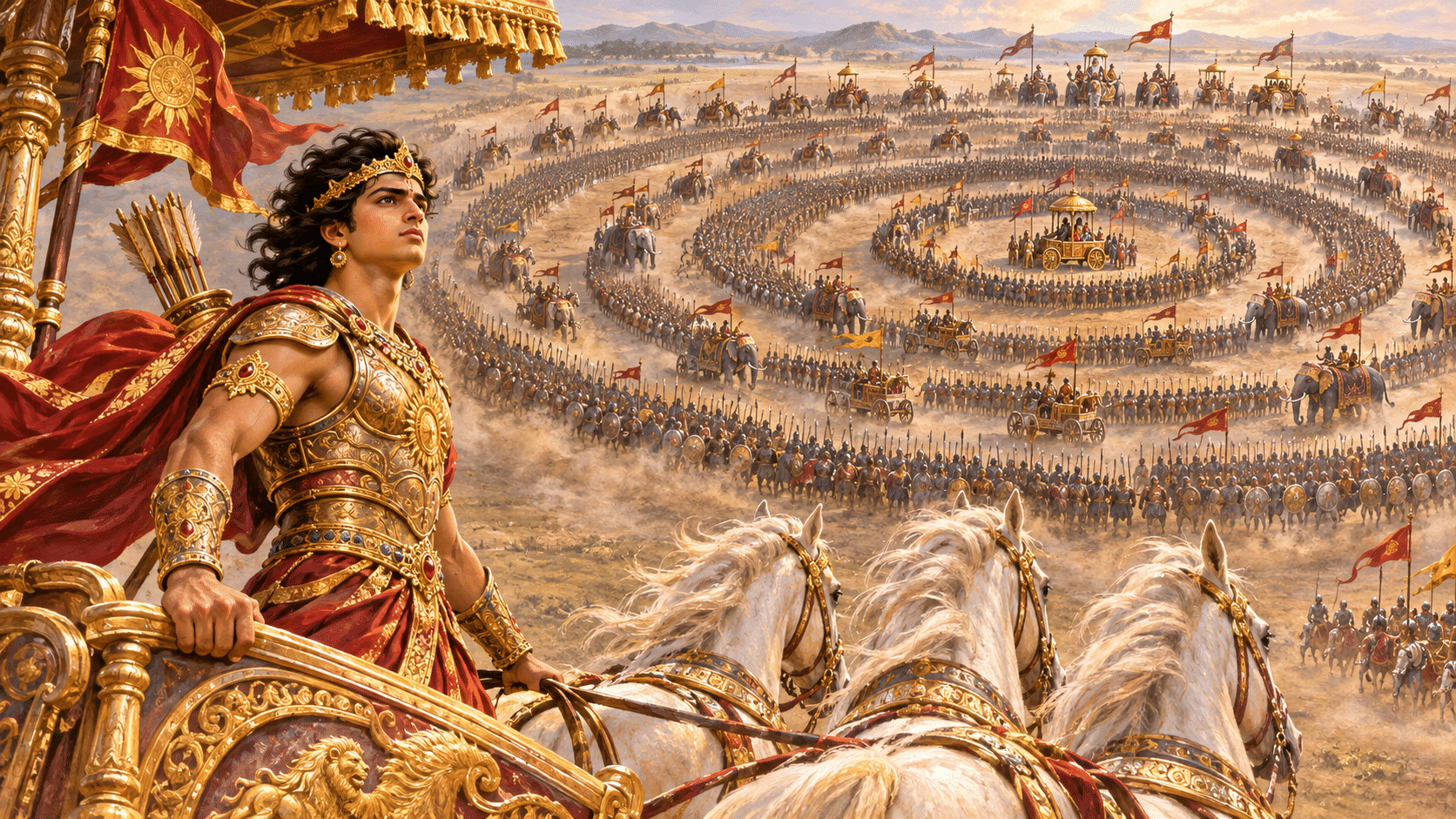
The first to lead the Kaurava army was Bhishma, an elder of the royal house (great-uncle of both families).
Though he was practically a grandfather to both families, out of loyalty to the Kuru kingdom he stood on the side of Duryodhana (eldest of the hundred).
On the tenth day the Pandava side put Shikhandi (a warrior on the five brothers’ side) at the front. Bhishma (great-uncle of both families) had a reason not to turn a weapon against this person.
Seizing that chance, Arjuna (third of the five) shot him, and Bhishma fell. He did not die at once but lay on a bed of arrows to await his final moment.
Next the army was led by the princes’ teacher Drona (martial arts teacher of both families’ princes). On the thirteenth day, while Arjuna fought elsewhere, his son Abhimanyu broke through the enemy’s intricate formation.
But his side did not follow, and he was isolated. The young Abhimanyu fought bravely but was attacked by several warriors and killed.
Learning of his son’s death, Arjuna vowed to kill Jayadratha (a king on the hundred’s side), who had blocked his allies’ advance, before the next day’s sunset. On the fourteenth day he fulfilled that vow.
That same night Bhima’s (second of the five) son Ghatotkacha also fought and was killed by Karna’s powerful weapon. It was a weapon that could be used only once, one Karna had been saving for his decisive duel with Arjuna.
On the fifteenth day the Pandava side killed Drona (martial arts teacher of both families’ princes) with a cowardly lie.
As schemes to win piled up, the rules that should have been kept on the battlefield, such as respecting one’s teacher and not attacking someone who has put down his weapon, also collapsed.
12. The Showdown with Karna and the Victory on the Eighteenth Day
It was Karna who took command after Drona (martial arts teacher of both families’ princes).
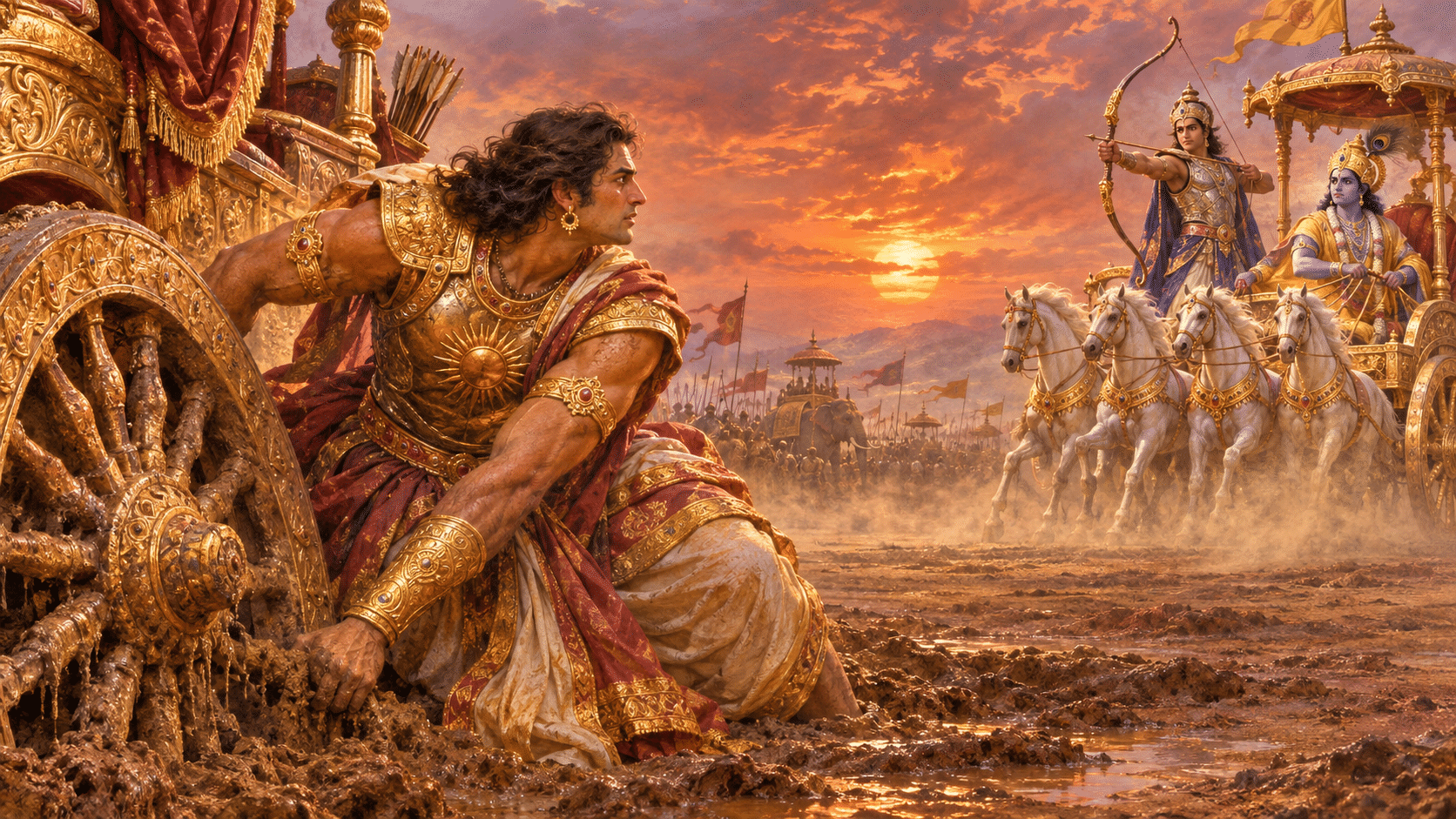
On the seventeenth day he and Arjuna (third of the five) finally faced each other head-on. It was a duel between brothers of the same mother, but Arjuna still did not know the blood tie.
In the fierce fight, the wheel of Karna’s chariot sank into the ground. With the effect of a curse added, he was in a tight spot.
Karna invoked the rules of combat and asked them to wait, but Krishna rebuked him: why had he not kept those rules when Draupadi, the shared wife of the five brothers, was insulted, or when Abhimanyu (son of Arjuna, third of the five) was attacked?
The fight resumed, and in the end Arjuna’s arrow took Karna’s life. The long rivalry between the two did not end in reconciliation.
On the eighteenth day the successor commander Shalya (commander of the hundred) also fell, and Sahadeva (youngest of the five) killed Shakuni (uncle on the hundred’s side), who had cheated in the gambling.
Bhima (second of the five) had already struck down Dushasana (second of the hundred) and the other ninety-eight brothers one after another.
Finally Duryodhana (eldest of the hundred) faced Bhima (second of the five) in a single combat with maces.
Bhima struck the thigh, which was forbidden to hit, and brought his opponent down. The vow of revenge he had made when Draupadi (wife of the five) was insulted was fulfilled, but even his own side criticized the way he won.
So the eighteen-day great war ended in victory for the Pandava side. But on a battlefield where so many of their kin and allies had been lost, there was no joyful triumph. And the revenge was not yet over.
13. The Night Raid and Karna’s Secret: Loss That Remained Even for the Victors
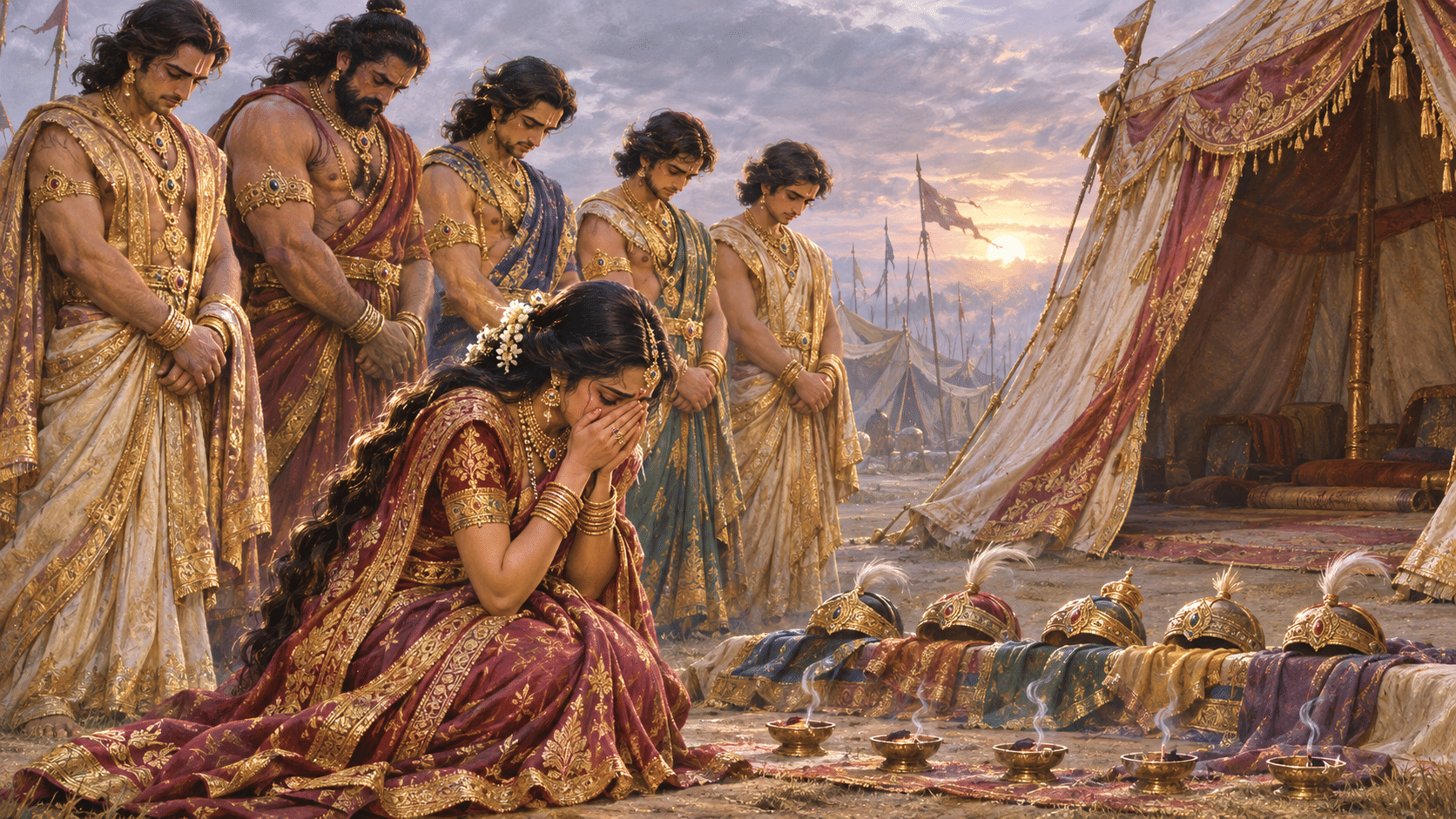
Ashwatthama, son of Drona (martial arts teacher of both families’ princes), and others came to the dying Duryodhana (eldest of the hundred).
Having lost his father by a trick, he attacked the Pandava (five brothers) camp on the night the fighting ended.
The brothers were not there, but Dhrishtadyumna (brother of the five’s wife) and the five sons she had borne to the five brothers were killed.
Even after they won back the kingdom, the lost children did not return.
While mourning the dead, Kunti (mother of the five) revealed that Karna had been her son too.
At that moment the five brothers learned for the first time that the archenemy they had defeated was their own elder brother.
Yudhishthira (eldest of the five) in particular was tormented by the thought that he had killed his brother to gain a kingdom. The regret that the war might have been avoided had they known the secret of Karna’s birth sooner weighed heavily on the victory.
Meanwhile Gandhari (mother of the hundred), who had lost a hundred sons, turned her anger not only on the five Pandava brothers but also on Krishna.
She cursed that because he could have stopped the war and did not, his clan too would one day be destroyed in the same way.
The story does not move on and leave the sorrow of the defeated behind.
14. Governing After the War and the Death of Krishna
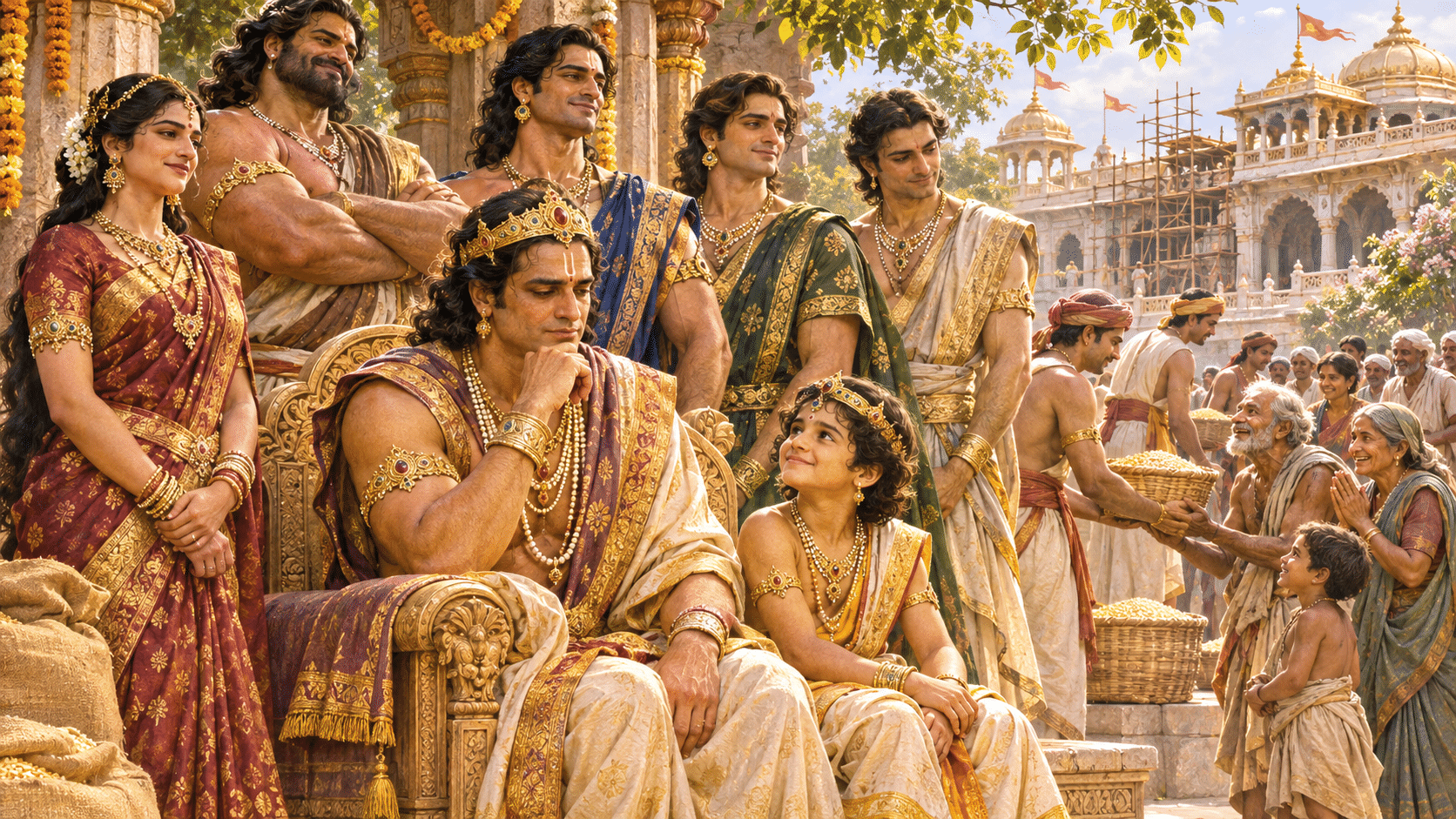
Yudhishthira (eldest of the five) hesitated to become king after taking so many lives. Even so, urged by his brothers, Krishna and the sages, he accepted the responsibility of governing the devastated land.
He visited Bhishma (great-uncle of both families), lying on his bed of arrows, and received teaching about the duties a king must fulfill and about how to live as a human being.
After passing on his long teachings, Bhishma died at the time he himself chose. Strength to win a war alone could not support the postwar country.
In time Yudhishthira also performed the horse sacrifice that shows royal authority. The Kuru kingdom moved toward rebuilding, and Parikshit, the posthumous son of Abhimanyu (son of Arjuna, third of the five), grew up as the next generation.
Dhritarashtra (father of the hundred), Gandhari (mother of the hundred) and Kunti (mother of the five) later left the palace and died after living in the forest.
Thirty-six years after the great war, destruction also came to Krishna’s Yadava clan.
As curses and fate overlapped, the clan fought at a drinking feast and killed one another. The infighting that had destroyed the Kuru house now struck another family.
After his elder brother Balarama left this world, Krishna lay down in the forest.
An arrow shot by the hunter Jara, who mistook him for a deer, struck his foot. Krishna comforted the frightened hunter and passed from the human world.
Arjuna, told the news, led the survivors out, but on the way he could not show his former valor.
Even the power of heroes and a prosperous capital come to an end. Having lost Krishna, the five brothers realized that their own age had ended too.
15. The Five Brothers’ Last Journey and the King Who Would Not Abandon a Dog
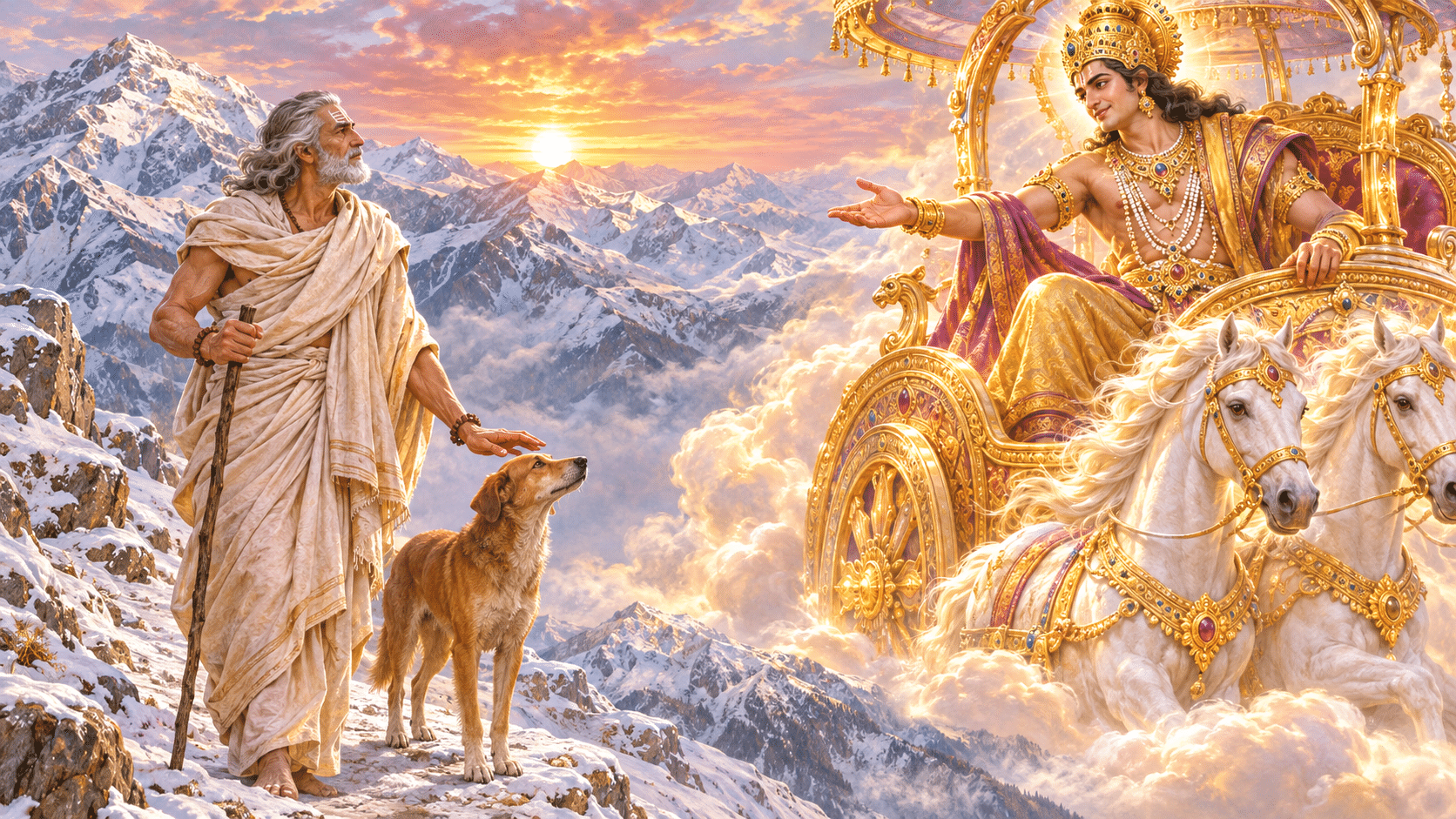
Yudhishthira (eldest of the five) entrusted the throne to Parikshit (Arjuna’s grandson, the next king).
The five brothers and their wife left royal life and set out on a last journey. At some point a dog had started to follow the group.
Heading north into steep mountains, first the wife fell. Then Sahadeva (youngest), Nakula (fourth), Arjuna (third) and Bhima (second) fell as well.
Each time, the story tells of the weakness within them, such as partial affection or pride in their own beauty, wisdom or strength.
Only Yudhishthira (eldest) and the dog walked to the end.
Then the god Indra appeared and tried to welcome the king to heaven. But he said the dog could not come along.
Yudhishthira refused, saying he could not abandon one who had trusted and followed him for the sake of his own happiness.
Then the dog returned to the form of Dharma, god of justice and also his father. It had been a test of the king’s heart.
But here the story shakes the king once more. The one in heaven was Duryodhana (eldest of the hundred), who had fought him as an enemy.
Meanwhile the brothers and wife he longed to see were nowhere to be found. Yudhishthira searched for them and, led to a place where he could hear voices of suffering, refused to go back to a place of happiness by himself.
This too was a final test. Soon the terrible sights vanished, and the king, freed of human sorrow and enmity by the waters of the heavenly Ganges, was guided to a reunion with his brothers and kin.
The tale of those who split into enemies and allies in the human world closes with their reunion in heaven.
At the origin of the family’s war was the question of who would inherit the throne.
But what made it an irreparable war was jealousy, insult, revenge, debts of gratitude, secrets, and the judgment of those around them, who could not stop the conflict.
The question left at the end is not only who won the kingdom.
It is what one believes is right, and how one acts toward the person in front of oneself.